

NGO Fund Utilization Report Format: How to Show Every Rupee Clearly
Learn how NGOs can prepare a clear fund utilization report for donors, CSR partners, audits, and internal transparency. Includes format, sample table, checklist, and common mistakes.
Vivek Bhos
Updated 8 min read
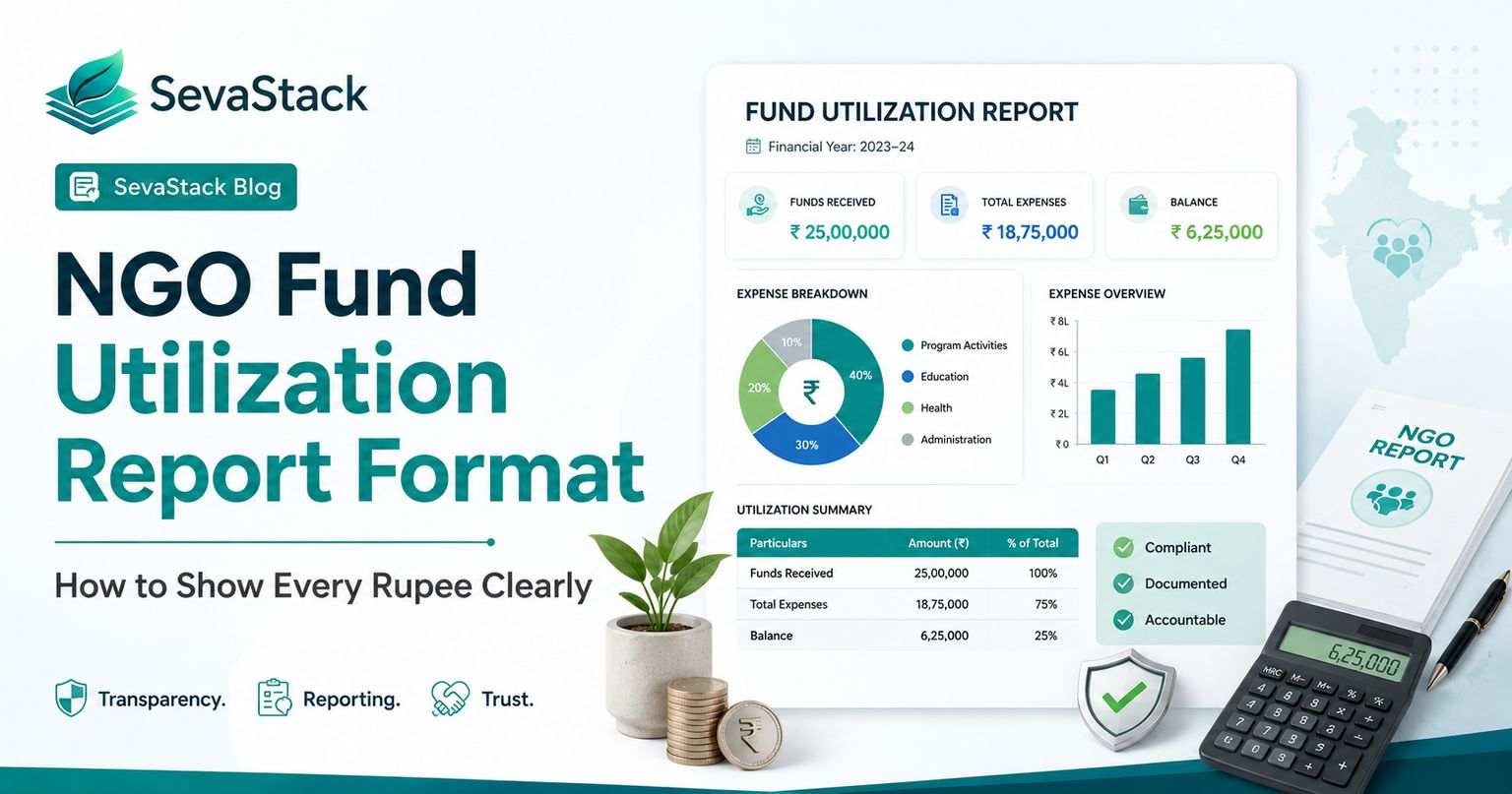
When a donor gives money to an NGO, they are not only giving funds.
They are giving trust.
And once that money reaches your NGO, the most important responsibility is to show how it was used.
This is where a fund utilization report becomes important.
A good utilization report does not just show expenses. It builds confidence.
It tells donors, CSR partners, trustees, and auditors:
“This money was received for a purpose, used properly, and recorded clearly.”
For Indian NGOs, this is even more important because fund usage is connected with donor trust, CSR reporting, audit preparation, and income tax compliance.
What Is a Fund Utilization Report?
A fund utilization report is a simple document that explains:
how much money was received
who gave the money
for what purpose it was received
how much was spent
where it was spent
what balance remains
what impact was created
In simple words, it answers one question:
Where did the money go?
Why Fund Utilization Reporting Matters
Many NGOs do good work but fail to communicate it properly.
They may spend funds correctly, but if records are weak, donors may still lose confidence.
A proper utilization report helps your NGO:
build donor trust
stay audit-ready
satisfy CSR partners
track project-wise spending
reduce confusion during reporting
improve future fundraising
For CSR-funded projects, utilization becomes even more important. MCA’s CSR FAQ clarifies that mere disbursal of CSR funds to an implementing agency is not treated as spending unless the agency actually utilizes the amount. It also states that the Board must satisfy itself that the funds were used for the approved purpose and that the CFO or person responsible for financial management must certify it.
This means companies will naturally ask NGOs for clear fund utilization reports before they consider the project closed.
When Should an NGO Prepare a Fund Utilization Report?
Your NGO should prepare this report whenever:
a donor asks for usage details
a CSR project milestone is completed
a grant period ends
an audit is coming up
trustees need financial review
annual reports are being prepared
a project is completed
Ideally, don’t wait until year-end.
For active projects, prepare utilization reports monthly or quarterly.
Basic Fund Utilization Report Format
Here is a simple format NGOs can use.
1. NGO Details
Include:
NGO name
registration number
PAN
12A / 80G details, if applicable
CSR-1 number, if applicable
address
contact person
This gives the report credibility.
2. Donor / Funding Source Details
Mention:
donor name
donor type: individual, corporate, CSR, grant, foreign donor
donation date
donation amount
payment mode
purpose of donation
receipt number
This helps connect the funds received with the funds used.
3. Project Details
Include:
project name
location
project period
target beneficiaries
objective of the project
approved budget
Example:
Project Name: Digital Learning Support for Rural Students
Location: Pune District, Maharashtra
Project Period: April 2026 to September 2026
Target Beneficiaries: 300 students
Approved Budget: ₹5,00,000
4. Fund Received Summary
Particulars | Amount |
|---|---|
Total approved budget | ₹5,00,000 |
Funds received during the period | ₹3,00,000 |
Previous balance, if any | ₹50,000 |
Total funds available | ₹3,50,000 |
This section shows how much money was available for use.
5. Expense Utilization Summary
Expense Head | Budgeted Amount | Actual Spent | Balance | Remarks |
|---|---|---|---|---|
Educational kits | ₹1,50,000 | ₹1,35,000 | ₹15,000 | 300 kits purchased |
Training sessions | ₹1,00,000 | ₹90,000 | ₹10,000 | 6 sessions completed |
Travel and logistics | ₹50,000 | ₹42,000 | ₹8,000 | Field visits completed |
Printing and material | ₹40,000 | ₹38,000 | ₹2,000 | Study material printed |
Admin cost | ₹30,000 | ₹25,000 | ₹5,000 | Within approved limit |
Total | ₹3,70,000 | ₹3,30,000 | ₹40,000 |
This is the most important part of the report.
Keep it simple and easy to verify.
6. Balance Fund Statement
Particulars | Amount |
|---|---|
Total funds available | ₹3,50,000 |
Total amount utilized | ₹3,30,000 |
Balance amount | ₹20,000 |
If there is a balance, clearly mention:
whether it will be used in the next phase
whether it will be refunded
whether it is kept for approved future activity
Never leave balance funds unexplained.
7. Impact Summary
A utilization report should not only show money.
It should also show impact.
Add simple numbers:
Impact Indicator | Result |
|---|---|
Students supported | 300 |
Training sessions conducted | 6 |
Schools covered | 4 |
Learning kits distributed | 300 |
Volunteers involved | 18 |
This helps donors understand what their funds created on the ground.
8. Supporting Documents
Attach or mention available proofs:
bills and invoices
payment receipts
bank statements
attendance sheets
beneficiary list
photographs
vendor quotations
project completion note
utilization certificate, if required
A report without proof is weak.
A report with proper documents builds trust.
Sample Fund Utilization Report Structure
You can use this structure directly:
1. Cover Page
NGO name, project name, donor name, reporting period
2. Executive Summary
Short overview of funds received, spent, and impact created
3. Donor and Project Details
Who funded the project and what the project was about
4. Fund Received Statement
Amount received with date and receipt number
5. Expense Utilization Table
Budget vs actual spending
6. Balance Fund Statement
Remaining amount and planned usage
7. Impact Summary
Beneficiaries, outcomes, milestones
8. Supporting Documents List
Bills, invoices, photos, bank proof
9. Declaration / Certification
Signed by authorized person, accountant, or CA if required
Simple Utilization Certificate Format
Many donors and CSR partners may also ask for a utilization certificate.
Here is a basic format:
Utilization Certificate
This is to certify that [NGO Name] received an amount of ₹[Amount] from [Donor / Company Name] for the purpose of [Project Name / Purpose].
The amount has been utilized for the approved project activities during the period [Start Date] to [End Date].
Particulars | Amount |
|---|---|
Amount received | ₹[Amount] |
Amount utilized | ₹[Amount] |
Balance amount | ₹[Amount] |
The funds have been used only for the approved purpose and the supporting documents are maintained by the organization.
Authorized Signatory
Name:
Designation:
Date:
Place:
Seal:
CA Certification, if required
Name:
Membership No.:
Signature:
Common Mistakes NGOs Make
1. Mixing project funds
Many NGOs receive funds for different projects but spend from one common pool.
This creates confusion.
Always track project-wise fund utilization.
2. Not keeping bills
If an expense cannot be supported, it becomes difficult to justify.
Every major expense should have a bill, invoice, voucher, or bank proof.
3. Reporting only expenses, not impact
Donors want to know what changed because of their money.
Don’t only write “₹1,00,000 spent.”
Also show:
how many people benefited
what activity was completed
what outcome was achieved
4. Not explaining balance funds
Balance funds are not a problem.
Unexplained balance funds are.
Always mention what will happen to the remaining amount.
5. Preparing reports at the last minute
Last-minute reporting leads to mistakes.
It is better to track utilization continuously.
How Often Should NGOs Send Utilization Reports?
For individual donors:
send simple updates monthly or quarterly
include photos, milestones, and basic expense summary
For CSR partners:
send reports as per MoU terms
usually monthly, quarterly, milestone-based, or project-end
For trustees:
review fund utilization monthly
For audits:
maintain records throughout the year
This keeps everyone informed and reduces year-end pressure.
Fund Utilization Report Checklist
Before sending the report, check:
NGO details are correct
donor details are correct
project period is mentioned
amount received matches bank records
expenses are grouped properly
balance amount is explained
impact numbers are included
bills and proofs are available
report is signed by authorized person
CA certificate is attached if required
Why Clear Fund Utilization Helps Fundraising
A well-made utilization report can help you raise more funds.
Why?
Because it shows:
your NGO is serious
funds are used responsibly
documentation is strong
donors can trust you
CSR partners can rely on you
Many NGOs lose future funding not because their work is weak, but because their reporting is weak.
Clear reporting creates repeat funding.
How SevaStack Helps NGOs Track Fund Utilization
Most fund utilization problems happen because data is scattered.
Donation records are in one place.
Bills are in another place.
Project updates are somewhere else.
Reports are prepared manually at the end.
SevaStack helps NGOs organize this better.
With SevaStack, NGOs can:
track donations project-wise
manage donor records
maintain campaign data
generate reports
keep compliance documents organized
share updates with donors
stay ready for CSR and audit requirements
This helps NGOs show every rupee clearly and build stronger trust with donors and companies.
Final Thoughts
Fund utilization reporting is not just accounting.
It is trust-building.
When your NGO shows clearly how money was used, donors feel confident.
CSR partners feel secure.
Audits become easier.
And your NGO becomes more fundable.
The simple rule is:
Don’t just spend funds properly.
Show it properly.
Because in the NGO sector, transparency is not optional.
It is the foundation of long-term growth.
Vivek Bhos
Written by the Sevastack team, who build and maintain the 80G receipt, FCRA, and Form 10BD/10BE automation used by Indian NGOs on the platform every day. Compliance guidance is reviewed against current Income Tax Act and FCRA rules before publishing.
Read next
Finance
NGO Accounting in India (2026): The Complete Guide to Fund Accounting, 80G, FCRA & Financial Management
Learn everything about NGO accounting in India—from fund accounting and financial statements to 80G, Form 10BD/10BE, FCRA, CSR grants, audits, and accounting best practices for trusts, societies, and
Fundraising
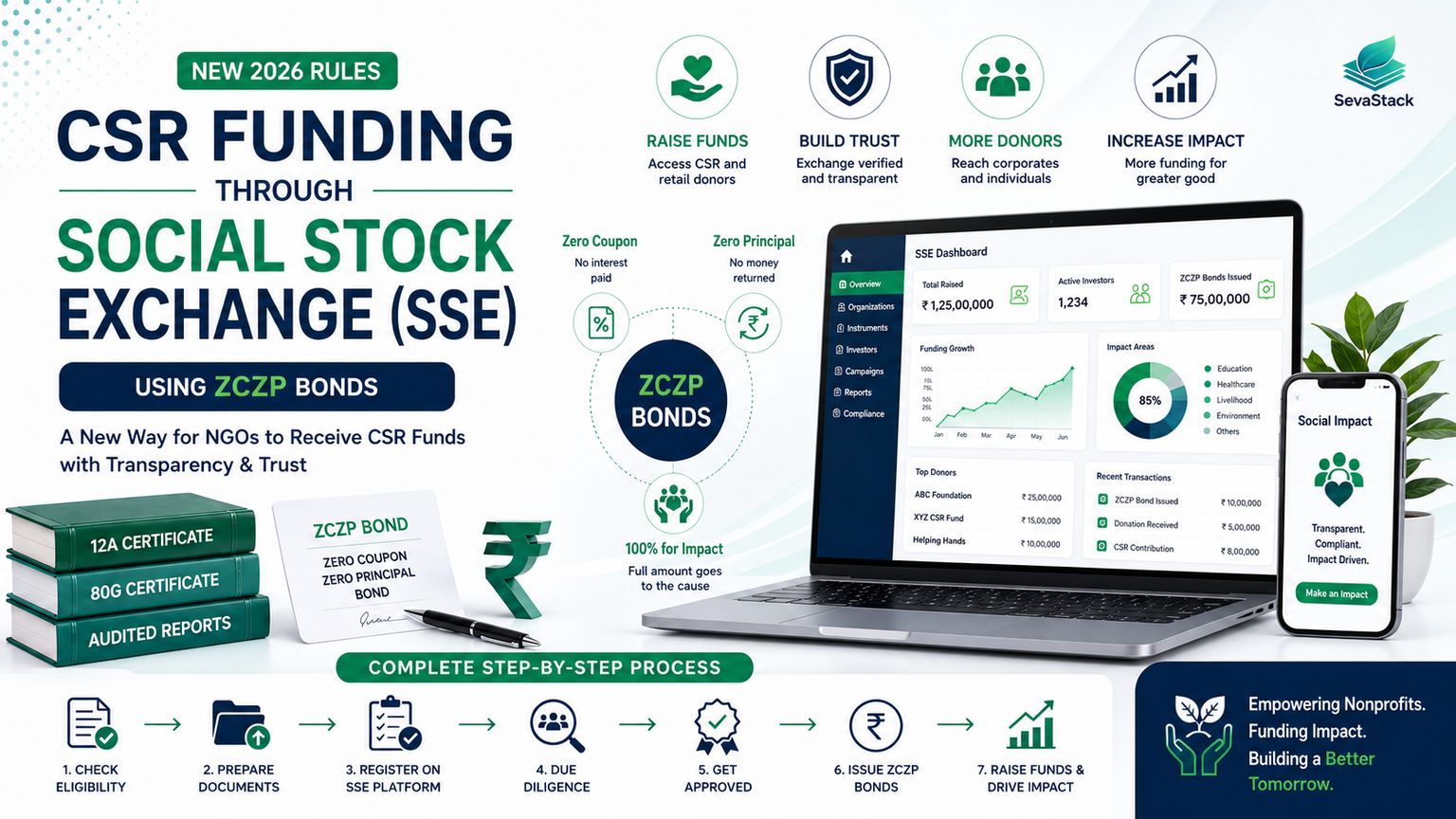
How NGOs Can Receive CSR Funds Through Social Stock Exchange (SSE) and ZCZP Bonds: Complete Guide (2026)
Learn how NGOs can receive CSR funds through India's Social Stock Exchange (SSE) using Zero Coupon Zero Principal (ZCZP) bonds. Understand eligibility, the new 2026 rules, and how the funding process
CSR
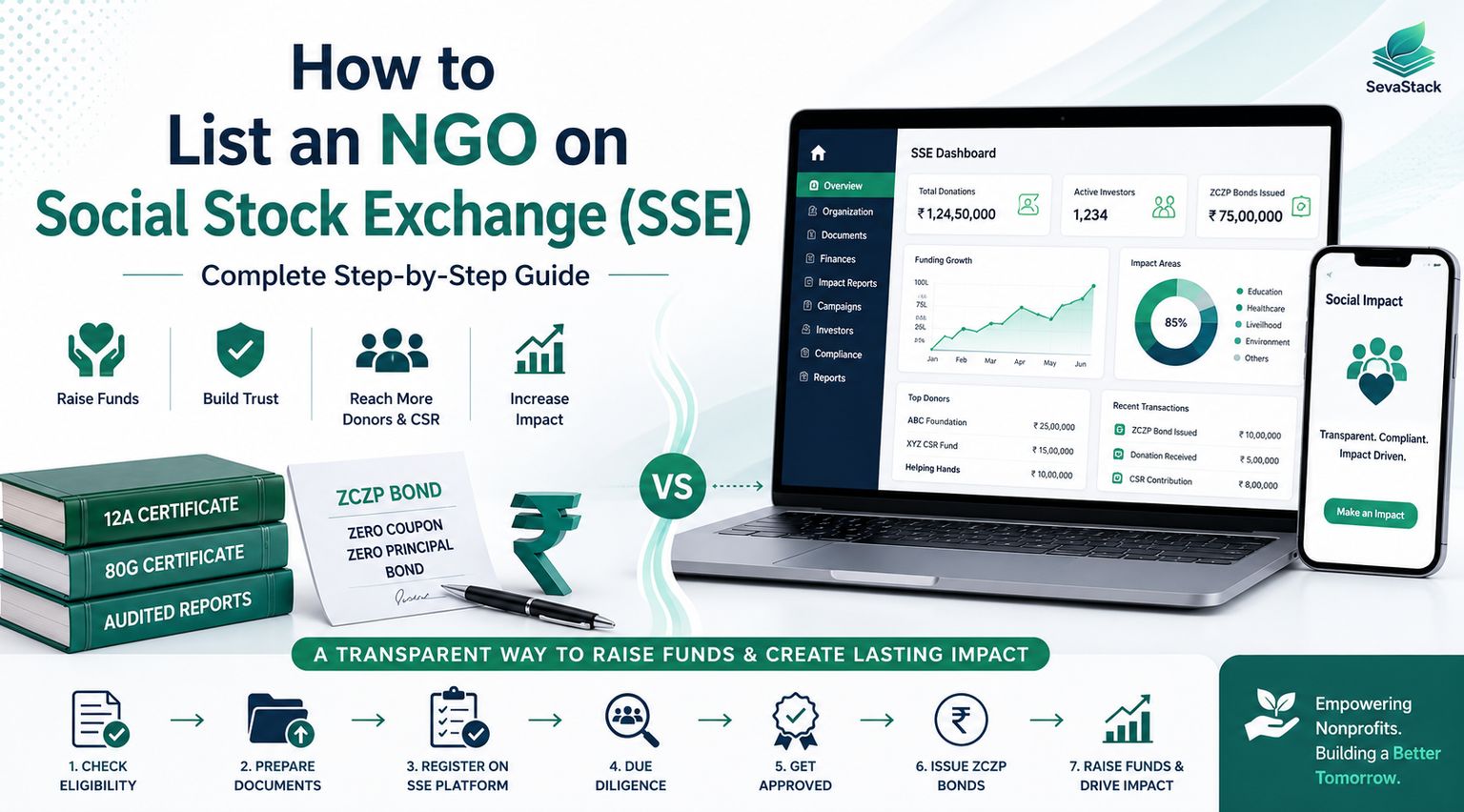
How to List an NGO on India's Social Stock Exchange (SSE): Complete Step-by-Step Guide
Learn how NGOs and Section 8 companies can list on India's Social Stock Exchange (SSE). Understand eligibility, required documents, ZCZP bonds, fundraising opportunities, and the complete step-by-step
Never miss a filing date
Sevastack keeps your NGO's compliance calendar and reminds you by email and WhatsApp before each return is due. Donors, 80G receipts and accounts sit in the same place.