

Starting an NGO in India: Trust, Society, or Section 8 Company?
Learn how to start an NGO in India. Compare Trust, Society, and Section 8 Company with pros, cons, compliance, and funding advantages in 2026.
Vivek Bhos
Updated 4 min read
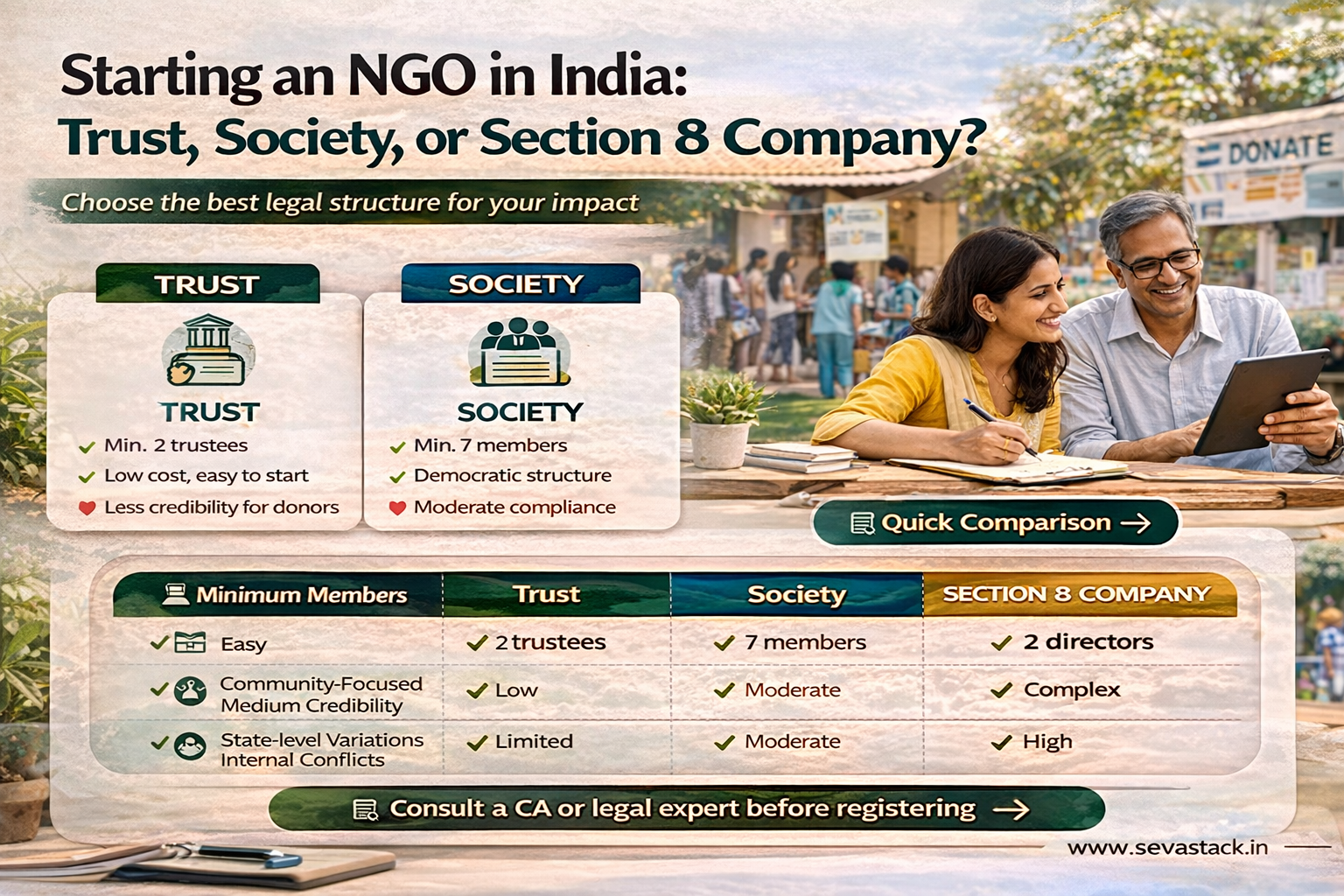
Starting an NGO in India: Trust, Society, or Section 8 Company?
Starting an NGO is one of the most meaningful journeys you can take.
You’re not just building an organization — you’re building impact.
But before you start working on your mission…
There’s one critical decision you must make:
👉 Which legal structure should you choose?
Trust, Society, or Section 8 Company?
This is not just a legal formality.
It directly affects your:
Funding opportunities
Credibility
Compliance requirements
Long-term scalability
Choosing the right structure from Day 1 can save you years of struggle later.
⚖️ Understanding the Three Main NGO Structures in India
Let’s break them down in simple terms:
🏛️ 1. Public Charitable Trust
A Trust is one of the simplest ways to start an NGO in India.
It is created when a person (settlor) transfers property or assets for a charitable purpose.
✅ Key Features:
Minimum 2 trustees required
Governed by the Indian Trusts Act (state-specific in some cases)
Easy and quick registration
Less compliance
👍 Pros:
Fast setup
Low cost
Simple structure
👎 Cons:
Less transparency
Lower credibility for large donors
Limited flexibility
👉 Best for: Small NGOs, family-run initiatives, local charity work
🏢 2. Society (Societies Registration Act, 1860)
A Society is a group of individuals coming together for a common charitable purpose.
✅ Key Features:
Minimum 7 members required
Governed by the Societies Registration Act, 1860
Democratic structure
👍 Pros:
More structured than a Trust
Better credibility than Trust
Suitable for community-based work
👎 Cons:
More compliance than Trust
State-level variations in rules
Internal conflicts can arise
👉 Best for: NGOs working in education, culture, community development
🏆 3. Section 8 Company (Companies Act, 2013)
A Section 8 Company is the most formal and structured type of NGO.
It operates like a company — but without profit distribution.
✅ Key Features:
Minimum 2 directors (private)
Governed by the Companies Act, 2013
Profits must be reinvested into the mission
👍 Pros:
High credibility
Preferred by CSR donors
Transparent governance
Easy to scale
👎 Cons:
Higher compliance
Slightly complex registration
Requires professional support
👉 Best for: Large NGOs, startups in social impact, organizations seeking funding
📊 Trust vs Society vs Section 8 Company (Quick Comparison)
Feature | Trust | Society | Section 8 Company |
|---|---|---|---|
Minimum Members | 2 | 7 | 2 Directors |
Registration Ease | Easy | Moderate | Complex |
Compliance | Low | Medium | High |
Credibility | Low-Medium | Medium | High |
CSR Funding | Limited | Moderate | High |
Scalability | Low | Medium | High |
🌐 Why Legal Structure Matters More in 2026
The NGO ecosystem in India is evolving fast.
With the introduction of RNPO (Registered Non-Profit Organisation) framework, things are becoming more standardized.
🔍 What is RNPO?
RNPO is a modern classification that helps unify tax compliance across NGOs.
It plays a key role in:
12A registration (tax exemption)
80G certification (donor tax benefits)
👉 Regardless of your structure (Trust, Society, or Section 8),
you must align with RNPO requirements for tax benefits.
💸 12A & 80G: The Real Game-Changer
Most NGOs don’t realize this early.
But the real power comes from tax registrations, not just structure.
✔ 12A Registration
Makes your NGO income tax-exempt
✔ 80G Certificate
Allows donors to claim tax benefits
👉 Without these, fundraising becomes much harder.
🧠 Why Section 8 Companies Are Becoming the Gold Standard
In 2026, donor expectations have changed.
Especially corporate donors.
They prefer:
Transparency
Proper governance
Clear reporting
And that’s exactly where Section 8 Companies win.
🚀 Why they stand out:
Trusted by CSR departments
Better funding opportunities
Structured compliance
Strong brand perception
👉 If you’re planning to scale — Section 8 is often the best choice.
🧩 Niche Structures You Should Know
Apart from the main three, there are some specialized structures:
🔹 Multi-State Cooperative Societies
Ideal for large member-based organizations
Useful in agriculture, rural development
🔹 Religious Endowments
For temples, mosques, churches
Governed by specific state laws
👉 These are niche and not suitable for most NGOs.
✅ How to Choose the Right Structure (Checklist)
Before you decide, ask yourself:
1. What is your scale?
Small/local → Trust
Medium/community → Society
Large/national → Section 8
2. Do you need funding?
Yes → Section 8 preferred
3. How important is credibility?
High → Section 8
Medium → Society
4. Can you handle compliance?
Low capacity → Trust
Professional setup → Section 8
🤝 Final Thoughts
Starting an NGO is not just about passion.
It’s about building a system that can sustain impact.
Your legal structure is the foundation of that system.
Choose wisely.
Because changing it later is not easy.
📢 Call to Action
Before you finalize your NGO registration:
👉 Consult a CA or legal expert
They can help you:
Choose the right structure
File registrations correctly
Avoid costly mistakes
🌐 Build Smarter, Not Harder
If you're planning to manage donors, compliance, and fundraising efficiently:
New law, same rule. From 1 April 2026 the Income-tax Act, 2025 replaced the Income-tax Act, 1961. Section 12A/12AB is now covered by Section 332. Only the number changed, not what you have to do. People still say "Section 12A/12AB", so we use it here too. Filing close to the change-over? Check the form with your CA.
Vivek Bhos
Written by the Sevastack team, who build and maintain the 80G receipt, FCRA, and Form 10BD/10BE automation used by Indian NGOs on the platform every day. Compliance guidance is reviewed against current Income Tax Act and FCRA rules before publishing.
Read next
NGO Management
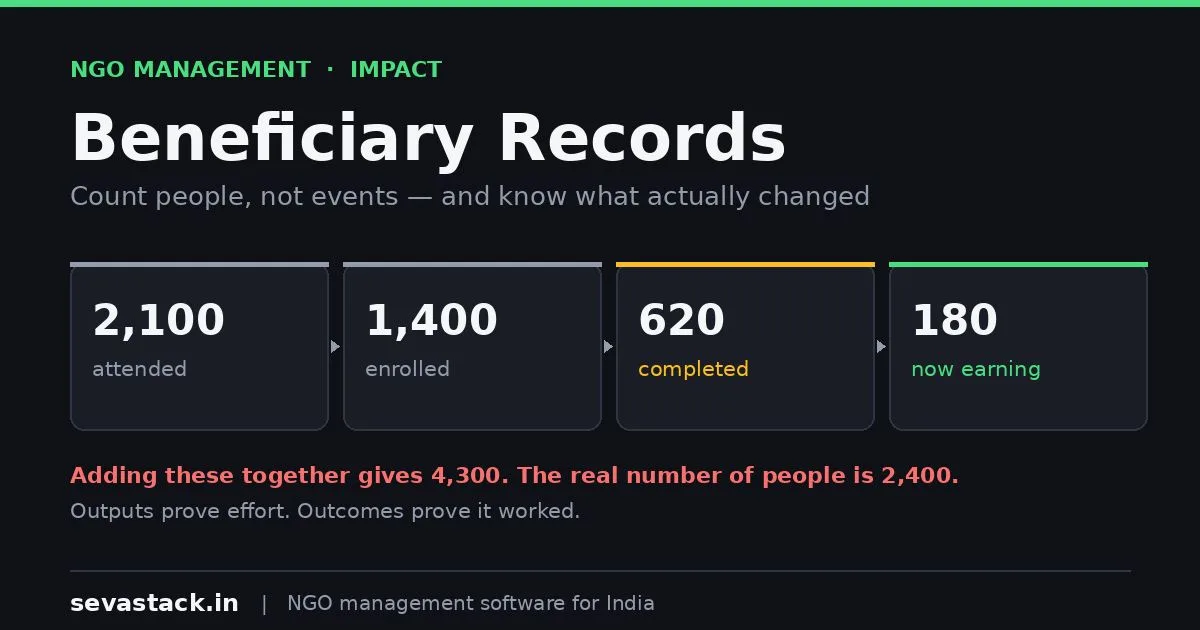
Beneficiary Management: How NGOs Should Track Their Work
Can you prove the numbers in your annual report? A simple guide to beneficiary records, avoiding double counting, and measuring outcomes not outputs.
NGO Management
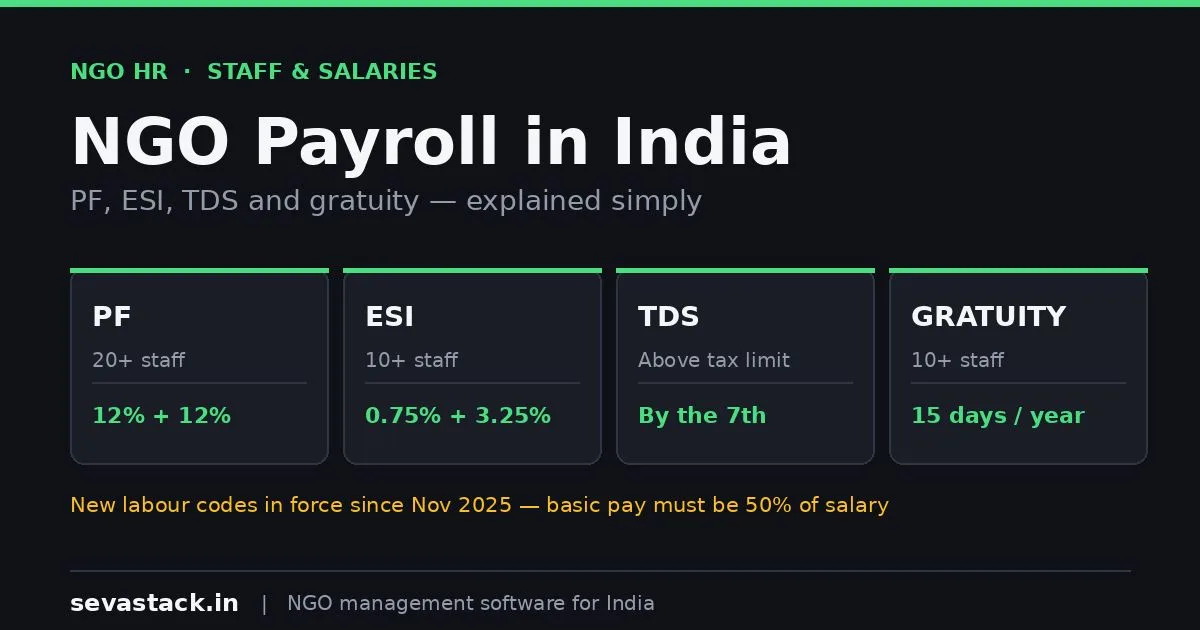
NGO Payroll in India: PF, ESI, TDS and Gratuity Made Simple
A simple guide to NGO payroll in India. When PF and ESI apply, how much to deduct, TDS on salary, gratuity rules and the new labour code changes.
NGO Management
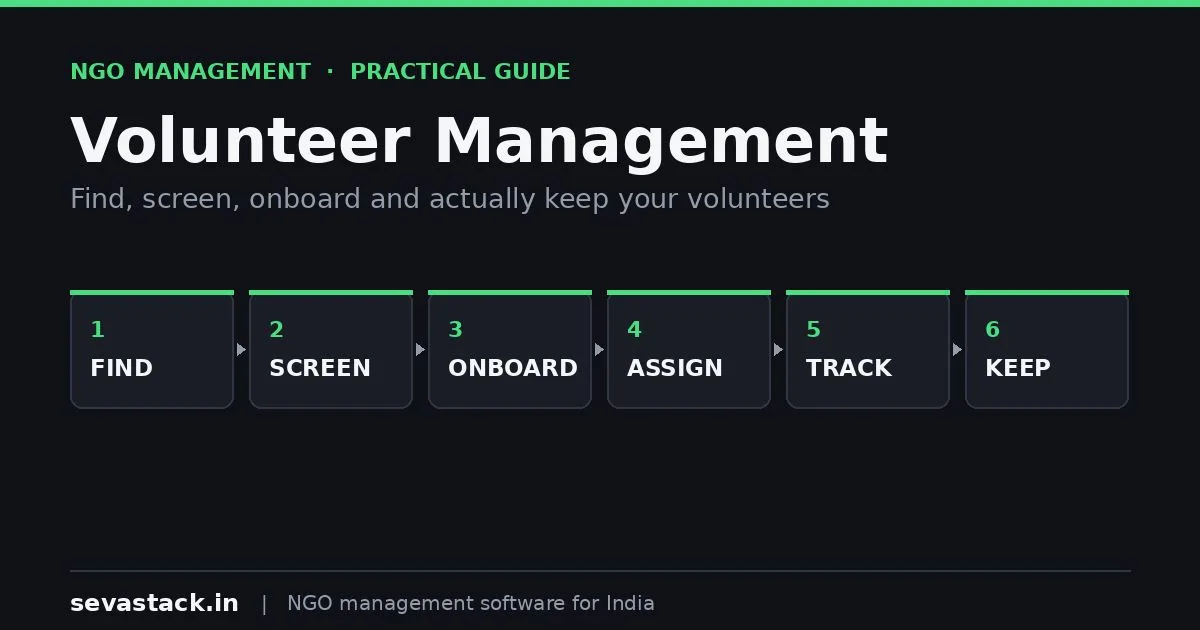
Volunteer Management for NGOs: A Simple Practical Guide
How to find, screen, onboard and keep volunteers at your NGO. A simple guide to hour tracking, certificates, safety rules and what actually works.
Never miss a filing date
Sevastack keeps your NGO's compliance calendar and reminds you by email and WhatsApp before each return is due. Donors, 80G receipts and accounts sit in the same place.