

Why Companies Avoid NGOs for CSR Funding (And What They Actually Look For)
Discover why many NGOs fail to secure CSR funding in India and what companies actually evaluate before partnering with nonprofits.
Vivek Bhos
Updated 4 min read

Corporate Social Responsibility (CSR) funding has become one of the largest funding sources for NGOs in India.
Every year, companies allocate a portion of their profits to social impact initiatives.
Yet, a surprising number of NGOs struggle to secure CSR partnerships.
The problem is not always the cause.
It is often the lack of structure, transparency, and readiness.
Understanding what companies look for — and why they reject NGOs — is critical if you want to unlock CSR funding.
The Reality of CSR Funding in India
Companies today are not just donating.
They are investing.
CSR is treated like a strategic function, with:
Defined impact goals
Compliance requirements
Reporting standards
Risk management frameworks
This means NGOs are evaluated almost like vendors or partners — not just beneficiaries.
Why Companies Avoid NGOs
1. Lack of Proper Compliance
One of the biggest reasons NGOs get rejected is incomplete compliance.
Companies typically require:
12A registration
80G certification
CSR-1 registration
Proper legal structure
If any of these are missing or outdated, companies will not proceed.
2. Poor Financial Transparency
Corporates need complete clarity on how funds will be used.
NGOs often fail to provide:
Audited financial statements
Clear fund allocation plans
Budget breakdowns
Without transparency, companies see high risk.
3. Weak Documentation and Reporting
CSR funding requires structured reporting.
Many NGOs struggle with:
Impact reports
Utilization certificates
Project documentation
Manual systems and scattered data make this worse.
4. No Measurable Impact
Companies want results.
They need answers to questions like:
How many beneficiaries will be impacted?
What outcomes will be achieved?
How will success be measured?
NGOs that cannot quantify their impact are often rejected.
5. Lack of Professional Systems
NGOs relying on Excel sheets and manual processes create operational risk.
Companies prefer NGOs that have:
Donor management systems
Financial tracking tools
Compliance workflows
This signals maturity and reliability.
6. Low Credibility and Governance
Structure matters.
Section 8 Companies are often preferred over Trusts because they offer:
Better governance
Higher transparency
Stronger legal framework
NGOs without proper governance structures face trust issues.
What Companies Actually Look For in NGOs
1. Strong Legal and Compliance Setup
At a minimum, companies expect:
12A and 80G registrations
CSR-1 registration
Valid legal entity
Compliance is the entry ticket.
2. Clear Project Proposal
A good NGO proposal includes:
Problem statement
Target beneficiaries
Execution plan
Budget breakdown
Expected outcomes
Clarity increases approval chances.
3. Impact Measurement
Companies want data-backed impact.
This includes:
KPIs (Key Performance Indicators)
Before vs after results
Real beneficiary stories
Impact must be measurable and reportable.
4. Financial Accountability
NGOs must demonstrate:
Clean accounting practices
Audit readiness
Proper fund utilization
Companies need assurance that funds are used correctly.
5. Technology Adoption
Modern NGOs use digital systems to manage:
Donations
Compliance
Reporting
Communication
Technology improves efficiency and builds trust.
6. Professional Communication
Clear and timely communication matters.
NGOs must:
Respond quickly
Share updates regularly
Maintain documentation
This builds long-term partnerships.
Why This Matters More in 2026
CSR expectations in India are evolving.
Companies are becoming:
More data-driven
More compliance-focused
More impact-oriented
This means NGOs must also evolve.
The gap between “traditional NGOs” and “modern NGOs” is growing rapidly.
How NGOs Can Improve Their Chances
To increase CSR funding opportunities:
Ensure all registrations are updated
Maintain proper financial records
Use digital tools for operations
Create structured project proposals
Track and report impact consistently
Small improvements in systems can lead to major funding opportunities.
Final Thoughts
CSR funding is not about asking for money.
It is about proving capability.
Companies are looking for NGOs they can trust, measure, and scale with.
If your NGO can demonstrate:
Compliance
Transparency
Impact
You significantly increase your chances of getting funded.
Build a Strong Foundation
If you want to manage donors, compliance, and reporting efficiently:
Vivek Bhos
Written by the Sevastack team, who build and maintain the 80G receipt, FCRA, and Form 10BD/10BE automation used by Indian NGOs on the platform every day. Compliance guidance is reviewed against current Income Tax Act and FCRA rules before publishing.
Read next
Finance
NGO Accounting in India (2026): The Complete Guide to Fund Accounting, 80G, FCRA & Financial Management
Learn everything about NGO accounting in India—from fund accounting and financial statements to 80G, Form 10BD/10BE, FCRA, CSR grants, audits, and accounting best practices for trusts, societies, and
Fundraising
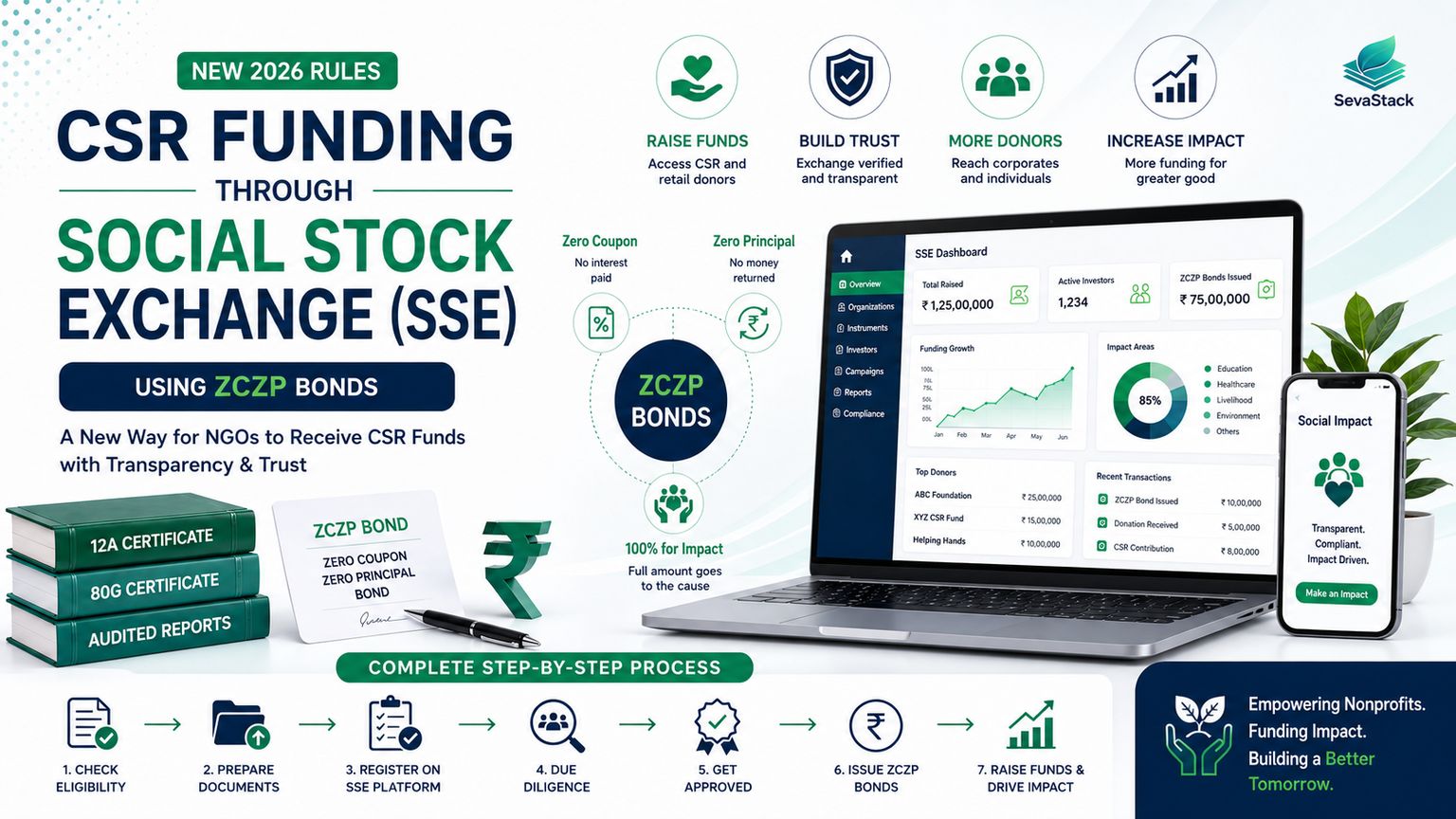
How NGOs Can Receive CSR Funds Through Social Stock Exchange (SSE) and ZCZP Bonds: Complete Guide (2026)
Learn how NGOs can receive CSR funds through India's Social Stock Exchange (SSE) using Zero Coupon Zero Principal (ZCZP) bonds. Understand eligibility, the new 2026 rules, and how the funding process
CSR
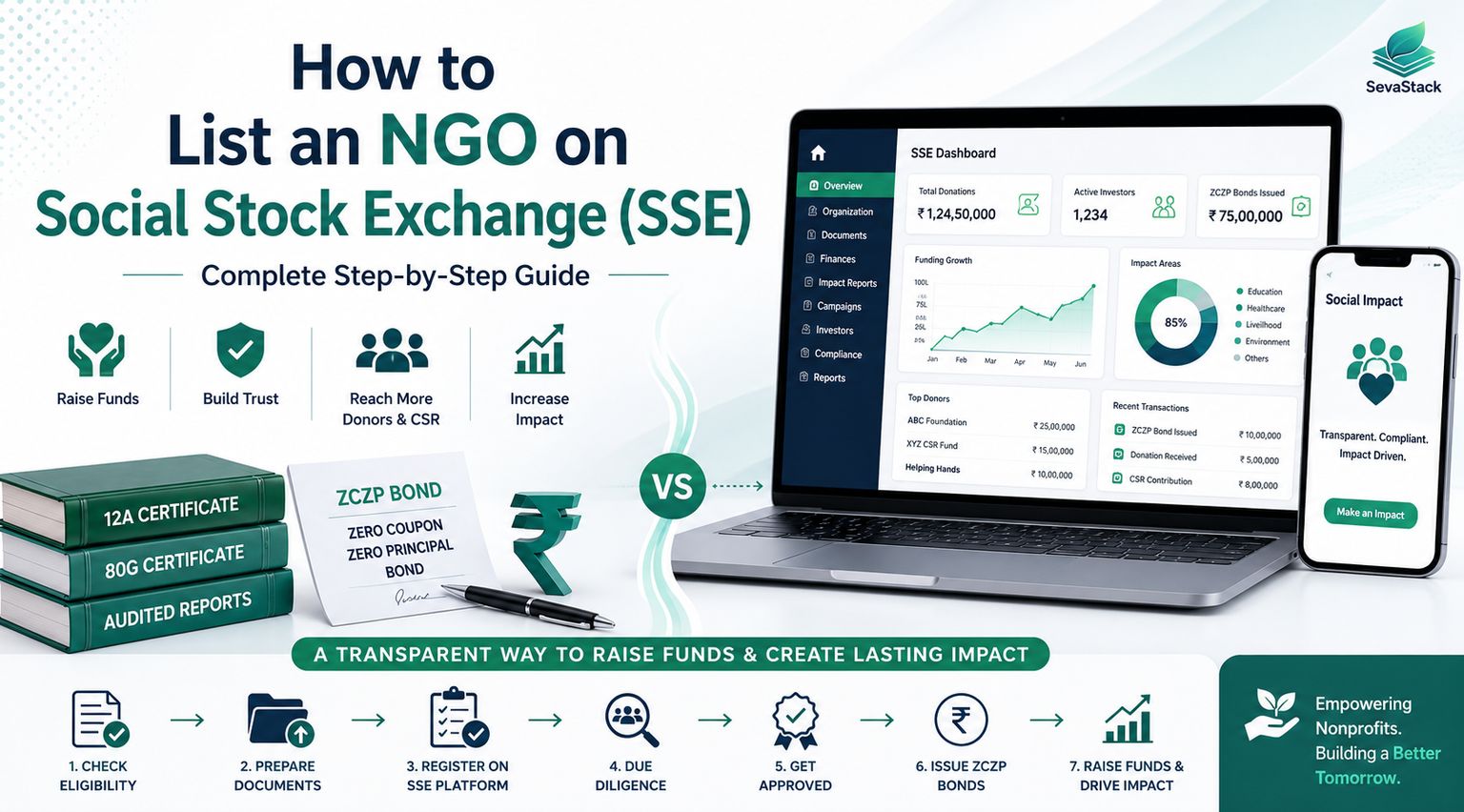
How to List an NGO on India's Social Stock Exchange (SSE): Complete Step-by-Step Guide
Learn how NGOs and Section 8 companies can list on India's Social Stock Exchange (SSE). Understand eligibility, required documents, ZCZP bonds, fundraising opportunities, and the complete step-by-step
Never miss a filing date
Sevastack keeps your NGO's compliance calendar and reminds you by email and WhatsApp before each return is due. Donors, 80G receipts and accounts sit in the same place.