

What Happens If Your NGO Fails Compliance? Real Risks, Penalties & Recovery Steps (India 2026)
Missed NGO compliance in India? Learn the real risks, penalties, and step-by-step recovery plan to protect your NGO and funding.
Vivek Bhos
Updated 4 min read

Let’s be honest.
Most NGOs don’t ignore compliance on purpose.
It usually happens because:
Deadlines get missed
Documents are scattered
Teams are small
Or no one is clearly responsible
But here’s the harsh reality 👇
👉 Even one compliance mistake can cost your NGO funding, credibility, and sometimes even registration.
This guide breaks it down simply:
What actually happens when compliance fails
Real risks and penalties
And how to fix it before it’s too late
🚨 What Does “NGO Compliance Failure” Mean?
In India, NGO compliance includes things like:
Filing ITR-7 (Income Tax Return)
Submitting Form 10B / 10BB (Audit Report)
Filing Form 10BD & issuing 10BE (80G donations)
Maintaining proper financial records
FCRA compliance (if applicable)
CSR reporting (if funded by companies)
👉 Missing or doing any of these incorrectly = compliance failure
⚠️ Real Risks of Non-Compliance
This is where things get serious.
1. Loss of 12A & 80G Benefits
If you don’t follow compliance properly:
👉 Your 12A registration can be cancelled
👉 Your 80G certificate can be revoked
What that means:
Your income becomes taxable
Donors stop getting tax benefits
👉 Result: Donations drop instantly
2. Heavy Penalties & Fines
Some common penalties:
Late filing fees
₹200 per day (in some cases)
Penalties under Income Tax Act
FCRA violations → much stricter penalties
👉 Small mistake → Big financial impact
3. CSR Funding Gets Blocked
Companies don’t take risks.
If your NGO:
Misses filings
Has incomplete documents
Shows poor reporting
👉 You will be rejected during CSR due diligence
And worst part?
👉 You may never get a second chance from that company.
4. Donor Trust Breaks
Today’s donors expect:
Transparency
Proper receipts
Clear reporting
If you fail compliance:
👉 Delayed 80G receipts
👉 No proper reports
👉 Confusion in records
👉 Result: Donors stop trusting you
5. Risk of NGO Registration Cancellation
In extreme cases:
👉 Your NGO registration can be suspended or cancelled
This happens if:
Continuous non-compliance
Financial irregularities
Legal violations
👉 This is the worst-case scenario.
📉 Real Example (What Actually Happens)
A small NGO:
Forgot to file Form 10BD
Issued wrong donation receipts
Had no proper audit report
Result:
Penalty imposed
Donors complained
CSR proposal rejected
👉 Not because they lacked impact
👉 But because they lacked compliance
🛠️ How to Recover If You’ve Already Missed Compliance
Good news:
👉 Most compliance issues can be fixed — if you act fast.
Step 1: Identify What You Missed
Start with basics:
Did you file ITR-7?
Audit report submitted?
10BD & 10BE done?
FCRA filings (if applicable)?
👉 Make a checklist.
Step 2: Talk to a CA Immediately
Don’t delay.
A good CA can:
File delayed returns
Handle penalties
Guide correction process
👉 The earlier you act, the lower the damage.
Step 3: File Pending Forms
Even if late:
👉 File everything ASAP
This includes:
ITR
Audit report
Donation statements
👉 Late is better than never.
Step 4: Fix Your Documentation
Organize:
Financial records
Donation data
Receipts
Reports
👉 Clean records = faster recovery
Step 5: Communicate Transparently
If donors or partners are affected:
👉 Be honest
👉 Inform them
👉 Fix the issue
👉 Transparency rebuilds trust
🔄 How to Prevent This in Future
This is the real goal.
1. Create a Compliance Calendar
Track:
All deadlines
Filing dates
Audit timelines
👉 No more last-minute panic
2. Assign Responsibility
Don’t leave compliance “to someone”.
👉 Assign a clear owner:
Internal team
CA
Admin person
3. Automate Where Possible
Manual systems fail.
Use tools to:
Track donations
Generate receipts
Store documents
Monitor deadlines
4. Keep Everything in One Place
Biggest problem:
👉 Data scattered everywhere
Solution:
👉 Central system for:
Compliance
Donors
Financials
🚀 How SevaStack Helps You Stay Compliant
Let’s be real.
Most NGOs don’t fail because they don’t care.
They fail because systems are messy.
That’s exactly what SevaStack fixes.
With SevaStack, you can:
Track compliance deadlines
Manage donor data
Generate 80G receipts automatically
Keep all records in one place
Stay audit-ready anytime
👉 No spreadsheets
👉 No confusion
👉 No missed deadlines
✅ Final Thoughts
Compliance is not just paperwork.
👉 It’s your NGO’s credibility system
When compliance is strong:
Donors trust you
Companies fund you
Growth becomes easier
When it fails:
Everything slows down
👉 Fix it early.
👉 Systemize it.
👉 Don’t ignore it.
💬 Question for You
Have you ever missed a compliance deadline?
Or are you currently managing everything manually?
New law, same rule. From 1 April 2026 the Income-tax Act, 2025 replaced the Income-tax Act, 1961. Section 12A/12AB is now covered by Section 332. Only the number changed, not what you have to do. People still say "Section 12A/12AB", so we use it here too. Filing close to the change-over? Check the form with your CA.
Vivek Bhos
Written by the Sevastack team, who build and maintain the 80G receipt, FCRA, and Form 10BD/10BE automation used by Indian NGOs on the platform every day. Compliance guidance is reviewed against current Income Tax Act and FCRA rules before publishing.
Read next
Compliance
FCRA Annual Return (FC-4): Step-by-Step Guide for 2026
Got foreign donations? File your FCRA annual return (FC-4) by 31 December 2026. A simple step-by-step guide with documents, mistakes and a checklist.
Compliance
80G Is Now Section 133: What Changes on Your NGO Receipts
Section 80G is now Section 133 under the new Income-tax Act. Learn in simple words what changes for NGO receipts, Form 113 and Form 114, and what stays the same.
Compliance
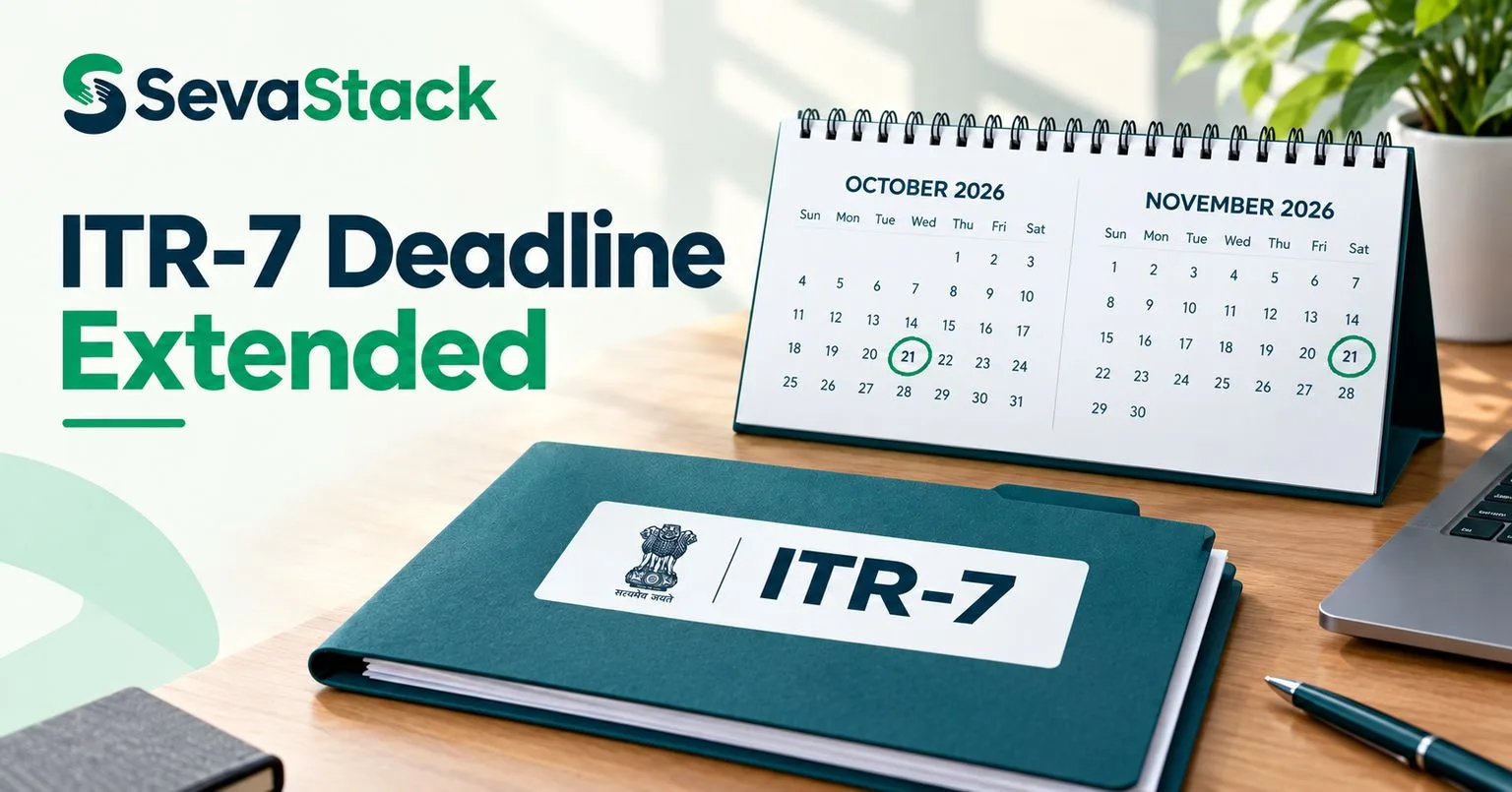
ITR-7 Due Date Extended to 21 November: What NGOs Must Do
CBDT has extended the ITR-7 due date to 21 November 2026 and the audit report date to 21 October. Here is what your NGO should do now, step by step.
Never miss a filing date
Sevastack keeps your NGO's compliance calendar and reminds you by email and WhatsApp before each return is due. Donors, 80G receipts and accounts sit in the same place.