

NGO vs RNPO: What’s the Real Difference? A Simple Guide for Founders & Donors
Understand the real difference between NGO and RNPO in simple language. Learn registration types, tax benefits, funding opportunities, and which structure is best for your social initiative.
Vivek Bhos
Updated 6 min read
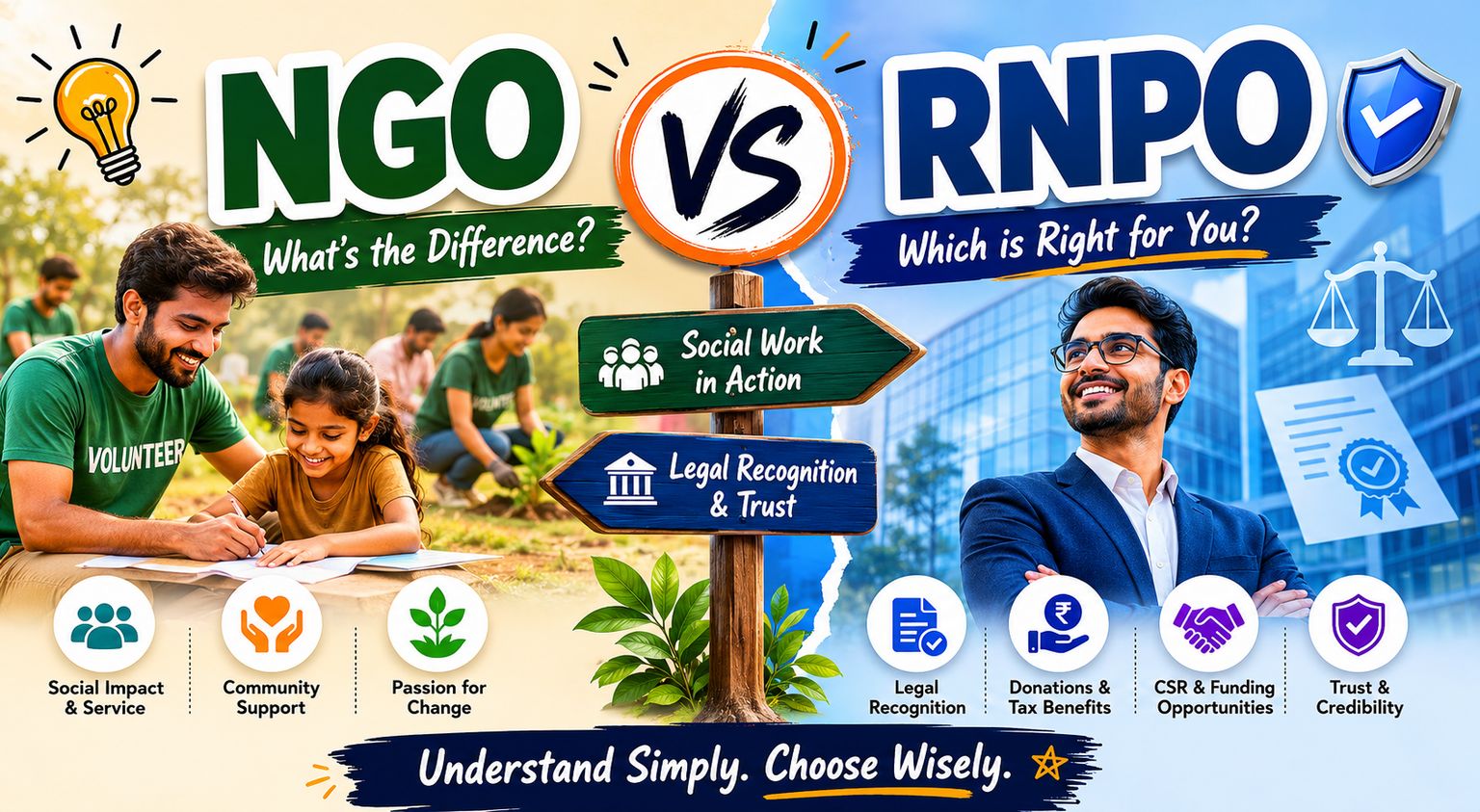
A simple guide for founders, donors, volunteers, and social entrepreneurs in India
India’s social sector is growing super fast. Thousands of people want to start initiatives for education, healthcare, environment, animal welfare, women empowerment, rural development, and many other causes.
But one question creates confusion for almost everyone:
“Should we register as an NGO or RNPO?”
Many people even think both are the same thing.
They are related — but not exactly the same.
This blog explains the difference between NGO and RNPO in very easy language, without complicated legal jargon.
First Understand One Thing
NGO is a broad term
NGO means:
Non-Governmental Organization
It simply refers to any organization working for social good and not controlled by the government.
An NGO can be:
A Trust
A Society
A Section 8 Company
A charitable group
A social initiative
A foundation
A nonprofit startup
So NGO is more like a category or concept.
Then What is RNPO?
RNPO usually means:
Registered Non-Profit Organization
This means the organization is:
✅ officially registered with the government
✅ legally recognized
✅ allowed to operate formally
✅ able to open bank accounts
✅ eligible for donations and compliance benefits
So:
Every RNPO can be called an NGO
But not every NGO is legally registered
That’s the biggest difference.
Simple Example
Imagine 3 friends start teaching poor students for free.
At this stage:
They are doing social work
People may call them an NGO
But legally they are not registered
Now they register officially as:
Trust
Society
or Section 8 Company
Now they become:
✅ Registered Non-Profit Organization (RNPO)
NGO vs RNPO in Simple Table
Feature | NGO | RNPO |
|---|---|---|
Meaning | Any social welfare organization | Officially registered nonprofit |
Legal status | May or may not be legal entity | Fully legal entity |
Government registration | Not necessary | Mandatory |
Can receive formal donations | Limited | Yes |
Can open NGO bank account | Usually difficult | Yes |
Eligible for CSR funding | Usually no | Yes |
Eligible for 12A & 80G | No | Yes |
Public trust level | Lower | Higher |
Compliance required | Minimal | Required |
Long-term scalability | Limited | Strong |
Why Registration Matters
Many people start social work informally.
That’s okay in the beginning.
But after some time, problems start appearing:
Donors ask for receipts
Companies ask for registration certificates
Banks ask for legal documents
Government schemes require compliance
Payment gateways ask for NGO proof
CSR teams ask for 80G and 12A
Without registration, growth becomes difficult.
That’s why serious social initiatives eventually become RNPOs.
Types of RNPOs in India
In India, there are mainly 3 ways to register a nonprofit.
1. Trust
A Trust is commonly used for:
charity
education
hospitals
community welfare
Pros
Easy to form
Less compliance
Good for family-led charities
Cons
Less transparent compared to Section 8
Harder to scale nationally
2. Society
A Society is used for:
cultural organizations
educational groups
community associations
clubs and welfare groups
Pros
Democratic structure
Multiple members involved
Cons
Compliance varies by state
Can become management-heavy
3. Section 8 Company
A Section 8 Company is registered under the Companies Act.
This is considered the most professional nonprofit structure in India.
Pros
High credibility
Better for CSR funding
Preferred by corporates and investors
Strong governance
Scalable
Cons
More compliance
More documentation
Professional accounting needed
Which One is Best?
There is no “one perfect option.”
It depends on your mission.
Choose Trust if:
You want simple local charity operations
Small community initiative
Family-run nonprofit
Choose Society if:
You have multiple active members
Community-based operations
Associations or educational groups
Choose Section 8 Company if:
You want to scale nationally
You want CSR funding
You want professional branding
You want long-term credibility
You are building a social startup
NGO vs RNPO for Donations
This is where many founders get confused.
Informal NGO
People can still donate.
But:
donors may not trust easily
no tax benefits
difficult accounting
payment gateway issues
RNPO
A registered nonprofit can:
✅ issue donation receipts
✅ apply for 80G tax exemption
✅ apply for 12A benefits
✅ receive CSR funds
✅ use payment gateways professionally
✅ build donor trust
That’s why registration matters a lot.
What is 12A and 80G?
These are very important for nonprofits in India.
12A
Helps the nonprofit get income tax exemption.
Meaning:
The organization saves tax on eligible nonprofit income.
80G
Helps donors save tax.
If someone donates to your RNPO with 80G approval:
they can claim tax deduction
This increases donor confidence massively.
Can a Startup Be an NGO?
Yes — and this is becoming very common.
Modern nonprofits now work like startups.
Examples:
donation platforms
education initiatives
healthcare technology
NGO management software
volunteer networks
crowdfunding systems
impact tracking platforms
Many social founders now build:
scalable systems
tech-enabled NGOs
nonprofit SaaS platforms
AI-based impact solutions
This is often called:
Social Entrepreneurship
Common Misconceptions
“NGO means free work only”
Wrong.
NGOs can hire employees and professionals.
Many nonprofits have:
developers
managers
marketers
accountants
designers
operations teams
“Nonprofits cannot earn money”
Wrong.
RNPOs can generate revenue.
But profits cannot be distributed to owners personally.
The money must support the mission.
“Registration is expensive”
Not always.
Basic nonprofit registration in India is often affordable compared to building long-term credibility.
When Should You Register?
You should think about registration when:
donations start increasing
you want CSR funding
you want tax exemptions
you want legal protection
you want transparency
you want to scale operations
you want long-term trust
Real-World Example
Imagine two organizations:
Group A
Works informally
Uses personal bank account
No registration
No donation receipts
No tax benefits
People may hesitate to donate large amounts.
Group B
Registered Section 8 Company
Has 80G and 12A
Transparent reporting
Professional website
Proper accounting
Corporates and donors trust them more easily.
That’s the power of becoming an RNPO.
Final Thoughts
NGO and RNPO are closely connected — but not identical.
In simple words:
NGO = social work organization
RNPO = legally registered nonprofit organization
If you’re just starting:
focus on impact first.
But if you want:
credibility
donor trust
CSR partnerships
tax benefits
scalability
professional operations
then becoming an RNPO is usually the smarter long-term path.
Quick Summary
NGO
Broad term
Social welfare work
May be informal
RNPO
Officially registered
Legal recognition
Better trust and funding opportunities
Required for serious scaling
If you are building a modern nonprofit ecosystem, choosing the right structure early can save a lot of future headaches — especially when handling donations, compliance, fundraising, and technology platforms.
Under the Income-tax Act, 2025 (effective 1 April 2026, replacing the Income-tax Act, 1961), Section 12A/12AB is now governed by Section 332 of the new Act. "Section 12A/12AB" remains the commonly used and searched term during the transition — the underlying requirement is unchanged, only the section/form numbering has moved. Confirm the applicable form with your CA if you're filing close to the transition date.
Vivek Bhos
Written by the Sevastack team, who build and maintain the 80G receipt, FCRA, and Form 10BD/10BE automation used by Indian NGOs on the platform every day. Compliance guidance is reviewed against current Income Tax Act and FCRA rules before publishing.
Read next
Finance
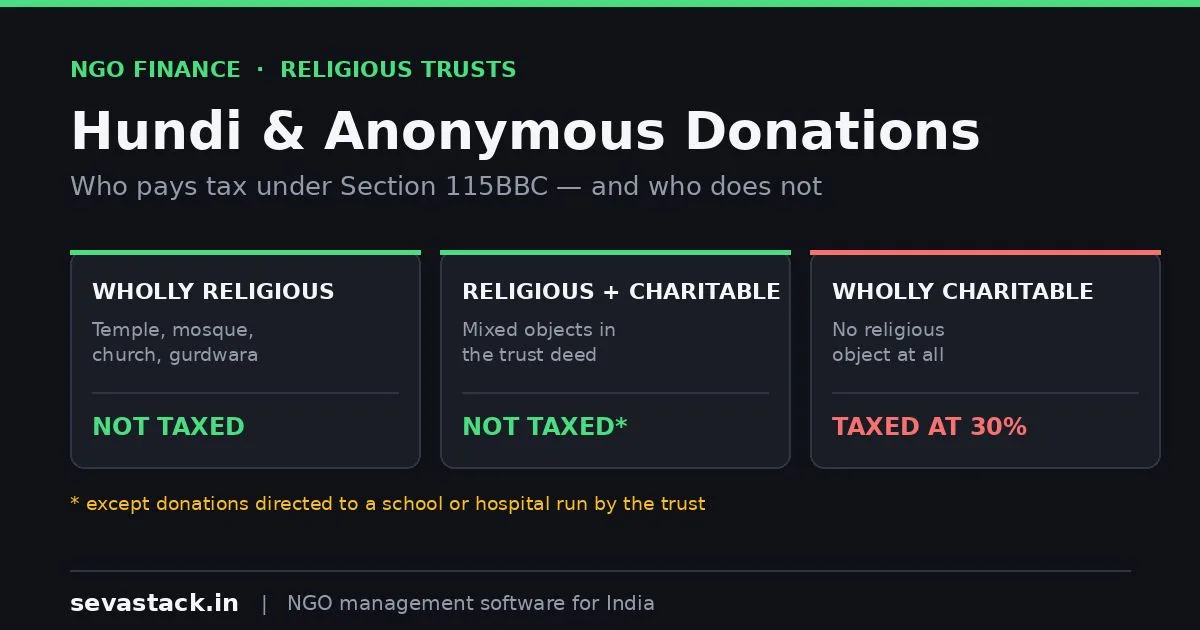
Temple and Religious Trust Accounting: A Practical Guide
Hundi collections, anonymous donations and Section 115BBC explained. Why wholly religious trusts are treated differently, and how to record offerings.
NGO Management
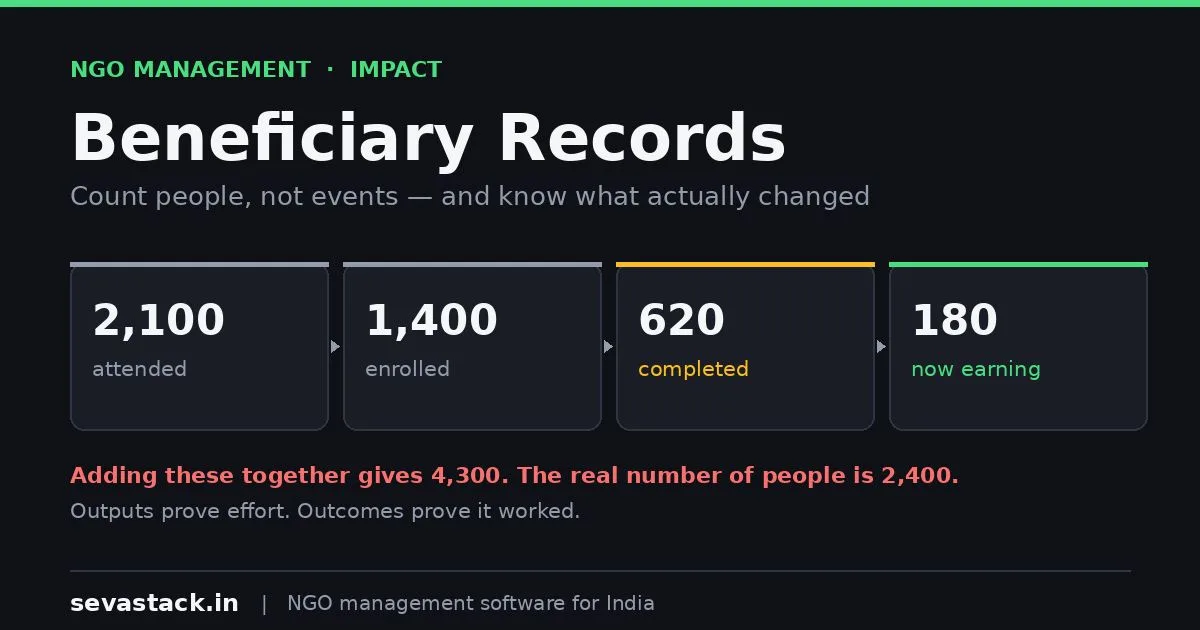
Beneficiary Management: How NGOs Should Track Their Work
Can you prove the numbers in your annual report? A simple guide to beneficiary records, avoiding double counting, and measuring outcomes not outputs.
NGO Management
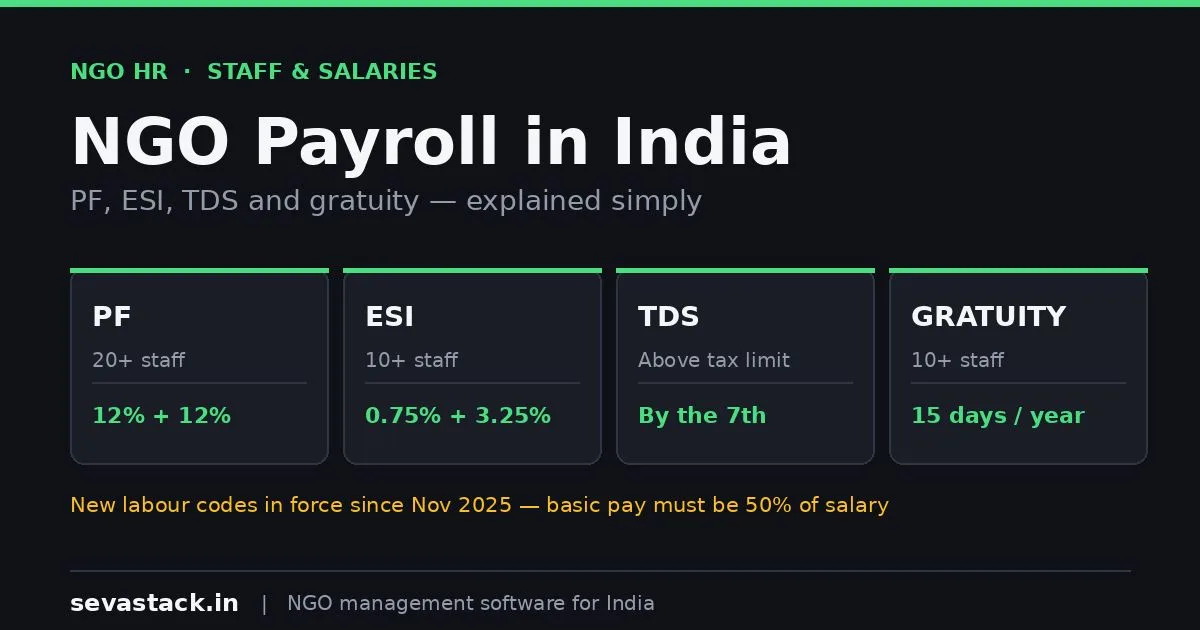
NGO Payroll in India: PF, ESI, TDS and Gratuity Made Simple
A simple guide to NGO payroll in India. When PF and ESI apply, how much to deduct, TDS on salary, gratuity rules and the new labour code changes.
Never miss a filing date
Sevastack keeps your NGO's compliance calendar and reminds you by email and WhatsApp before each return is due. Donors, 80G receipts and accounts sit in the same place.