

NGO Income Tax Compliance in India: Complete Filing Guide for 2026
A complete, simple guide to NGO income tax compliance in India. Learn about ITR-7, Form 10BD, 10BE, audit reports, and deadlines for 2026.
Vivek Bhos
Updated 4 min read
Running an NGO is not just about doing good work.
It also comes with important compliance responsibilities.
Many NGOs lose their tax benefits not because of wrong intent — but because of missed filings.
If you want to keep your NGO legally compliant and maintain tax-exempt status, this guide will help you understand everything in simple terms.
Why Compliance Matters for NGOs
Income tax compliance is critical because:
It keeps your NGO legally active
It ensures tax exemption benefits (12A/12AB)
It allows donors to claim 80G deductions
It builds trust with CSR donors
Missing even one filing can lead to:
👉 Penalties
👉 Loss of tax benefits
👉 Funding issues
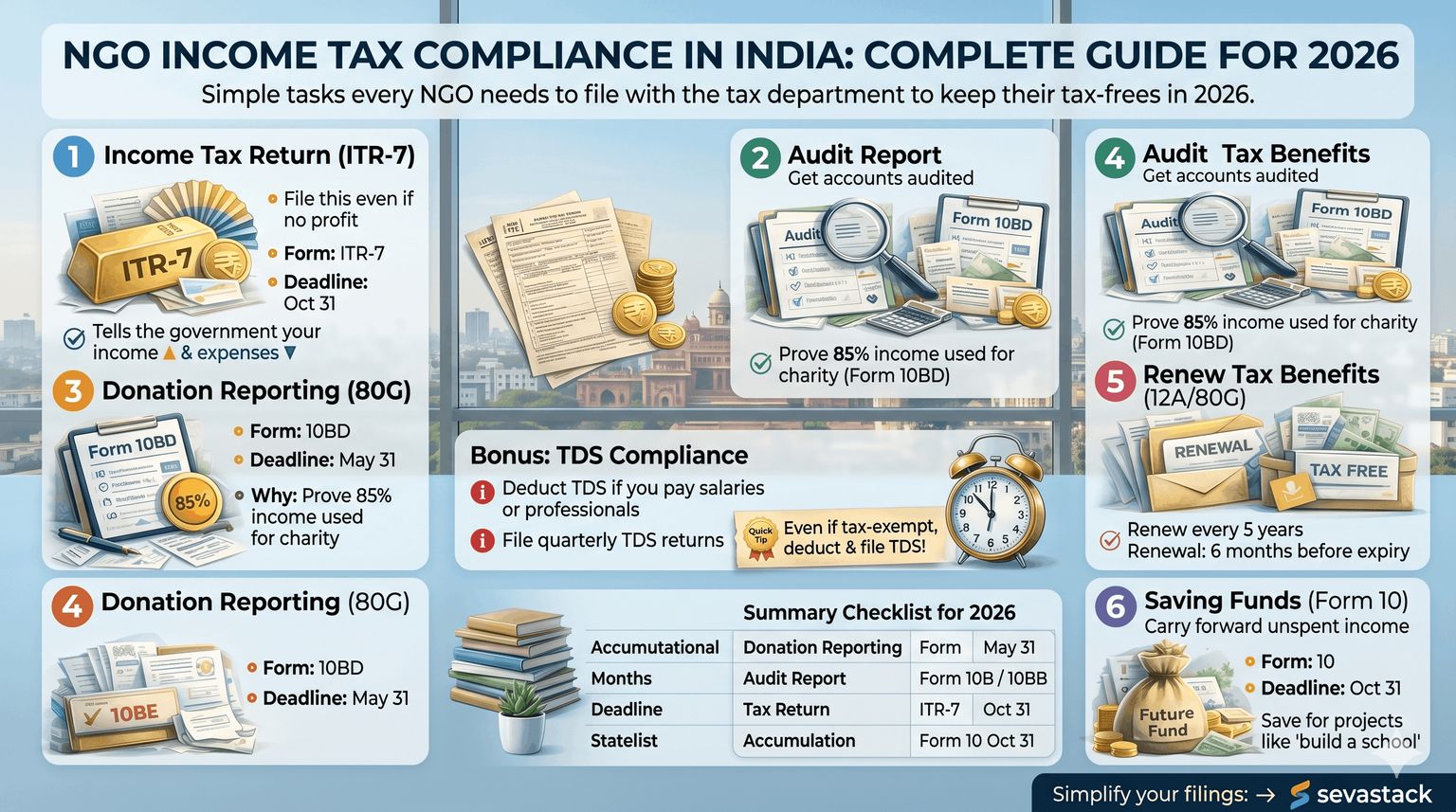
1. Annual Income Tax Return (ITR-7)
This is the most important filing for every NGO.
Even if your NGO has no profit, you must file it.
📌 Details:
Form: ITR-7
Deadline: Usually October 31
Who should file: All registered NGOs
💡 Why it matters:
It shows the government:
Total income (donations, grants)
Expenses towards your cause
Financial transparency
2. Audit Report (Proof of Proper Usage)
If your NGO earns above ₹2.5 lakh annually, you must get your accounts audited.
📌 Forms:
Form 10B → If income > ₹5 crore or foreign funding
Form 10BB → Smaller/local NGOs
📌 Deadline:
September 30 (before ITR filing)
💡 Why it matters:
This report proves:
👉 At least 85% of your income is used for charitable purposes
3. Donation Reporting (80G Compliance)
If your NGO is registered under 80G, you must report all donations.
📌 Form:
Form 10BD
📌 Deadline:
May 31 (for previous financial year)
📄 What happens after filing 10BD?
After submitting Form 10BD:
The Income Tax Department generates Form 10BE
You must send this certificate to each donor
💡 Why it matters:
Without Form 10BE:
👉 Donors cannot claim tax deductions
4. Maintaining Your Tax-Free Status (12A & 80G Renewal)
Earlier, tax registrations were permanent.
Now, they must be renewed periodically.
📌 Forms:
Form 10A → New registration
Form 10AB → Renewal
📌 Validity:
Usually valid for 5 years
⚠️ Important:
Apply for renewal at least 6 months before expiry
5. Saving Funds for Future Use (Form 10)
Sometimes NGOs cannot spend all funds in one year.
For example:
Building infrastructure
Long-term projects
📌 Form:
Form 10 (Accumulation Statement)
💡 Why it matters:
It allows you to:
👉 Carry forward funds for up to 5 years
👉 Avoid paying tax on unspent income
📌 Deadline:
Before ITR filing
📊 Summary Checklist for 2026
Compliance Task | Form | Deadline |
|---|---|---|
Donation Reporting | Form 10BD | May 31 |
Audit Report | Form 10B / 10BB | Sept 30 |
Income Tax Return | ITR-7 | Oct 31 |
Fund Accumulation | Form 10 | Oct 31 |
⚠️ Bonus: TDS Compliance (Often Ignored)
Many NGOs forget this.
If your NGO:
Pays salaries
Pays professionals (CA, consultants, vendors)
You must:
👉 Deduct TDS
👉 File quarterly TDS returns
Just like a business.
Common Mistakes NGOs Make
Not filing ITR because “no profit”
Missing Form 10BD deadline
Not sending Form 10BE to donors
Ignoring audit requirements
Forgetting renewal deadlines
The Real Challenge: Managing Everything Together
The biggest issue is not knowledge.
It’s management.
NGOs struggle with:
Tracking deadlines
Managing donor data
Preparing reports
Handling compliance manually
This leads to:
👉 Stress
👉 Errors
👉 Missed filings
The Better Approach
Smart NGOs:
Track compliance throughout the year
Maintain proper records
Use digital tools for automation
This ensures:
✔ No last-minute chaos
✔ Accurate filings
✔ Better donor experience
Final Thoughts
NGO compliance may feel complex.
But once you understand the system, it becomes manageable.
The key is:
👉 Consistency
👉 Proper documentation
👉 Timely filing
If you stay organized, you not only stay compliant — you also build trust and unlock funding opportunities.
🚀 Simplify NGO Compliance
If you want to manage donor data, automate compliance, and avoid deadlines stress:
Under the Income-tax Act, 2025 (effective 1 April 2026, replacing the Income-tax Act, 1961), Form 10BD is now filed as Form 113, governed by Section 354(1) of the new Act. "Form 10BD" remains the commonly used and searched term during the transition — the underlying requirement is unchanged, only the section/form numbering has moved. Confirm the applicable form with your CA if you're filing close to the transition date.
Vivek Bhos
Written by the Sevastack team, who build and maintain the 80G receipt, FCRA, and Form 10BD/10BE automation used by Indian NGOs on the platform every day. Compliance guidance is reviewed against current Income Tax Act and FCRA rules before publishing.
Read next
Compliance
80G Is Now Section 133: What Changes on Your NGO Receipts
Section 80G is now Section 133 under the new Income-tax Act. Learn in simple words what changes for NGO receipts, Form 113 and Form 114, and what stays the same.

Compliance
ITR-7 Due Date Extended to 21 November: What NGOs Must Do
CBDT has extended the ITR-7 due date to 21 November 2026 and the audit report date to 21 October. Here is what your NGO should do now, step by step.
Compliance
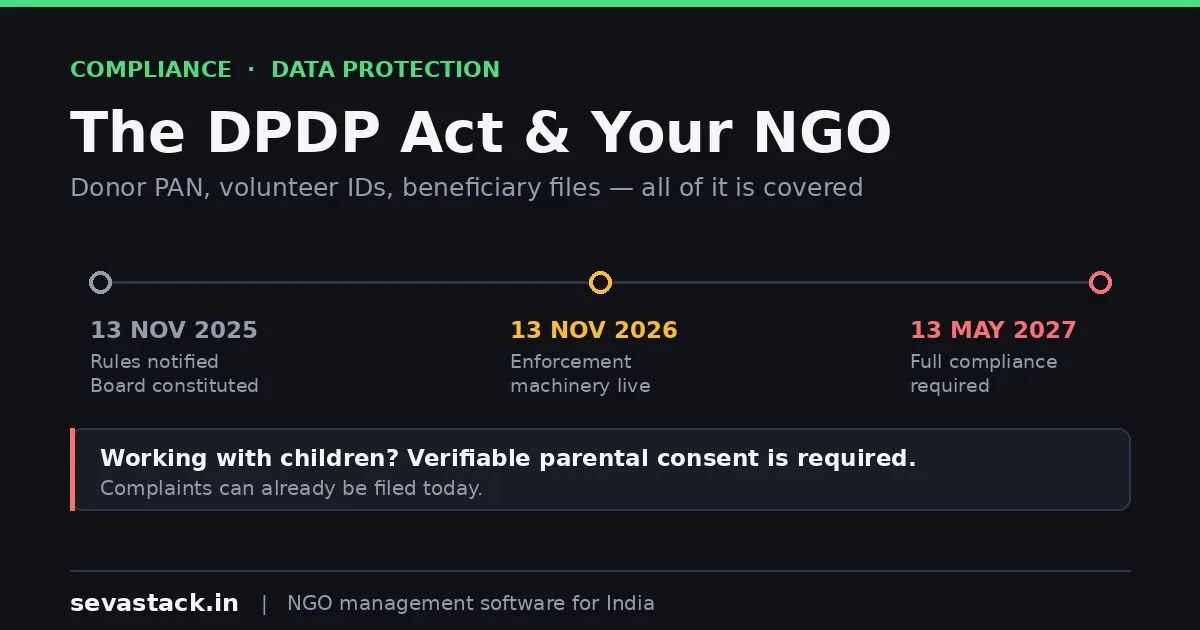
DPDP Act for NGOs in India: A Simple Compliance Guide
Your NGO holds donor PAN, phone numbers and beneficiary records. India's data protection law now covers all of it. Here is what to do, and by when.
Never miss a filing date
Sevastack keeps your NGO's compliance calendar and reminds you by email and WhatsApp before each return is due. Donors, 80G receipts and accounts sit in the same place.