

How to List an NGO on India's Social Stock Exchange (SSE): Complete Step-by-Step Guide
Learn how NGOs and Section 8 companies can list on India's Social Stock Exchange (SSE). Understand eligibility, required documents, ZCZP bonds, fundraising opportunities, and the complete step-by-step
Vivek Bhos
Updated 4 min read
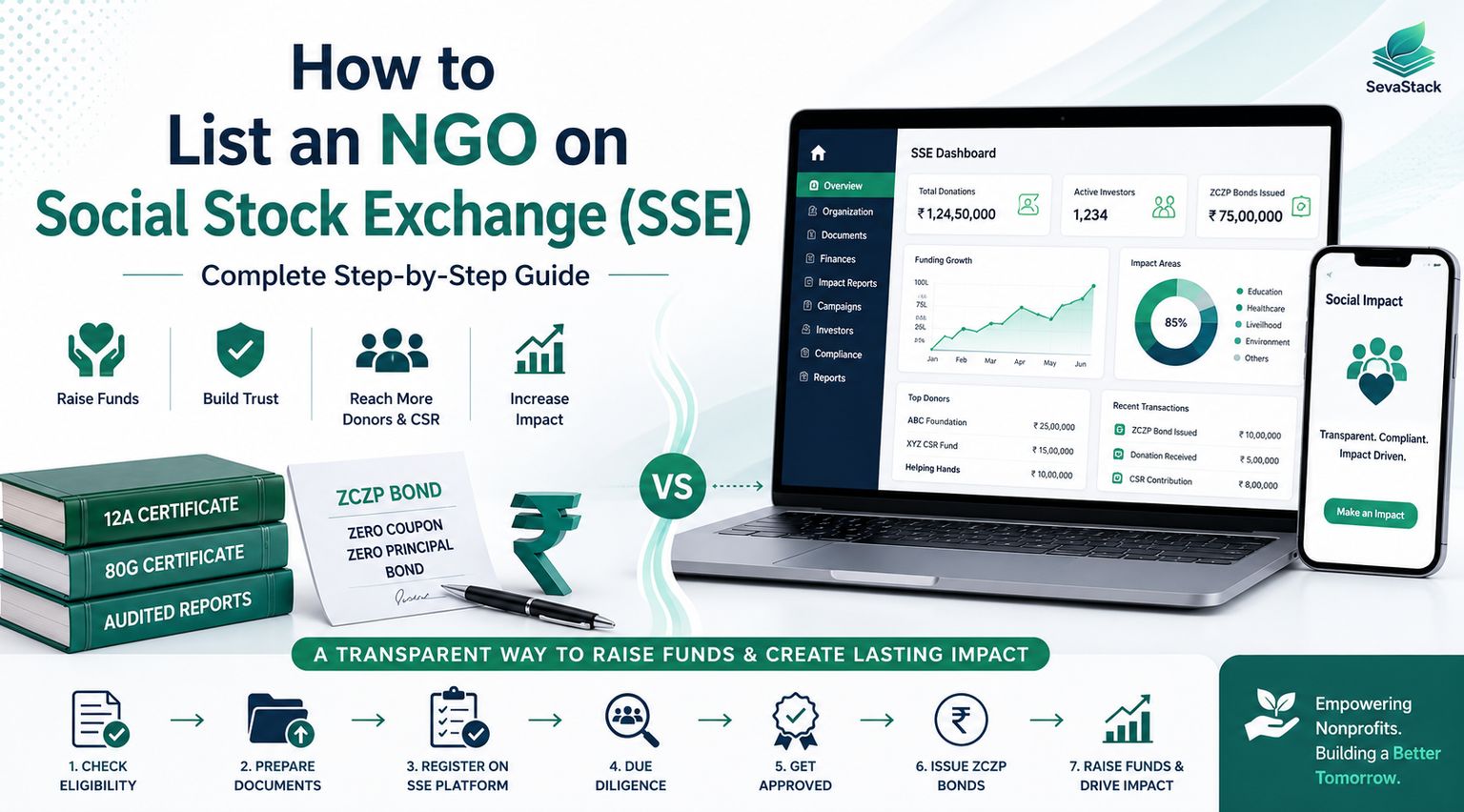
India has introduced something revolutionary for the social sector.
For the first time, NGOs and nonprofit organizations can raise funds through a platform similar to the stock market.
This platform is called the Social Stock Exchange (SSE).
It was launched by SEBI to help nonprofits access transparent and structured funding.
But many founders ask:
Can an NGO really get listed on the stock exchange?
The answer is:
Yes—but not in the same way as companies like TCS or Infosys.
Let's understand everything in simple language.
What is Social Stock Exchange (SSE)?
The Social Stock Exchange is a separate segment created by SEBI under:
NSE (National Stock Exchange)
BSE (Bombay Stock Exchange)
Its purpose is to connect:
Social Organizations
with
Investors, Donors and CSR Contributors
through a transparent ecosystem.
Why Was SSE Introduced?
Many NGOs struggle with:
Lack of funding
Limited visibility
Trust issues
Difficulty attracting large donors
Dependence on grants
The Social Stock Exchange aims to solve these problems.
Who Can List on Social Stock Exchange?
Two categories are allowed:
1. Non-Profit Organizations (NPOs)
Including:
Section 8 Companies
Charitable Trusts
Registered Societies
2. For-Profit Social Enterprises (FPEs)
Businesses that generate profit while creating measurable social impact.
Can Every NGO List on SSE?
No.
The organization must satisfy several conditions.
Eligibility Requirements
The NGO should:
Be registered as:
Trust
Society
Section 8 Company
Have:
Minimum 3 years of existence
Valid PAN
12A registration
80G registration
Financial Requirements
The NGO should have:
Annual spending of at least ₹50 lakh during the previous financial year
OR
Funding of ₹10 lakh in the previous year
No major legal disputes
The organization should maintain proper governance and compliance.
What Documents Are Required?
You'll generally need:
Registration Certificate
Trust Deed or Incorporation Certificate.
PAN Card
12A Certificate
80G Certificate
Audited Financial Statements
Usually for the last three years.
Annual Reports
Board Details
Trustees or directors information.
Impact Reports
Evidence showing the social impact created by the organization.
Step-by-Step Process to List an NGO on SSE
Step 1: Ensure Compliance
Obtain:
PAN
12A
80G
Audited accounts
Step 2: Register on SSE Segment
Apply through:
NSE Social Stock Exchange
or
BSE Social Stock Exchange
Step 3: Submit Documents
Provide:
Registration certificates
Financial statements
Governance information
Impact reports
Step 4: Due Diligence
The exchange verifies:
Legal status
Transparency
Compliance
Financial health
Step 5: Registration Approval
After approval, the NGO gets listed on the SSE platform.
How Do NGOs Raise Money on SSE?
Unlike normal companies, NGOs do not issue shares.
Instead, they issue:
Zero Coupon Zero Principal (ZCZP) Bonds
What are Zero Coupon Zero Principal Bonds?
These bonds:
Do not pay interest.
Do not return principal.
Work more like donations.
Investors contribute money to support social causes rather than earn profits.
Areas Eligible for Fundraising
Organizations working in:
Education
Healthcare
Poverty Alleviation
Women Empowerment
Skill Development
Environment Protection
Rural Development
Animal Welfare
Agriculture
Disaster Relief
can benefit from SSE.
Benefits of Listing on Social Stock Exchange
Higher Credibility
Listing increases public trust.
Access to Larger Donors
Attract:
HNIs
Corporates
CSR contributors
Impact investors
Better Transparency
Financial reporting becomes more structured.
Nationwide Visibility
Organizations become visible across India.
Easier Fundraising
Less dependence on traditional grants.
Challenges of SSE Listing
Despite its advantages, NGOs should know:
Compliance requirements are strict.
Impact measurement is essential.
Reporting standards are higher.
Professional accounting is necessary.
Annual disclosures are mandatory.
Is SSE Suitable for Small NGOs?
Not always.
Very small organizations may find:
compliance expensive,
reporting difficult,
impact measurement challenging.
SSE is generally better suited for:
Established NGOs
Section 8 companies
Large foundations
Social enterprises
Real Example
Suppose an education NGO working for rural children has:
operated for 5 years,
obtained 12A and 80G,
audited accounts,
annual expenditure of ₹80 lakh,
then it can potentially apply for Social Stock Exchange registration and raise funds through Zero Coupon Zero Principal bonds.
Future of Social Stock Exchange in India
The Social Stock Exchange has the potential to transform nonprofit fundraising.
It can bring:
greater transparency,
institutional funding,
impact investing,
accountability,
and trust
to India's social sector.
As awareness grows, more NGOs and Section 8 companies are expected to join this ecosystem.
Conclusion
The Social Stock Exchange is one of India's biggest innovations in the nonprofit sector.
It allows eligible NGOs to raise funds in a transparent and regulated manner while building trust among donors and investors.
For established organizations aiming to scale their impact, SSE can become a powerful fundraising mechanism and a gateway to long-term sustainability.
Under the Income-tax Act, 2025 (effective 1 April 2026, replacing the Income-tax Act, 1961), Section 12A/12AB is now governed by Section 332 of the new Act. "Section 12A/12AB" remains the commonly used and searched term during the transition — the underlying requirement is unchanged, only the section/form numbering has moved. Confirm the applicable form with your CA if you're filing close to the transition date.
Vivek Bhos
Written by the Sevastack team, who build and maintain the 80G receipt, FCRA, and Form 10BD/10BE automation used by Indian NGOs on the platform every day. Compliance guidance is reviewed against current Income Tax Act and FCRA rules before publishing.
Read next
Finance
NGO Accounting in India (2026): The Complete Guide to Fund Accounting, 80G, FCRA & Financial Management
Learn everything about NGO accounting in India—from fund accounting and financial statements to 80G, Form 10BD/10BE, FCRA, CSR grants, audits, and accounting best practices for trusts, societies, and
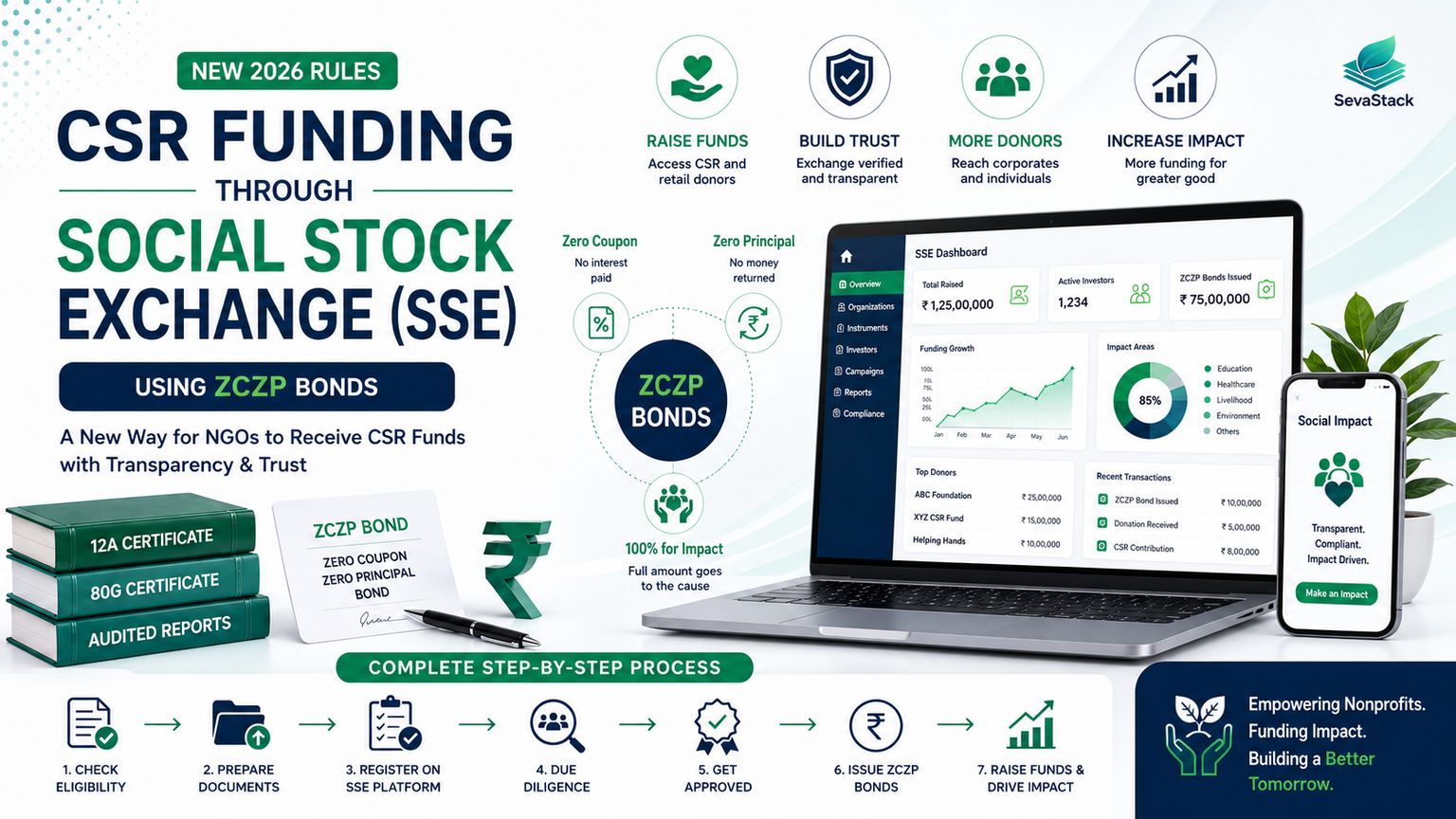
Fundraising
How NGOs Can Receive CSR Funds Through Social Stock Exchange (SSE) and ZCZP Bonds: Complete Guide (2026)
Learn how NGOs can receive CSR funds through India's Social Stock Exchange (SSE) using Zero Coupon Zero Principal (ZCZP) bonds. Understand eligibility, the new 2026 rules, and how the funding process
NGO Management
NGO vs RNPO: What’s the Real Difference? A Simple Guide for Founders & Donors
Understand the real difference between NGO and RNPO in simple language. Learn registration types, tax benefits, funding opportunities, and which structure is best for your social initiative.
Never miss a filing date
Sevastack keeps your NGO's compliance calendar and reminds you by email and WhatsApp before each return is due. Donors, 80G receipts and accounts sit in the same place.