

How NGOs Can Receive CSR Funds Through Social Stock Exchange (SSE) and ZCZP Bonds: Complete Guide (2026)
Learn how NGOs can receive CSR funds through India's Social Stock Exchange (SSE) using Zero Coupon Zero Principal (ZCZP) bonds. Understand eligibility, the new 2026 rules, and how the funding process
Vivek Bhos
Updated 4 min read
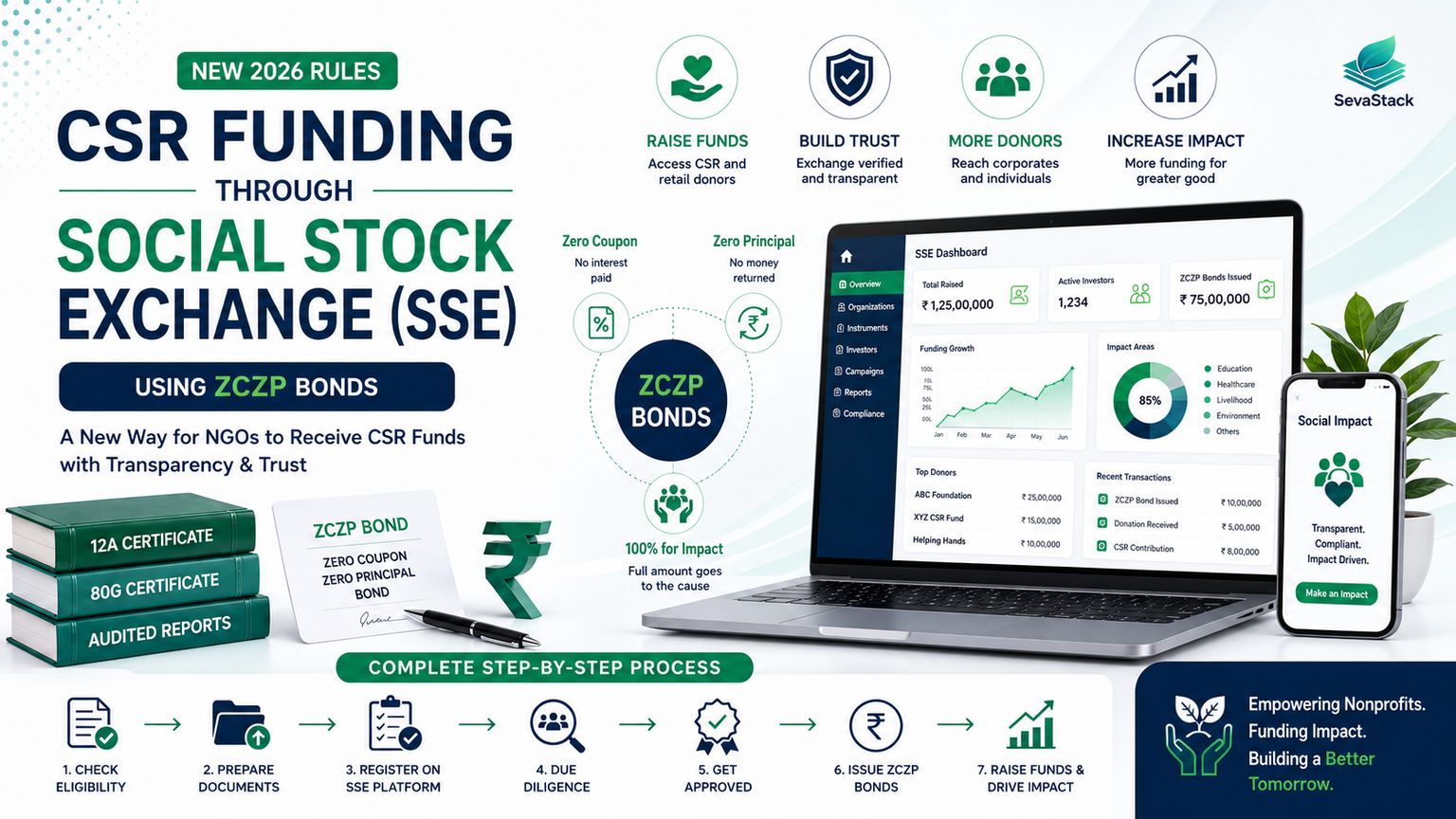
On 27 May 2026, India introduced an important change in CSR regulations.
For the first time, companies can use a part of their mandatory CSR budget to subscribe to Zero Coupon Zero Principal (ZCZP) bonds issued by NGOs listed on the Social Stock Exchange (SSE).
This creates a completely new fundraising channel for nonprofits.
But many founders are confused:
What are ZCZP bonds?
How does the money flow?
Can every NGO use this?
Is this really a ₹50,000 crore opportunity?
Let's understand everything in simple language.
What Changed in 2026?
Under the new MCA rules effective from 27 May 2026, companies can route a portion of their CSR spending through ZCZP instruments issued by NGOs listed on the Social Stock Exchange.
This gives:
Companies
Better transparency
Exchange-verified paper trail
Reduced compliance burden
NGOs
Access to a new funding source
Increased credibility
Wider donor base
What is a ZCZP Bond?
ZCZP stands for:
Zero Coupon Zero Principal
Think of it as a donation instrument traded through NSE or BSE instead of a normal donation receipt.
Zero Coupon
No interest is paid.
Zero Principal
The money is never returned.
The entire amount goes towards the social project.
Simple Example
Imagine:
Meghdoot Industries Ltd.
CSR obligation:
₹3 crore
Sunrise Foundation
A charitable trust:
4 years old
Has 12A and 80G
Registered on BSE Social Stock Exchange
Runs girls' education programs
Step 1: NGO Creates a Project
Sunrise Foundation wants to open digital learning centers.
Project size:
₹50 lakh over three years.
Step 2: ZCZP Bond is Issued
The NGO issues a ₹50 lakh ZCZP bond on the Social Stock Exchange. Retail donors can participate with as little as ₹1,000.
Step 3: Company Invests
Since Meghdoot's CSR obligation is ₹3 crore, it can route only 10% through ZCZP.
Maximum allowed:
₹30 lakh.
Step 4: Remaining Money Comes From Others
The remaining ₹20 lakh can come from:
Other companies
Individual donors
Retail contributors
At least 75% of the issue must be subscribed. Otherwise, money is refunded.
Step 5: Funds Are Used For Social Impact
Since these are Zero Principal bonds, nobody gets money back.
The entire ₹50 lakh goes towards the NGO project.
Benefits for Companies
Companies receive:
CSR compliance
The subscribed amount counts towards CSR obligations.
Lower compliance costs
No separate impact assessment.
Better transparency
Exchange-verified documentation.
Benefits for NGOs
NGOs receive:
Funding
A new channel beyond traditional grants.
Higher trust
Being listed on SSE improves credibility.
Better visibility
Potential access to corporate and retail donors.
Can Every NGO Use This?
No.
The NGO must first qualify for Social Stock Exchange registration.
Eligibility Requirements
The organization should be:
✅ Trust
✅ Society
✅ Section 8 Company
and must have:
3 years of operations
Three years of audited financial statements
Valid 12A registration
Valid 80G registration
Annual expenditure of around ₹50 lakh
At least ₹10 lakh raised during the previous year
Social impact aligned with Schedule VII activities
The 10% Limit Explained
Many headlines claim:
"₹50,000 crore funding opportunity for NGOs!"
Reality is different.
Companies can route only 10% of their total CSR obligation through ZCZP instruments. Traditional CSR still accounts for roughly 90% of CSR spending.
So ZCZP should be viewed as:
An additional funding door—not a replacement for conventional CSR.
Common Myths
Myth 1
"No more grant hunting."
Reality:
Companies still decide whether to subscribe. Money isn't automatic.
Myth 2
"Anyone can list and raise money easily."
Reality:
SSE registration involves serious compliance and eligibility requirements.
Myth 3
"This changes everything."
Reality:
It is a useful development, but conventional CSR remains dominant because of the 10% cap.
Is This Good for Small NGOs?
For very small NGOs, the first priority should be:
12A registration
80G registration
Maintaining audited accounts
Building donor trust
After achieving scale and eligibility, SSE and ZCZP bonds can become powerful fundraising tools.
Final Thoughts
The new 2026 rules have opened a fresh funding channel for Indian nonprofits.
But this is not a shortcut to unlimited funding.
Organizations that maintain transparency, compliance, and measurable impact will benefit the most.
For established NGOs and Section 8 companies, Social Stock Exchange and ZCZP bonds may become one of the most important fundraising innovations in India's social sector.
Under the Income-tax Act, 2025 (effective 1 April 2026, replacing the Income-tax Act, 1961), Section 12A/12AB is now governed by Section 332 of the new Act. "Section 12A/12AB" remains the commonly used and searched term during the transition — the underlying requirement is unchanged, only the section/form numbering has moved. Confirm the applicable form with your CA if you're filing close to the transition date.
Vivek Bhos
Written by the Sevastack team, who build and maintain the 80G receipt, FCRA, and Form 10BD/10BE automation used by Indian NGOs on the platform every day. Compliance guidance is reviewed against current Income Tax Act and FCRA rules before publishing.
Read next
Finance
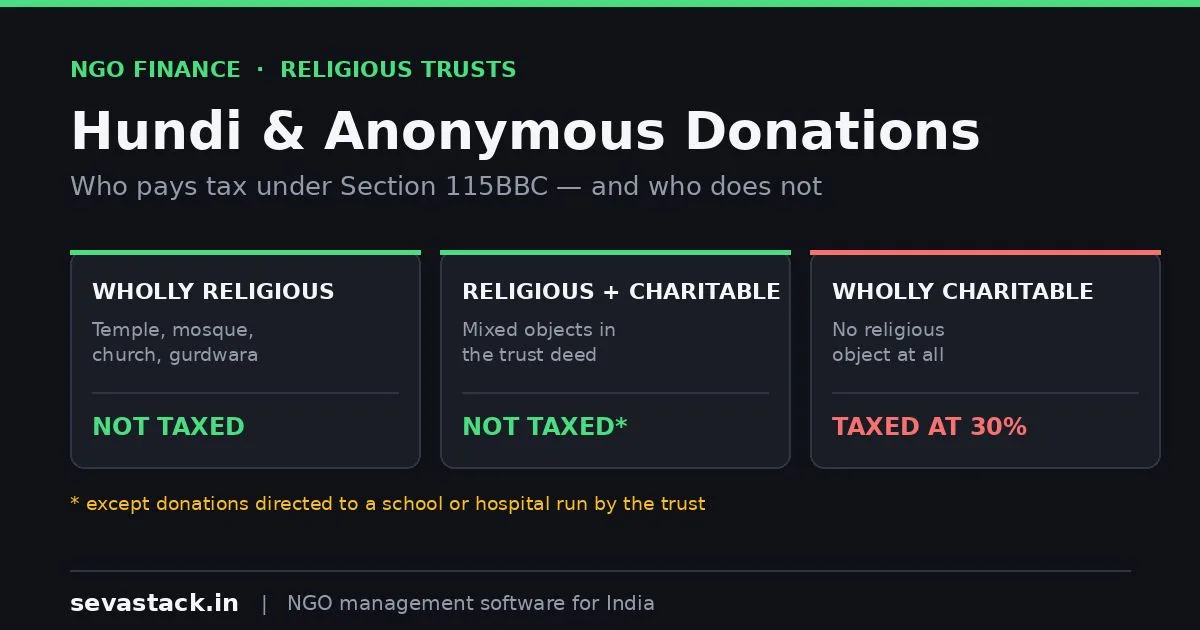
Temple and Religious Trust Accounting: A Practical Guide
Hundi collections, anonymous donations and Section 115BBC explained. Why wholly religious trusts are treated differently, and how to record offerings.
Fundraising
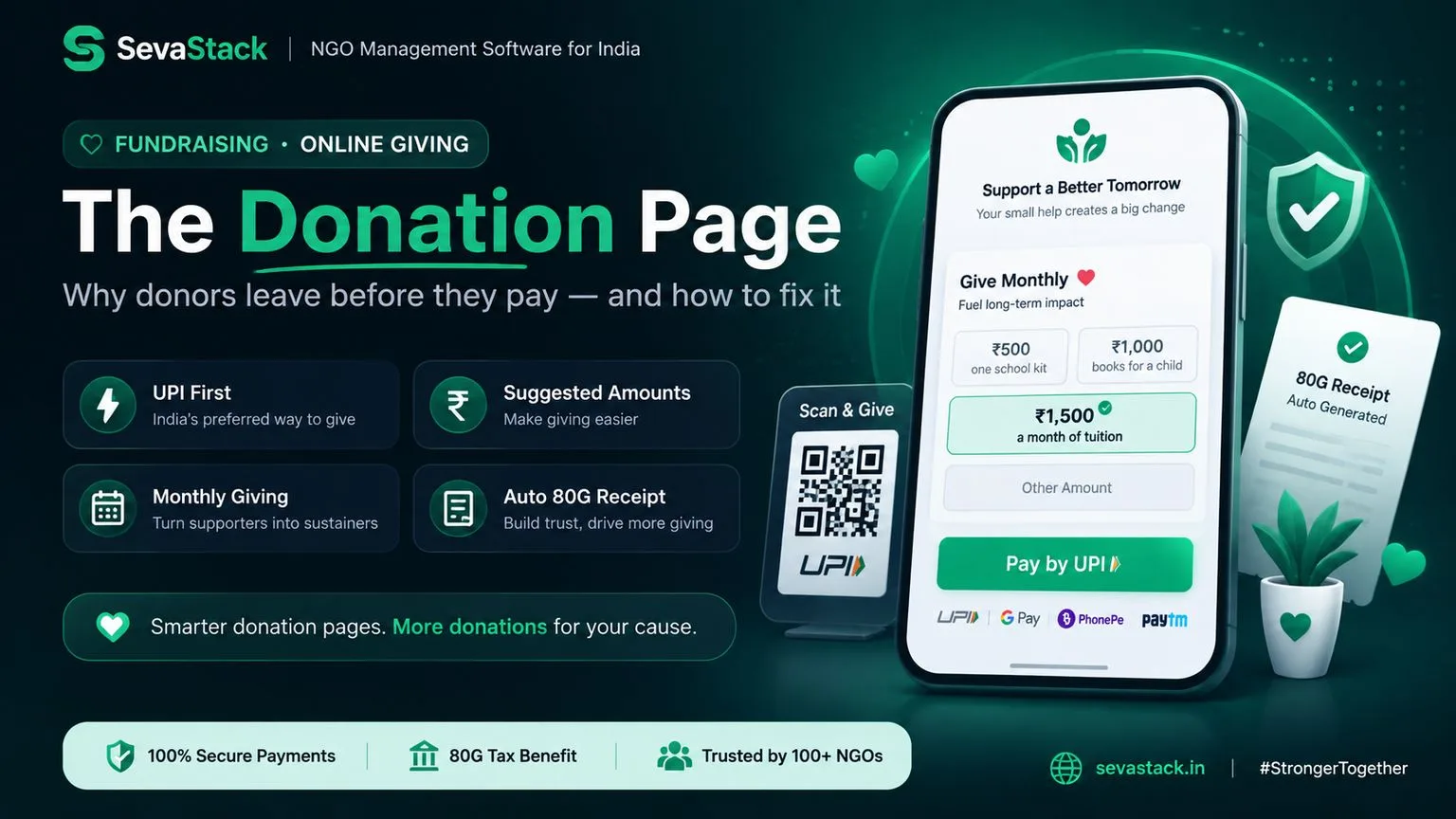
How to Build a Donation Page That Actually Gets Donations
Most NGO donation pages lose donors before they pay. Here is what to fix: UPI, mobile speed, suggested amounts, PAN collection and instant 80G receipts.

Fundraising
Daan Utsav 2026: A Simple Campaign Plan for Small NGOs
Daan Utsav runs 2-8 October 2026. Here is a simple week-by-week plan any small NGO can follow, with campaign ideas and a day-by-day schedule.
Never miss a filing date
Sevastack keeps your NGO's compliance calendar and reminds you by email and WhatsApp before each return is due. Donors, 80G receipts and accounts sit in the same place.