

NGO Accounting in India (2026): The Complete Guide to Fund Accounting, 80G, FCRA & Financial Management
Learn everything about NGO accounting in India—from fund accounting and financial statements to 80G, Form 10BD/10BE, FCRA, CSR grants, audits, and accounting best practices for trusts, societies, and
Vivek Bhos
Updated 8 min read
Form FC-4 statutory due date31/12/2026
Statutory due date
Running an NGO is about changing lives.
Whether you're educating children, supporting women, providing healthcare, protecting the environment, or empowering rural communities, every rupee you receive represents someone's trust.
That trust comes from donors, CSR partners, government agencies, foundations, volunteers, and the communities you serve.
Maintaining that trust requires one critical foundation:
Transparent and accurate accounting.
Unlike traditional businesses, NGOs do not exist to maximize profits. Instead, they manage donations, grants, CSR funding, corpus funds, government assistance, and foreign contributions—each with different legal, financial, and reporting requirements.
Poor accounting can result in:
Loss of donor confidence
Rejected CSR proposals
Compliance notices
Failed audits
Difficulty obtaining grants
Operational inefficiencies
Good accounting, on the other hand, enables NGOs to demonstrate transparency, attract funding, simplify audits, and focus more time on creating impact.
This guide explains everything Indian NGOs need to know about accounting—from basic bookkeeping to fund accounting, FCRA, statutory reports, and digital transformation.
What is NGO Accounting?
NGO accounting is the process of recording, organizing, monitoring, and reporting every financial transaction of a non-profit organization while ensuring transparency, accountability, and compliance with Indian regulations.
Unlike commercial businesses, NGOs must demonstrate how money was utilized, not simply how much profit was earned.
For example:
A business asks:
"How much profit did we make?"
An NGO asks:
"Did we utilize donor funds exactly for their intended purpose?"
That difference changes the entire accounting process.
How NGO Accounting Differs from Business Accounting
Business Accounting | NGO Accounting |
|---|---|
Goal is Profit | Goal is Social Impact |
Revenue from Sales | Income from Donations & Grants |
Profit & Loss Statement | Income & Expenditure Statement |
Customers | Beneficiaries |
Shareholders | Donors & Trustees |
Capital Investment | Corpus Fund |
Business Growth | Community Impact |
In NGO accounting, accountability matters more than profitability.
Why Proper NGO Accounting Matters
Many NGOs begin with simple Excel sheets or handwritten cashbooks.
Initially, this may seem sufficient.
But as donations increase, multiple projects begin, CSR partners come onboard, and statutory compliance grows, manual accounting becomes risky.
Proper accounting helps NGOs:
Build donor confidence
Secure CSR funding
Prepare accurate utilization certificates
Complete audits smoothly
File statutory returns on time
Track project expenses
Prevent misuse of restricted funds
Make informed financial decisions
Strong accounting is not just compliance—it is credibility.
Understanding Fund Accounting
One of the biggest differences between NGO accounting and business accounting is Fund Accounting.
Fund accounting ensures that money received for one purpose is never accidentally used for another.
Imagine an NGO receives:
₹20 lakh CSR Grant for Education
₹10 lakh FCRA Donation
₹5 lakh Corpus Donation
₹8 lakh General Donations
Although all the money is in the organization's accounts, each amount belongs to a different purpose.
If the NGO spends education grant money on office renovation, it violates donor restrictions.
Fund accounting prevents this.
Instead of tracking only income and expenses, NGOs track which fund each transaction belongs to.
Types of Funds in an NGO
1. Corpus Fund
Corpus donations are capital contributions meant to strengthen the organization's long-term financial stability.
These funds are generally invested and are not intended for routine operational expenses.
Example:
A donor contributes ₹25 lakh specifically as a permanent corpus.
This amount should remain in the corpus unless governing rules permit otherwise.
2. General Fund
General funds are unrestricted donations.
The NGO can use them for salaries, rent, utilities, administration, and other operational expenses.
Example:
Individual donations collected through the NGO website.
3. Restricted Fund
Some donors specify exactly how their donation must be utilized.
Example:
"This ₹5 lakh must only be used for girls' education."
The NGO must maintain separate records for these funds.
4. Project Fund
Large NGOs often run multiple projects simultaneously.
Each project requires independent budgeting and expense tracking.
Examples:
Water Conservation
Skill Development
Rural Healthcare
Digital Education
Project-wise accounting helps prepare donor reports and utilization certificates.
5. CSR Fund
Corporate Social Responsibility (CSR) grants generally include:
Approved budgets
Project timelines
Reporting requirements
Impact measurements
Utilization certificates
Every expense must be linked to the approved project budget.
6. FCRA Fund
Foreign donations require separate accounting.
Indian NGOs receiving foreign contributions must maintain separate records and comply with applicable FCRA requirements.
Keeping domestic and foreign funds clearly separated simplifies compliance and reporting.
Accounting Methods Used by NGOs
Cash Basis Accounting
Income is recorded only when money is received.
Expenses are recorded only when payments are made.
Simple but less suitable for larger organizations.
Accrual Basis Accounting
Income and expenses are recorded when they arise, regardless of when cash changes hands.
Provides a more accurate financial picture and is commonly used by growing NGOs.
Essential Financial Statements Every NGO Must Prepare
1. Receipts & Payments Account
This summarizes all cash and bank transactions during the financial year.
It includes:
Opening balance
Donations received
Grants received
Expenses paid
Closing balance
2. Income & Expenditure Account
This is similar to a Profit & Loss statement but designed for non-profits.
It includes:
Donation income
Grant income
Interest income
Salaries
Rent
Utilities
Depreciation
The focus is on surplus or deficit—not profit.
3. Balance Sheet
The Balance Sheet provides the financial position of the NGO.
It includes:
Assets
Bank Balance
Cash
Furniture
Computers
Buildings
Investments
Liabilities
Outstanding Expenses
Loans
Security Deposits
Funds
Corpus Fund
General Fund
Restricted Funds
Accounting for Donations
Different types of donations require different treatment.
Cash Donations
Recorded as general donation income unless specifically restricted.
Corpus Donations
Added directly to the Corpus Fund.
In-Kind Donations
Examples:
Hospital Beds
Computers
Furniture
Books
Wheelchairs
Medical Equipment
These should be recorded at a reasonable value and reflected in the organization's asset records where appropriate.
Anonymous Donations
Maintain supporting records and comply with applicable tax provisions.
CSR Grant Accounting
CSR funding usually follows an approved budget.
Proper accounting includes:
Recording the grant received
Mapping expenses to approved budget heads
Tracking unspent balances
Preparing utilization certificates
Sharing progress reports with the corporate partner
Good grant accounting builds long-term partnerships.
FCRA Accounting
NGOs receiving foreign contributions must maintain clear records for those funds and ensure they are used according to the approved purpose.
Typical good practices include:
Maintaining separate accounting records for foreign contributions
Tracking project-wise utilization
Preserving supporting documents
Preparing required reports accurately and on time
80G Receipts
Donors increasingly expect professional digital receipts.
A good 80G receipt typically includes:
NGO Name
Registration Number
Donation Receipt Number
Date
Donor Name
PAN (where applicable)
Donation Amount
Mode of Payment
Purpose (if restricted)
Authorized Signature
Digital receipts improve donor confidence and reduce administrative work.
Form 10BD & Form 10BE
NGOs eligible to issue tax-benefit receipts should maintain accurate donor information throughout the year.
Well-maintained records make annual reporting significantly easier and help avoid last-minute corrections.
Common Accounting Mistakes NGOs Make
Many NGOs unintentionally create compliance risks.
Common issues include:
Mixing Different Funds
Restricted donations should never be mixed with general operational funds.
Using Excel Forever
Spreadsheets work for very small organizations but become difficult to manage as the NGO grows.
Poor Documentation
Every financial transaction should have proper supporting documents.
Missing Bank Reconciliation
Regular reconciliation helps detect errors early.
No Asset Register
Furniture, computers, vehicles, and medical equipment should be tracked systematically.
Delayed Bookkeeping
Recording transactions months later increases the likelihood of mistakes.
Best Practices for NGO Accounting
Successful NGOs typically follow these practices:
Record transactions promptly
Separate funds clearly
Maintain digital copies of documents
Reconcile bank accounts regularly
Track budgets project-wise
Monitor grant utilization
Maintain donor records
Review financial reports every month
Conduct periodic internal reviews
Use accounting software designed for NGOs
Why Many NGOs Are Moving Beyond Excel
As organizations grow, manual processes become increasingly difficult.
Modern cloud-based NGO accounting solutions can help by providing:
Fund accounting
Donor management
Automated receipts
Budget tracking
Project accounting
Audit-ready reports
Fixed asset management
Bank reconciliation
Role-based access
Document management
Collaboration with accountants and auditors
Digital systems reduce manual effort and improve transparency.
Choosing the Right Accounting Software
When evaluating accounting software for your NGO, consider whether it supports:
Fund-wise accounting
Project accounting
Donor management
80G receipt generation
CSR grant tracking
FCRA support
Bank reconciliation
Fixed asset management
Audit-ready financial statements
Cloud access
Role-based permissions
Reporting and dashboards
Selecting software that matches your organization's size and compliance needs can save significant time and reduce errors.
Frequently Asked Questions
Can NGOs use Tally?
Yes. Many NGOs use Tally for general accounting, but they may require additional processes or tools for specialized NGO workflows depending on their needs.
Can NGOs use Excel?
Very small NGOs may begin with Excel, but as funding sources, projects, and reporting requirements increase, dedicated accounting software becomes more practical.
What is fund accounting?
Fund accounting tracks money separately based on its purpose, ensuring restricted funds are used only for approved activities.
Is NGO accounting different from company accounting?
Yes. NGO accounting focuses on accountability, donor reporting, restricted funds, grants, and compliance rather than profitability.
Why is donor management important?
Accurate donor records support communication, transparency, tax-benefit documentation, reporting, and long-term fundraising.
Final Thoughts
Great NGOs are built on trust.
Every donation—whether ₹100 from an individual, a CSR grant from a corporation, or a contribution from a philanthropic foundation—represents confidence in your mission.
Transparent accounting is how you honor that confidence.
When your books are accurate, your funds are clearly tracked, and your financial reports are reliable, you don't just satisfy auditors—you build stronger relationships with donors, attract more funding opportunities, and create a foundation for long-term impact.
As India's non-profit sector continues to embrace digital transformation, investing in strong accounting systems and disciplined financial practices is no longer optional—it's essential for sustainable growth and greater social impact.
New law, same rule. From 1 April 2026 the Income-tax Act, 2025 replaced the Income-tax Act, 1961. Form 10BD is now filed as Form 113 under Section 354(1). Only the number changed, not what you have to do. People still say "Form 10BD", so we use it here too. Filing close to the change-over? Check the form with your CA.
Vivek Bhos
Written by the Sevastack team, who build and maintain the 80G receipt, FCRA, and Form 10BD/10BE automation used by Indian NGOs on the platform every day. Compliance guidance is reviewed against current Income Tax Act and FCRA rules before publishing.
Read next
Finance
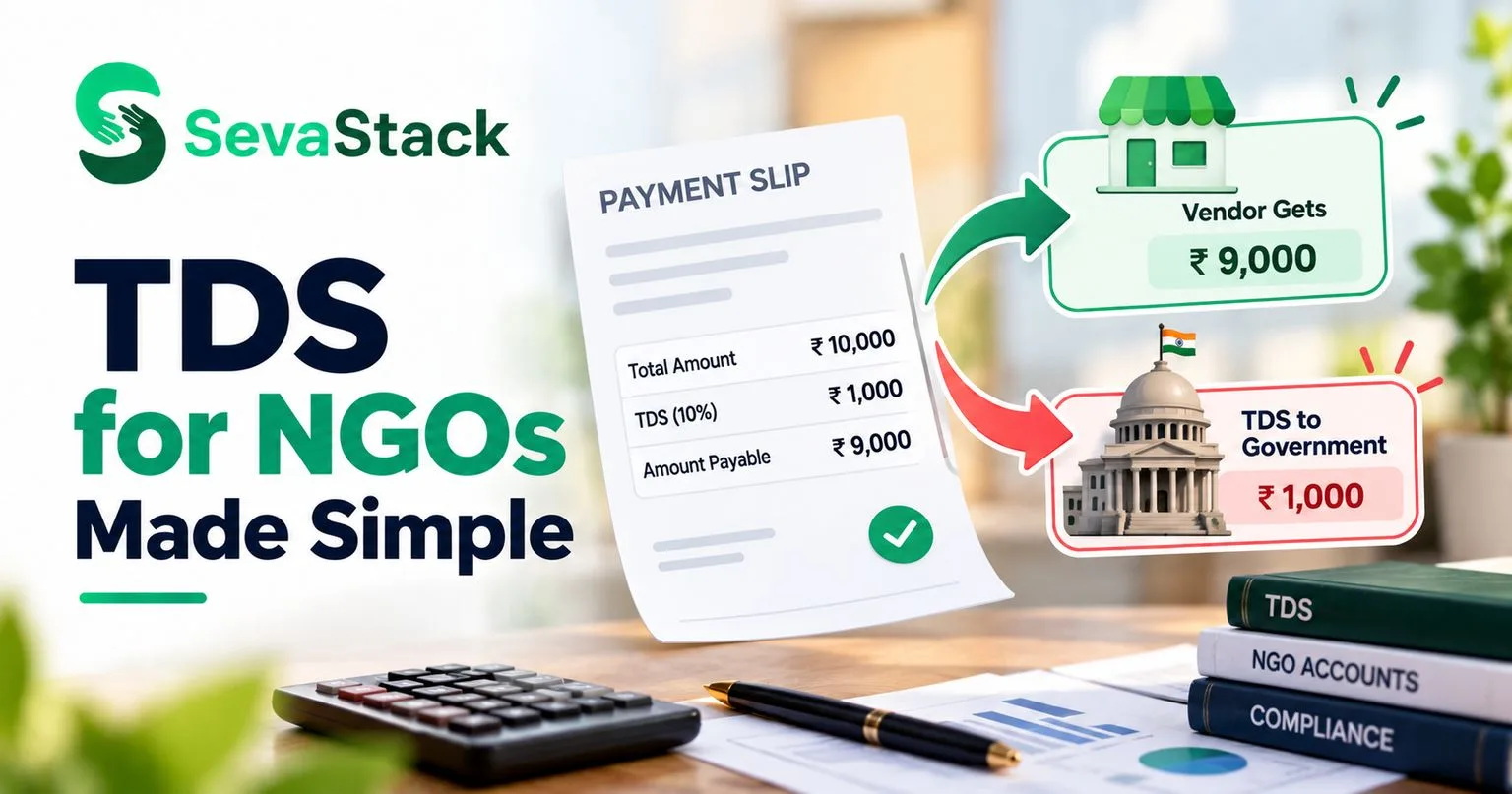
TDS on Vendor Payments: A Simple Guide for NGOs (2026)
Does your NGO need to cut TDS when paying vendors, contractors or professionals? A simple 2026 guide with rates, limits, due dates and mistakes to avoid.

Finance
Payment Gateway Charges: How NGOs Should Record Them
Online donation reached your bank with some money cut? Learn in simple words how NGOs should record payment gateway charges, with an easy example.

Finance
Receipts and Payments Account: A Simple Guide for NGOs
What is a Receipts and Payments Account? Learn in simple words how NGOs prepare it, how it differs from Income and Expenditure, with an easy example.
Never miss a filing date
Sevastack keeps your NGO's compliance calendar and reminds you by email and WhatsApp before each return is due. Donors, 80G receipts and accounts sit in the same place.