

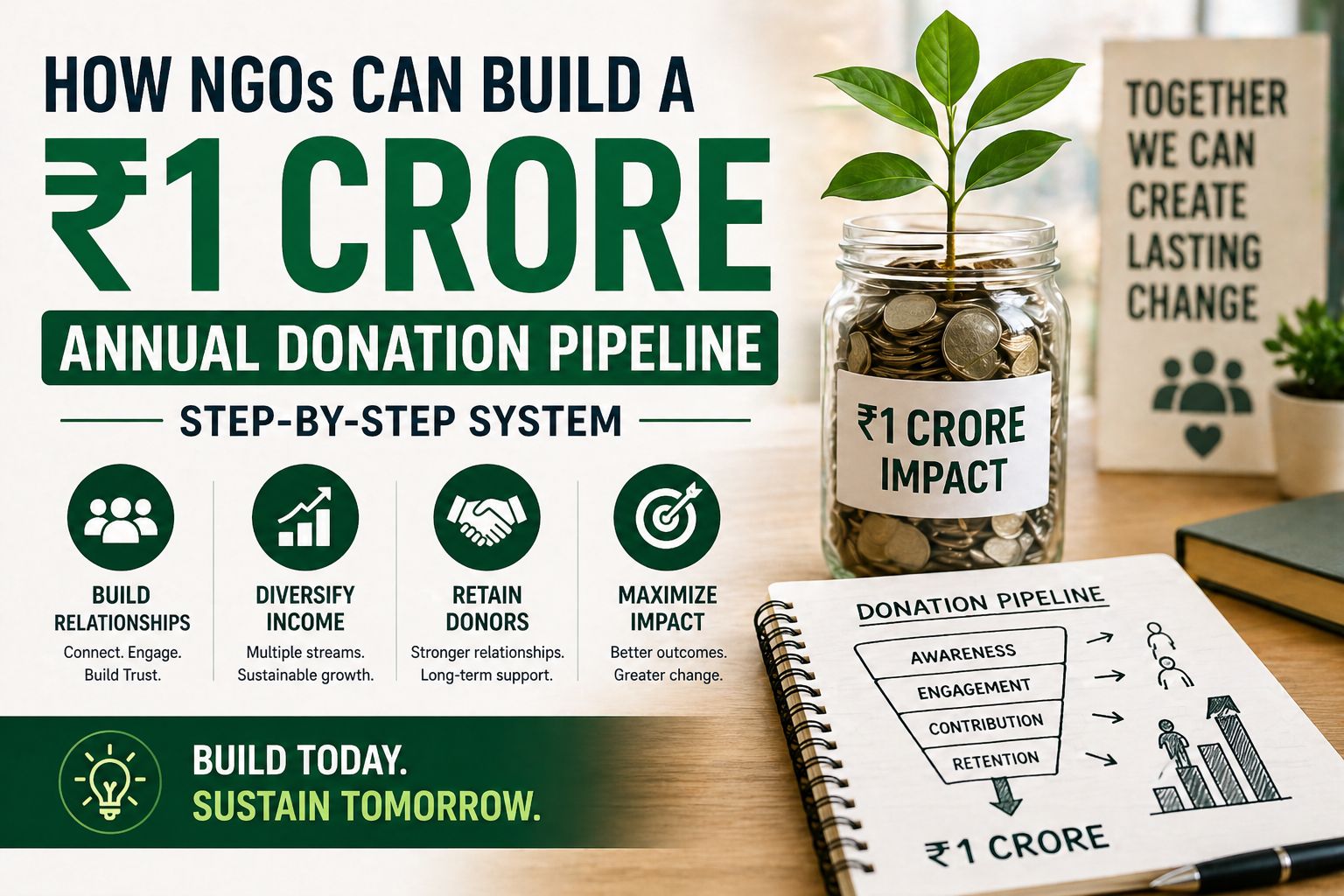
How NGOs Can Build a ₹1 Crore Annual Donation Pipeline (Step-by-Step System)
Learn how NGOs in India can build a ₹1 crore annual donation pipeline with a structured system for fundraising, donor retention, and scaling impact.
Vivek Bhos
Updated 4 min read
Every NGO wants to raise more funds.
But very few have a system to do it consistently.
Most fundraising efforts look like this:
Campaigns launched randomly
Donations come in bursts
No predictable income
Constant pressure to find new donors
And that’s the real problem.
👉 Fundraising is being treated as an activity, not a system.
If you want to reach ₹1 crore annually, you don’t need luck.
You need structure.
What is a Donation Pipeline?
A donation pipeline is a system that ensures:
A steady flow of donors
Regular engagement
Predictable income
Instead of asking:
“Where will the next donation come from?”
You know:
👉 Who is likely to donate
👉 When they will donate
👉 How much they may give
The Reality: Why Most NGOs Don’t Scale Fundraising
Before building a system, understand what’s going wrong.
Most NGOs:
Focus only on new donors
Ignore existing donors
Don’t track donor data
Have no follow-up process
Rely on manual methods
This leads to:
Donor drop-off
Inconsistent income
Missed opportunities
Step-by-Step System to Build a ₹1 Crore Pipeline
Step 1: Set a Clear Target
₹1 crore sounds big, but break it down:
Example:
100 donors × ₹1,00,000
1,000 donors × ₹10,000
5,000 donors × ₹2,000
👉 Different combinations can reach the same goal.
Decide your strategy based on your capacity.
Step 2: Build Donor Segments
Not all donors are the same.
Create categories:
Small donors (₹500–₹5,000)
Mid-level donors (₹5,000–₹50,000)
Large donors (₹50,000+)
Each group needs a different approach.
Step 3: Create a Monthly Fundraising Plan
Instead of random campaigns:
Plan:
Monthly campaigns
Quarterly drives
Annual flagship campaigns
This creates consistency.
Step 4: Focus on Donor Retention First
This is where most NGOs lose money.
It is easier to retain a donor than acquire a new one.
Build a simple system:
Thank every donor
Send regular updates
Share impact stories
Stay in touch
👉 Retention increases lifetime value.
Step 5: Build a Strong Outreach System
To grow, you need new donors too.
Use:
Social media campaigns
CSR outreach
Referral networks
Partnerships
But do it systematically.
Track:
Who you contacted
Follow-ups
Responses
Step 6: Introduce Recurring Donations
This is critical for scaling.
Instead of one-time donations:
Encourage:
Monthly giving
Subscription-based support
Even 500 donors giving ₹500/month = ₹30 lakhs/year.
👉 This creates stability.
Step 7: Track Everything
You cannot scale what you don’t track.
Maintain:
Donor database
Donation history
Follow-up status
Campaign performance
This helps you make better decisions.
Step 8: Build Trust Through Transparency
Donors give again when they trust you.
Show:
Where funds are used
Real impact
Clear reporting
👉 Transparency increases repeat donations.
Step 9: Strengthen CSR Pipeline
CSR funding can contribute significantly.
Build a system to:
Identify companies
Send structured proposals
Track outreach
Manage partnerships
Even 2–3 CSR projects can contribute a large portion.
Step 10: Build a Simple Tech System
Manual systems don’t scale.
At some point:
Excel breaks
Data gets lost
Follow-ups are missed
You need a platform that:
Tracks donors
Manages campaigns
Handles communication
Maintains compliance
What a ₹1 Crore Pipeline Looks Like
When done right:
You know your top donors
Campaigns are planned
Income is predictable
Donor relationships are strong
Fundraising becomes less stressful and more structured.
Common Mistakes to Avoid
Only focusing on new donors
No follow-up system
Poor communication after donation
No donor segmentation
Lack of tracking
These mistakes limit growth.
How SevaStack Helps Build This System
Most NGOs struggle not because of effort, but because of lack of structure.
SevaStack helps by:
Managing donor data in one place
Tracking campaigns
Sending updates
Generating receipts
Keeping everything organized
It helps turn fundraising into a system, not guesswork.
Final Thoughts
Raising ₹1 crore is not unrealistic.
But it doesn’t happen through random efforts.
It happens when:
You build a pipeline
You retain donors
You track consistently
You stay structured
Once the system is in place, growth becomes much easier.
Vivek Bhos
Written by the Sevastack team, who build and maintain the 80G receipt, FCRA, and Form 10BD/10BE automation used by Indian NGOs on the platform every day. Compliance guidance is reviewed against current Income Tax Act and FCRA rules before publishing.
Read next
Fundraising
Diwali Fundraising for NGOs: A Simple 3-Week Campaign Plan
Diwali is on 8 November. Here is a simple 3-week plan for Indian NGOs to run a Diwali fundraising campaign, with ideas, messages and a daily checklist.
Fundraising
After Daan Utsav: How to Thank and Keep Your New Donors
Daan Utsav is over, but your work is not. Learn simple ways to thank new donors, share your impact and keep them giving all year.
Fundraising
Best Fundraising Platforms for NGOs in India (2026)
Ketto, Milaap, GiveIndia, Donatekart and more. A simple guide to the best fundraising platforms for NGOs in India in 2026, with fees and tips.
Never miss a filing date
Sevastack keeps your NGO's compliance calendar and reminds you by email and WhatsApp before each return is due. Donors, 80G receipts and accounts sit in the same place.