

ITR-7 Due Date Extended to 21 November: What NGOs Must Do
CBDT has extended the ITR-7 due date to 21 November 2026 and the audit report date to 21 October. Here is what your NGO should do now, step by step.
Vivek Bhos
5 min read
ITR-7 statutory due date31/10/2026
Statutory due date

Good news for NGOs: you have 21 more days
If your NGO was rushing to finish its audit before 30 September, you can relax a little. The Central Board of Direct Taxes (CBDT) has given extra time to all taxpayers whose accounts need an audit. This includes most registered trusts, societies and Section 8 companies that file ITR-7.
Here are the new dates for AY 2026-27 (that is, the financial year 1 April 2025 to 31 March 2026):
What you file | Old due date | New due date |
|---|---|---|
Audit report (Form 10B or Form 10BB) | 30 September 2026 | 21 October 2026 |
Income tax return (ITR-7) | 31 October 2026 | 21 November 2026 |
That is 21 extra days for each. But remember, these are two different deadlines. The audit report comes first. The return comes after.
Why did CBDT give more time?
Tax professionals and business groups asked for more time. They pointed to late release of ITR forms, more reporting work, and problems on the e-filing portal like login issues and digital signature errors. CBDT agreed and moved the dates.
For NGOs, this is helpful because the audit of a trust is not a small job. Your CA has to check receipts, donations, how much money you spent on your objects, and much more.
Does this extension apply to my NGO?
It applies to your NGO if your accounts need to be audited under the Income-tax Act. Most registered NGOs fall in this group. If your NGO is registered under Section 12A or 12AB and its total income (before claiming exemption) is more than the basic exemption limit, your accounts must be audited.
If your NGO is very small and did not need an audit, this extension may not apply to you. Please check with your CA.
Important: These returns are for FY 2025-26. That year still falls under the old Income-tax Act, 1961. So you will still use the old form names (Form 10B, Form 10BB, ITR-7) for this filing. The new Income-tax Act, which came in on 1 April 2026, applies to the current year.
Form 10B or Form 10BB: which one do you need?
Many NGOs get confused here. Here is the simple rule:
Use Form 10B if any one of these is true:
Your NGO's total income (before exemption) is more than ₹5 crore
Your NGO received any foreign contribution (FCRA money) during the year
Your NGO used any of its income outside India
Use Form 10BB if none of the above is true. Most small and medium NGOs will use Form 10BB.
Your CA fills and uploads this form on the income tax portal. Then your NGO has to accept it from its own login.
What your NGO should do now: a simple checklist
Step 1: Talk to your CA this week.
Do not wait till 20 October. CAs are very busy in this season. Ask them when they can finish your audit and fix a date.
Step 2: Close your books for FY 2025-26.
Make sure all income and expenses for April 2025 to March 2026 are entered. Check your bank statements match your books.
Step 3: Collect your documents.
Keep these ready for your CA:
Bank statements for all accounts
Donation receipts and your donor list
Form 10BD filing details (your donation statement)
Bills and vouchers for expenses
Salary and TDS records
FCRA account details, if you have foreign funds
Details of any fixed deposits or investments
Your 12A/12AB and 80G registration certificates
Step 4: Check the 85% rule.
A registered NGO must spend at least 85% of its income on its objects during the year. If you spent less, you may need to accumulate the balance (using Form 10) or explain it. Ask your CA to check this early, because fixing it later is harder.
Step 5: Get the audit report uploaded by 21 October.
Once your CA uploads Form 10B or 10BB, log in to the income tax portal and accept it. Many NGOs forget this last step.
Step 6: File ITR-7 by 21 November.
After the audit report is filed, your CA will prepare ITR-7. Check the numbers, then file and verify it (with a digital signature or EVC).
What happens if you miss the deadline?
Missing these dates can cause real trouble for an NGO:
Late fee under Section 234F for a late return.
Loss of exemption. If the audit report is not filed on time, your NGO may not get the tax exemption for that year. This means your NGO might have to pay tax on its income, like a normal business.
Problems with 12AB and 80G. Repeated late filings can create issues when you renew your registration.
So treat 21 October as a firm date, not a flexible one.
Common mistakes to avoid
Mixing up the two dates. 21 October is for the audit report. 21 November is for ITR-7. They are not the same.
Forgetting to accept the audit report. Your CA uploads it, but your NGO must accept it from its own login.
Different numbers in the audit report and the ITR. The figures must match. If they don't, you may get a notice.
Leaving it to the last week. The portal gets very slow near deadlines. File early.
How Sevastack helps
If your NGO keeps its accounts, donations and receipts in Sevastack, your CA can get most of what they need in a few clicks. You can download your donation reports, income and expense summary and donor list, and share them directly. This saves many days of back-and-forth during audit season.
Quick summary
Audit report (Form 10B / 10BB): now due 21 October 2026
ITR-7: now due 21 November 2026
Applies to NGOs whose accounts need audit
This filing is for FY 2025-26, under the old Income-tax Act
Talk to your CA now and do not wait for the last week
Note: This post gives general information only. Please confirm details for your NGO with your Chartered Accountant.
Vivek Bhos
Written by the Sevastack team, who build and maintain the 80G receipt, FCRA, and Form 10BD/10BE automation used by Indian NGOs on the platform every day. Compliance guidance is reviewed against current Income Tax Act and FCRA rules before publishing.
Read next
Compliance
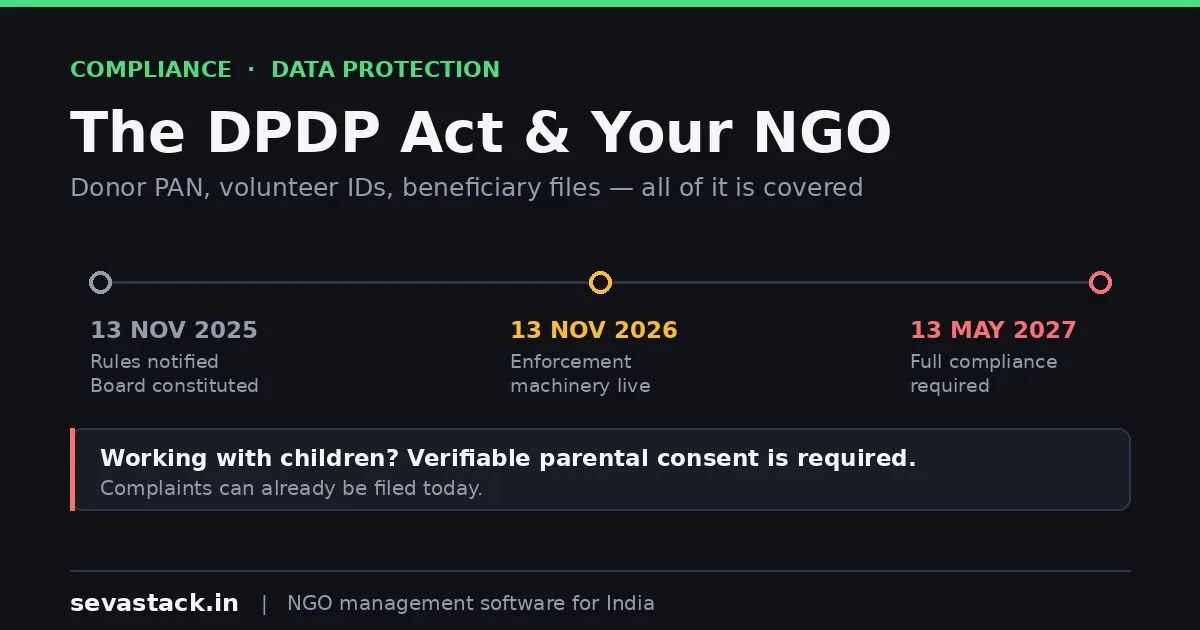
DPDP Act for NGOs in India: A Simple Compliance Guide
Your NGO holds donor PAN, phone numbers and beneficiary records. India's data protection law now covers all of it. Here is what to do, and by when.
Compliance
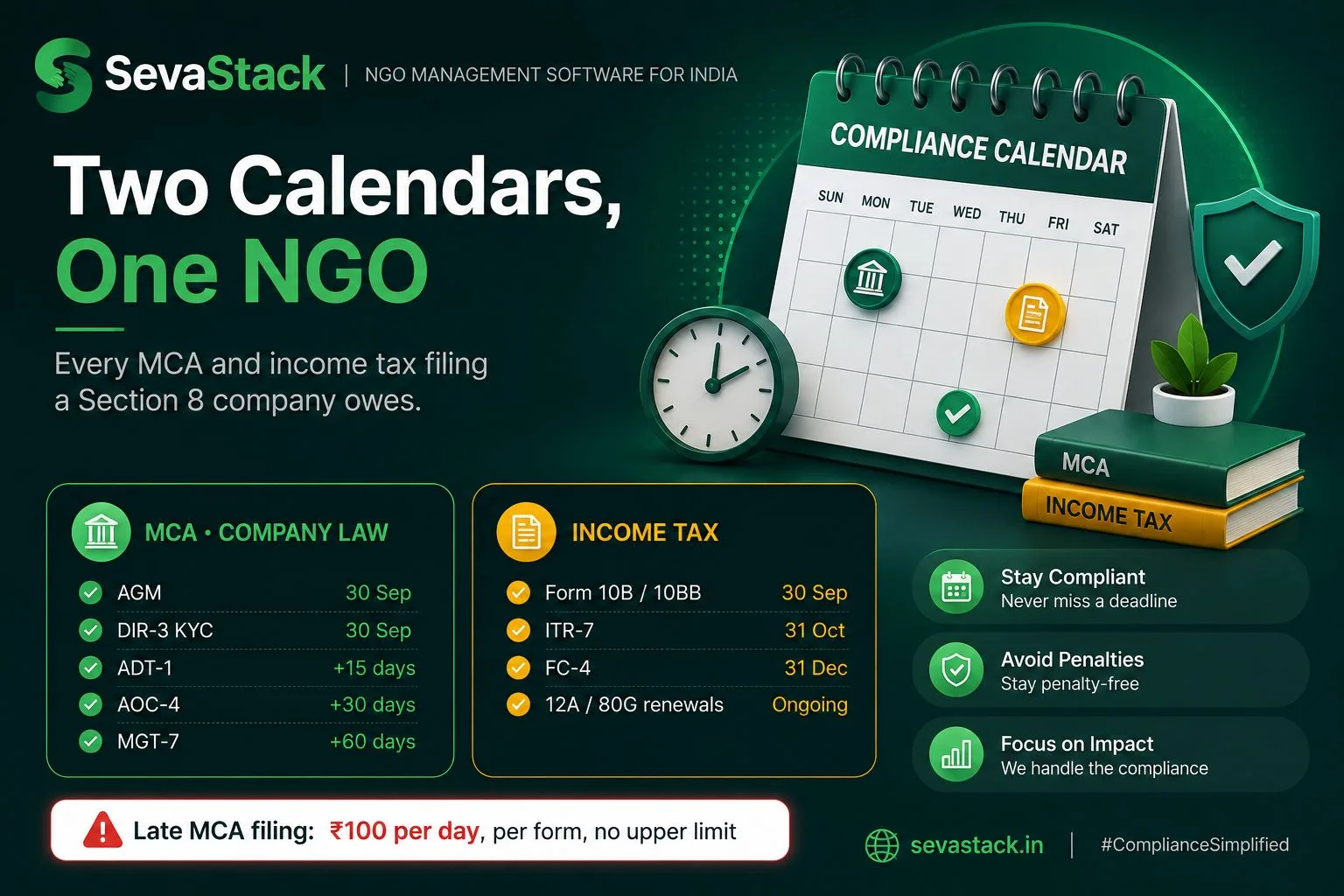
Section 8 Company Compliance: Every Filing and Due Date
Section 8 companies have two separate compliance calendars. Here is every MCA and income tax filing, the due dates, and what late filing costs you.
Compliance
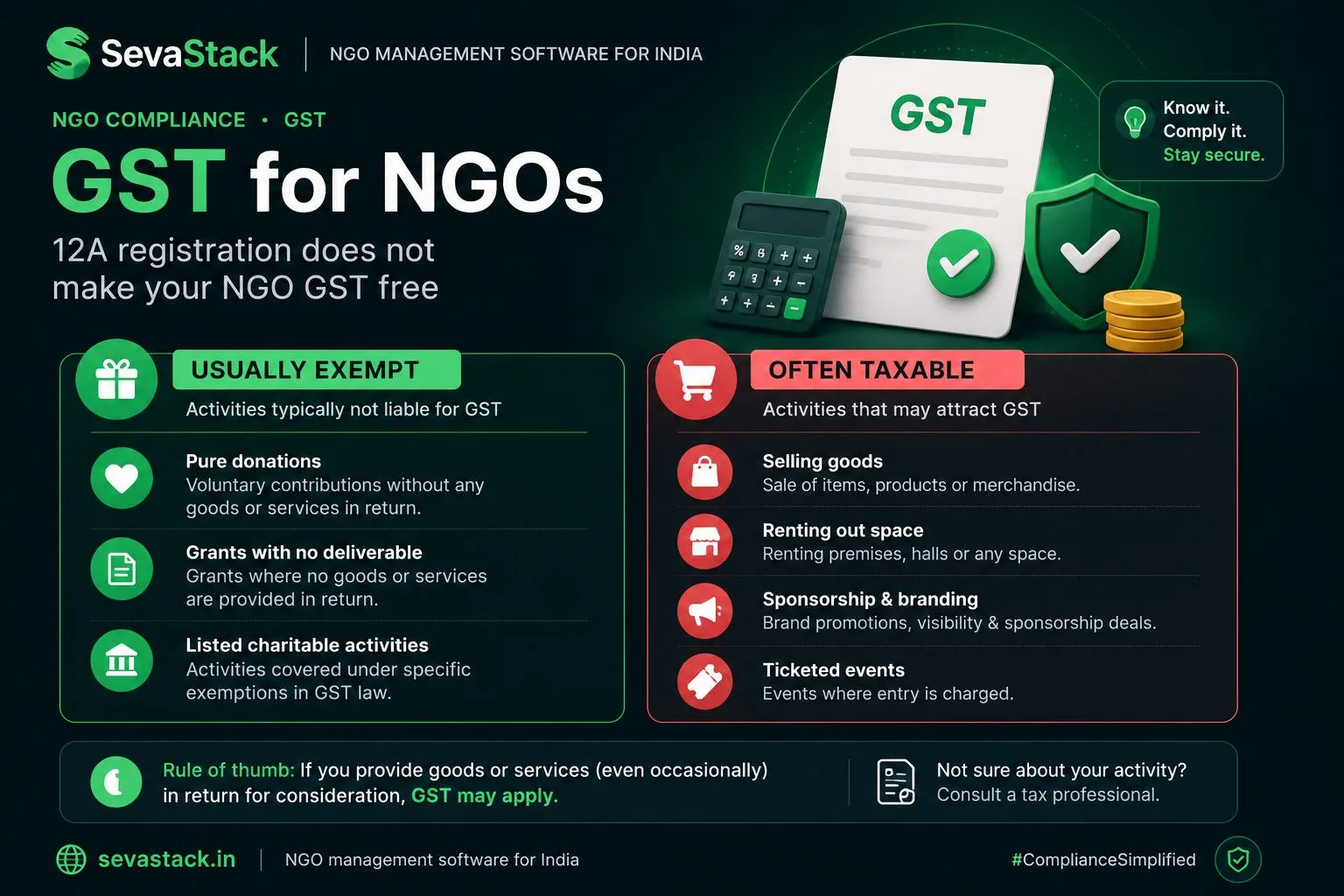
GST for NGOs in India: When Do You Actually Have to Pay?
Having 12A registration does not make your NGO GST free. Learn when GST applies, what counts as a charitable activity, and when you must register.
Never miss a filing date
Sevastack keeps your NGO's compliance calendar and reminds you by email and WhatsApp before each return is due. Donors, 80G receipts and accounts sit in the same place.