

Section 8 Company Compliance: Every Filing and Due Date
Section 8 companies have two separate compliance calendars. Here is every MCA and income tax filing, the due dates, and what late filing costs you.
Vivek Bhos
8 min read
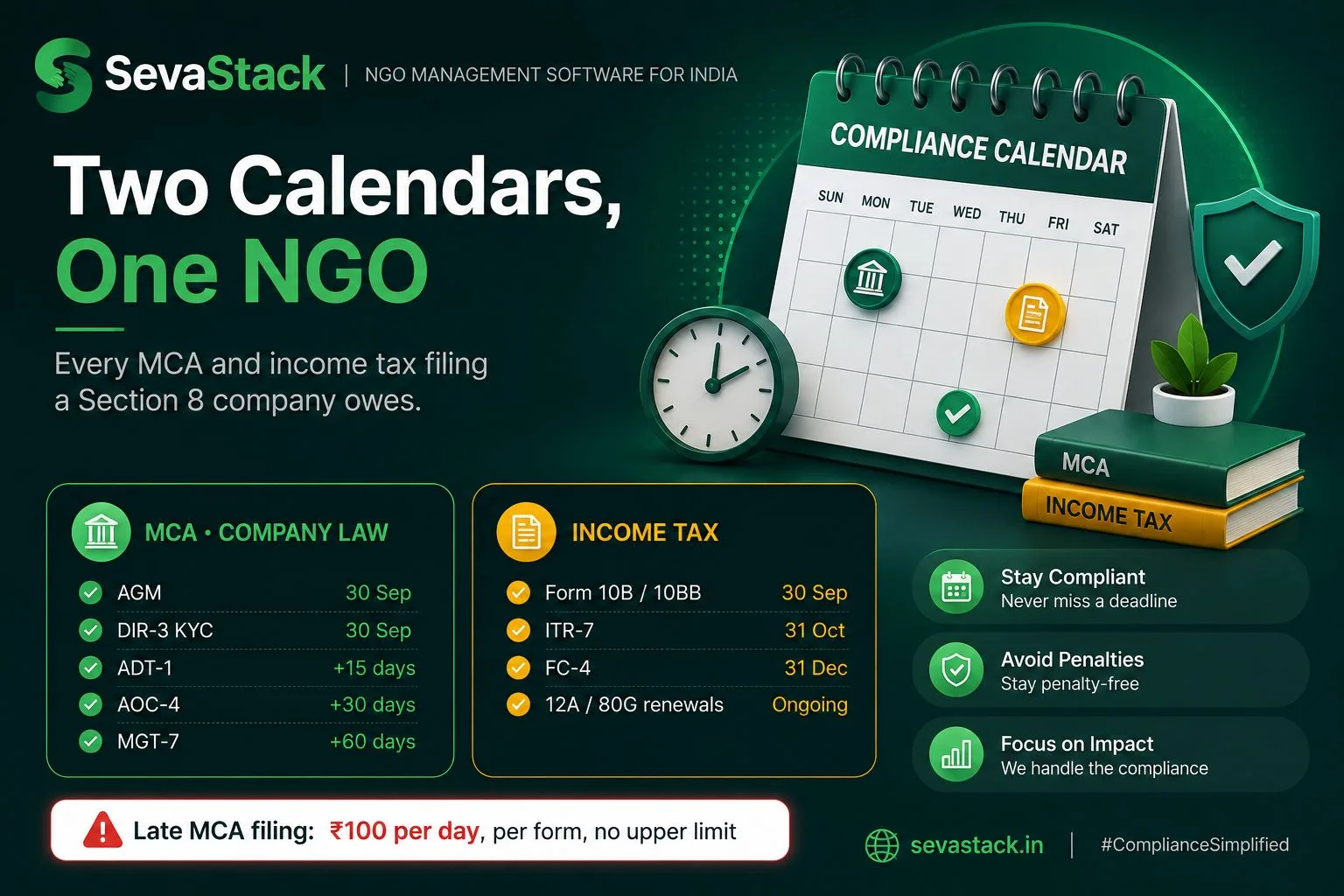
If your NGO is a Section 8 company, you have a problem that trusts and societies do not.
You have to satisfy two different departments, running two different calendars.
The Ministry of Corporate Affairs wants your AGM, AOC-4, MGT-7, ADT-1 and director KYC. The Income Tax Department wants your audit report and ITR-7. Neither knows or cares what you filed with the other.
Miss the tax filings and you risk your exemption. Miss the MCA filings and the penalty runs at ₹100 per day, per form, with no upper limit.
Most Section 8 NGOs track one calendar carefully and forget the other exists.
Here is both, in one place.
Quick summary — FY 2025-26
Filing | What it is | Due date |
|---|---|---|
AGM | Annual General Meeting | 30 September 2026 |
DIR-3 KYC | KYC for every director | 30 September 2026 |
Form 10B / 10BB | Income tax audit report | 30 September 2026 |
ADT-1 | Auditor appointment | Within 15 days of AGM |
AOC-4 | Financial statements | Within 30 days of AGM |
ITR-7 | Income tax return | 31 October 2026 |
MGT-7 | Annual return | Within 60 days of AGM |
If your AGM is on 30 September 2026: ADT-1 by 15 October, AOC-4 by 29 October, MGT-7 by 29 November.
First, a warning most founders get wrong
A Section 8 company is never a "small company."
The Companies Act specifically excludes Section 8 companies from small company status — no matter how tiny your turnover or paid-up capital.
Two consequences:
You file the full MGT-7, not the simplified MGT-7A that small companies use
You must prepare a cash flow statement, which a private company your size would be exempt from
If someone has been filing MGT-7A for your organisation, that needs correcting.
Second warning: audit is mandatory regardless of size. There is no turnover threshold. A Section 8 company with ₹4 lakh of receipts needs a statutory auditor exactly like one with ₹40 crore.
Track 1: MCA compliance
The AGM — 30 September
Your Annual General Meeting must be held within six months of the financial year ending. For FY 2025-26, that means by 30 September 2026.
Everything else flows from this date. Hold the AGM late and every subsequent deadline moves with it — but the penalty clock does not care why.
Before the AGM you need audited financial statements, the auditor's report, and the Director's Report under Section 134.
DIR-3 KYC — 30 September
Every director holding a DIN must complete KYC annually by 30 September.
Do this one first. Here is why: if any director's KYC has lapsed, the MCA portal blocks your AOC-4 filing. People discover this on day 28 of a 30-day window, with a director travelling and unreachable.
Late DIR-3 KYC means a ₹5,000 penalty and the DIN gets deactivated until it is fixed.
ADT-1 — within 15 days of AGM
Intimation of your auditor's appointment. Usually filed for a five-year term, so in most years this is only needed when the appointment or reappointment happens. Do not assume it does not apply — check.
AOC-4 — within 30 days of AGM
Your financial statements: balance sheet, profit and loss account, cash flow statement, auditor's report and Director's Report.
MGT-7 — within 60 days of AGM
Your annual return. Registered office, activities, directors and members, meetings held, changes during the year.
Board meetings
Section 8 companies get a genuine relaxation here. Where most companies must hold four board meetings a year, a Section 8 company needs at least one every six months.
So: minimum two per year, one in each half. Keep proper minutes — auditors and funders both ask for them.
Track 2: Income tax compliance
This runs completely separately, with the Income Tax Department.
Form 10B or 10BB — 30 September
Your audit report under the income tax rules, if you have 12A registration. Which form you file depends on your income, foreign funding and overseas spending — not on your registration section.
Full explanation of which form applies here.
ITR-7 — 31 October
A point of genuine confusion: you will see both ITR-6 and ITR-7 mentioned online for Section 8 companies. Here is the distinction.
Registered under 12A/12AB? File ITR-7
Not registered under 12A? You are taxed as a normal company and file ITR-6
The overwhelming majority of Section 8 NGOs have 12A registration and file ITR-7. Confirm yours with your CA rather than following a generic article.
Keeping 12A and 80G alive
These now run on renewal cycles rather than lasting forever. Check the expiry dates on your certificates and diarise the renewal application, which must go in well before expiry.
The 85% rule still applies
Being a company changes nothing about the income tax requirement to apply 85% of income towards your objects. The 85% rule explained simply.
If you also have FCRA or CSR
FCRA: Form FC-4 annual return by 31 December, even if you received nothing. A nil return is compulsory.
CSR-1: Required before you can receive CSR funds from companies. One-time registration, but keep the details current.
What late filing costs
Missed filing | Consequence |
|---|---|
AOC-4 late | ₹100 per day, no upper limit |
MGT-7 late | ₹100 per day, no upper limit |
DIR-3 KYC late | ₹5,000 and DIN deactivated |
Form 10B / 10BB late or wrong | Tax exemption can be denied |
ITR-7 late | Fee, interest, and exemption risk |
FC-4 late | Penalty; repeated default risks registration |
Understand the ₹100 per day figure properly. It is per form, and it does not stop. Two forms left unfiled for a year is roughly ₹73,000 — money taken straight out of programme funding.
And there is a bigger risk. Under the Companies Act, serious non-compliance by a Section 8 company can attract penalties measured in lakhs on the company and on officers personally, and in the worst cases the Section 8 licence itself can be revoked.
One more thing worth knowing: the concessions Section 8 companies enjoy under various MCA notifications do not extend to AOC-4, MGT-7 or ITR-7. Full penalties apply. And a company already in default on its annual filings can lose the benefit of those concessions entirely.
Your compliance checklist
By 30 September:
☐ DIR-3 KYC completed for every director — do this first
☐ Statutory audit finished, auditor's report signed
☐ Director's Report prepared under Section 134
☐ AGM held, minutes recorded
☐ Form 10B or 10BB filed and accepted on the income tax portal
October and November:
☐ ADT-1 filed within 15 days of AGM
☐ AOC-4 filed within 30 days of AGM
☐ ITR-7 filed by 31 October
☐ MGT-7 filed within 60 days of AGM
Through the year:
☐ At least two board meetings, one in each half
☐ Statutory registers maintained
☐ Books of accounts current
☐ 12A and 80G renewal dates diarised
☐ FC-4 by 31 December, if FCRA registered
Common questions
We had no activity this year. Do we still file everything? Yes. Every MCA filing is required regardless of activity. So is a nil FC-4 if you hold FCRA registration.
Can we skip the audit if our income is very small? No. Statutory audit under the Companies Act applies to every Section 8 company with no turnover threshold at all.
What if we missed last year's AOC-4? File it now. The ₹100 per day is still running. MCA occasionally opens settlement or amnesty windows with reduced fees — ask your CS whether one is currently available, but do not wait for one.
Is a Company Secretary compulsory? A full-time CS is only required above certain thresholds that most NGOs are well below. But you will need a practising professional to certify and file some forms.
Which is harder overall — Section 8, trust or society? Section 8 has the heaviest compliance load of the three, because you carry company law obligations on top of the tax ones. The trade-off is credibility: corporate and institutional funders often prefer Section 8 companies precisely because the governance is more visible.
Can our directors be paid? Section 8 companies cannot distribute profits to members. Reasonable remuneration for actual services can be permissible, but this is exactly the area regulators examine and where 12A exemption can be jeopardised. Take advice first.
The simple version
Diarise 30 September as your hard deadline. Three things fall on it — AGM, DIR-3 KYC and your income tax audit report — and two more depend on it.
Do the DIR-3 KYC first, because a lapsed director KYC will block your AOC-4 when you have no time left to fix it.
Then work backwards: audit complete by mid-September, board approval, AGM, and the filings follow on schedule instead of in a panic.
Sevastack tracks both your MCA and income tax deadlines in one calendar, keeps your books audit-ready through the year, and gives your CA and CS direct access when filing season arrives. Start free — no credit card needed.
This article is general information, not legal or tax advice. Please confirm your company's position with your Chartered Accountant or Company Secretary.
Related guides
Vivek Bhos
Written by the Sevastack team, who build and maintain the 80G receipt, FCRA, and Form 10BD/10BE automation used by Indian NGOs on the platform every day. Compliance guidance is reviewed against current Income Tax Act and FCRA rules before publishing.
Read next
Compliance
80G Is Now Section 133: What Changes on Your NGO Receipts
Section 80G is now Section 133 under the new Income-tax Act. Learn in simple words what changes for NGO receipts, Form 113 and Form 114, and what stays the same.

Compliance
ITR-7 Due Date Extended to 21 November: What NGOs Must Do
CBDT has extended the ITR-7 due date to 21 November 2026 and the audit report date to 21 October. Here is what your NGO should do now, step by step.
Compliance
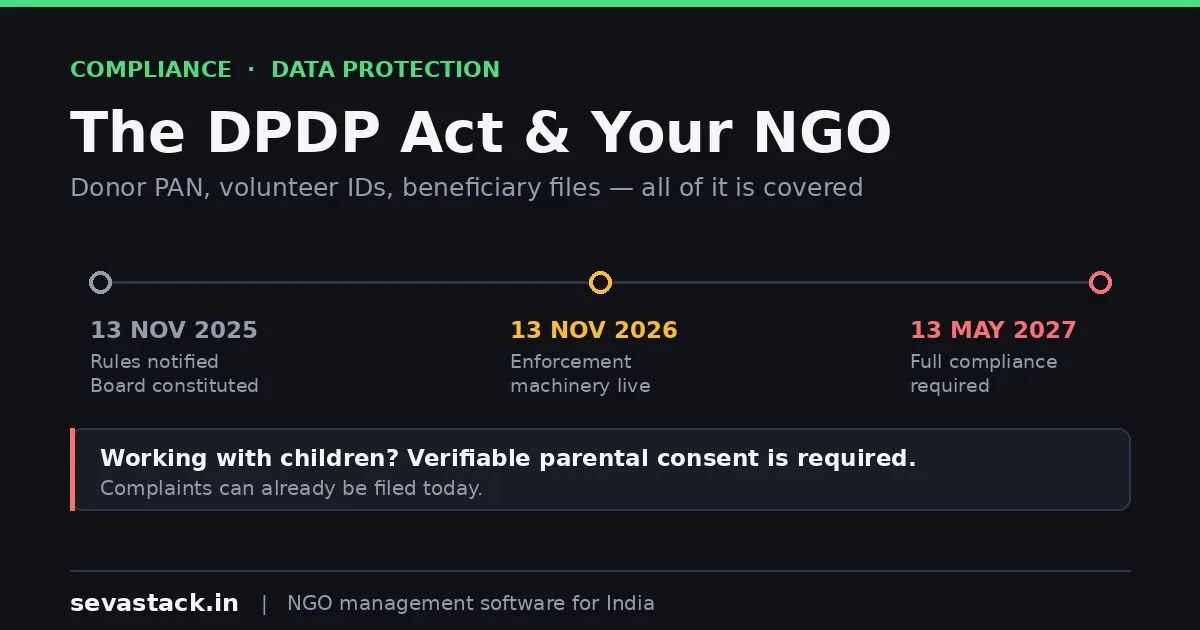
DPDP Act for NGOs in India: A Simple Compliance Guide
Your NGO holds donor PAN, phone numbers and beneficiary records. India's data protection law now covers all of it. Here is what to do, and by when.
Never miss a filing date
Sevastack keeps your NGO's compliance calendar and reminds you by email and WhatsApp before each return is due. Donors, 80G receipts and accounts sit in the same place.