

GST for NGOs in India: When Do You Actually Have to Pay?
Having 12A registration does not make your NGO GST free. Learn when GST applies, what counts as a charitable activity, and when you must register.
Vivek Bhos
8 min read
Ask most NGO trustees about GST and you get the same answer:
"We are a charitable trust with 12A registration. GST does not apply to us."
This is wrong, and it is probably the most expensive misunderstanding in the Indian NGO sector.
Your 12A registration is an income tax exemption. GST is a completely separate law with its own rules — and its own, much narrower, definition of what counts as "charitable."
Many NGOs doing genuinely good work are liable for GST and do not know it.
This guide explains when GST applies, in simple language.
The one thing to understand first
Under income tax law, "charitable purpose" is broad. It covers education, medical relief, relief of the poor, and the advancement of any other object of general public utility.
Under GST law, "charitable activities" is a short, specific list. Only these count:
Activity | Covered? |
|---|---|
Care or counselling of terminally ill people, people with severe disability, people with HIV/AIDS, people with addiction | ✅ Yes |
Advancement of religion, spirituality or yoga | ✅ Yes |
Educational or skill programmes for abandoned, orphaned or homeless children, abused persons, prisoners, or people over 65 in rural areas | ✅ Yes |
Preservation of environment — watershed, forests, wildlife | ✅ Yes |
General school education | ❌ Not on this list |
Women's empowerment programmes | ❌ Not on this list |
Rural development | ❌ Not on this list |
Livelihood and general skill training | ❌ Not on this list |
Look at that second half carefully. Some of the most common NGO activities in India are not on the GST exemption list at all.
That does not automatically mean you owe GST. It means the exemption under this particular entry does not protect you, and you need to look at your actual income sources.
Two conditions for the exemption
To use the charitable activities exemption, both must be true:
Your entity is registered under Section 12AA / 12AB of the Income Tax Act, and
The specific service is one of the charitable activities listed above
Fail either one and that income is outside this exemption.
When must an NGO register for GST?
The basic limit is ₹20 lakh of aggregate turnover in a financial year for services (₹10 lakh in some special category states). For goods it is generally ₹40 lakh.
But here is the trap that catches NGOs.
"Aggregate turnover" includes your exempt income
This is counter-intuitive and it is where NGOs go wrong.
Aggregate turnover is not just your taxable income. It includes exempt supplies too.
Example: Vidya Trust earns ₹22,00,000 a year from exempt charitable services. They also rent out a spare room in their office for ₹30,000 a month — ₹3,60,000 a year.
They assume: "Only ₹3.6 lakh is taxable, well under ₹20 lakh. No registration needed."
Wrong. Aggregate turnover is ₹22,00,000 + ₹3,60,000 = ₹25,60,000. That crosses ₹20 lakh, so registration is required — and the rent becomes taxable.
If your NGO has any commercial income at all, add up everything before deciding you are below the limit.
You may have to register regardless of turnover
Some situations require registration even if you are small — for example where you are liable to pay tax under the reverse charge mechanism. More on that below.
What is usually NOT taxable
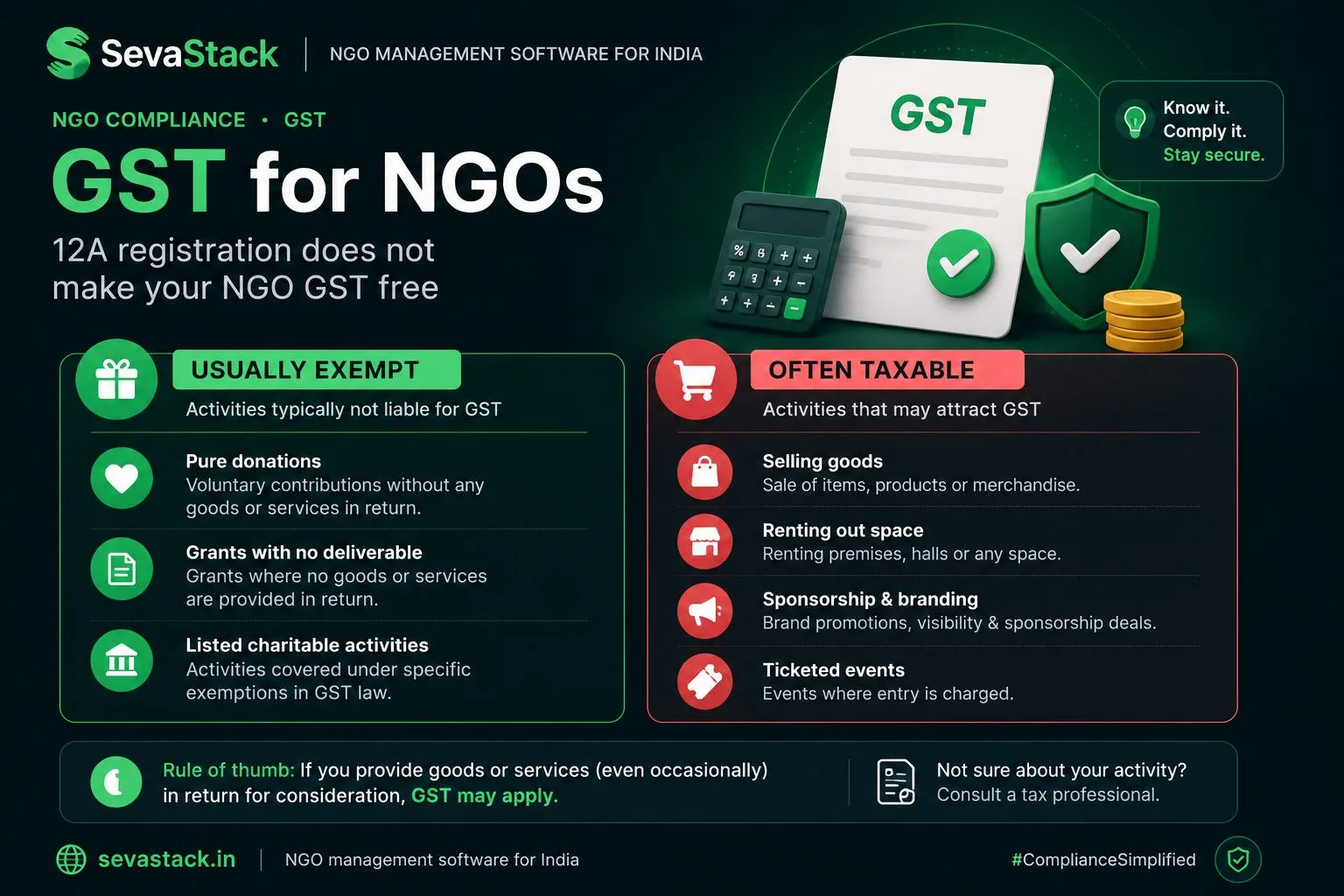
Pure donations. A donor gives money and gets nothing in return. This is not a supply, so no GST. This covers the majority of most NGOs' income.
Grants with no deliverable. If a funder gives money to support your work generally, with no service coming back to them, GST usually does not apply.
Genuine charitable activities from the list above.
What often IS taxable
This is the list to check yourself against.
1. Donations where the donor gets something back
If a company donates ₹5 lakh and you put their logo on your banners, their name on your building, or give them advertising space — that is not a pure donation. You have supplied a service in return. GST applies.
The test: did the donor receive anything of value? If yes, look again.
2. Sponsorship
Event sponsorship is taxable, and usually under reverse charge — meaning the sponsoring company pays the GST, not you. But you still need to handle it correctly.
3. Selling goods
Products made by your beneficiaries, handicrafts, books, calendars, greeting cards, memorabilia — sale of goods is taxable. There is no charitable exemption for selling things.
Many NGOs run livelihood programmes selling beneficiary-made products. Check this one.
4. Renting out property
Renting your hall, spare office, or rooms for a fee is taxable.
There is a narrow exemption for religious places owned by a registered charitable trust and meant for the general public, but only under set limits — broadly, rooms below ₹1,000 per day, a hall or open area below ₹10,000 per day, and shops below ₹10,000 per month. Above those figures, it is taxable.
5. Events, marathons and fundraisers
This one surprises people. Tax authorities have held that conducting a marathon is a separate supply of service to the participants — even where all the money raised goes to charity.
The reasoning: participants paid a registration fee and received an event in return. The good use of the money afterwards does not change what the transaction was.
The same logic can apply to ticketed charity dinners, paid workshops and similar events.
6. Consultancy or training you provide to others
If your NGO provides training, research or advisory services to another organisation for a fee, that is a commercial service. Being an NGO does not exempt it.
7. Reverse charge situations
Under reverse charge, you pay the GST instead of the supplier. Common ones for NGOs:
Legal services from an advocate
Goods transport agency services
Sponsorship received
Certain security services
If reverse charge applies to you, registration may be required regardless of your turnover.
Quick self-check
Go through this honestly:
☐ Do we receive any donation where the donor gets branding, advertising or naming rights?
☐ Do we sell any goods, however small the amount?
☐ Do we rent out any space?
☐ Do we charge fees for events, workshops or programmes?
☐ Do we provide any paid services to other organisations?
☐ Do we pay for legal services, transport or receive sponsorship?
☐ Adding all income together — exempt and taxable — are we above ₹20 lakh?
Two or more ticks means you should sit down with a CA. Not next year — now.
What happens if you should have registered and did not
Tax payable on past supplies, out of your own funds
Interest on the unpaid amount
Penalty
The amount you eventually pay is money that was meant for your beneficiaries
There is a second cost people forget. GST irregularities surface during funder due diligence and CSR partner checks. A company reviewing your last three years before releasing CSR funds will find it.
Common questions
We have 12A and 80G. Are we not automatically GST exempt? No. Those are income tax registrations. GST is a separate law with its own narrower definition of charitable activity.
All our income is donations. Do we need to worry? If they are genuinely pure donations with nothing given in return, you are largely fine. Check whether any donor receives branding or benefits.
We run a school. Are we exempt? Educational institutions have their own separate GST exemption, which is different from the charitable activities entry. Check which one applies to you — do not assume.
We sell products made by the women in our programme. Is that taxable? Sale of goods is taxable. The social purpose behind it does not create an exemption. Get advice on your specific situation.
Can we claim input tax credit? Only against taxable supplies. You cannot claim credit on inputs used for exempt supplies. If you have both, the apportionment rules get complicated — this needs a professional.
Our turnover is ₹18 lakh. Are we safe? Probably, but recheck the figure including exempt income, and confirm no reverse charge situation applies to you.
What are the filing dates if we register? Broadly, GSTR-1 by the 11th and GSTR-3B by the 20th each month, with an annual return by 31 December. Your CA will confirm which returns apply to you.
The honest summary
Most small NGOs living entirely on pure donations will not have a GST problem.
But NGOs that sell products, rent space, run ticketed events, take sponsorship, or give corporate donors visibility in return for money — those NGOs often have a GST liability they have never looked at.
The cost of checking is one conversation with your CA. The cost of not checking compounds every year.
Sevastack separates your donation income from commercial receipts as they come in, so you can see your real GST position at any time instead of discovering it during an audit. Start free — no credit card needed.
This article is general information, not tax advice. GST positions are fact-specific and have been litigated. Please confirm your NGO's position with your Chartered Accountant.
Related guides
New law, same rule. From 1 April 2026 the Income-tax Act, 2025 replaced the Income-tax Act, 1961. Section 12A/12AB is now covered by Section 332. Only the number changed, not what you have to do. People still say "Section 12A/12AB", so we use it here too. Filing close to the change-over? Check the form with your CA.
Vivek Bhos
Written by the Sevastack team, who build and maintain the 80G receipt, FCRA, and Form 10BD/10BE automation used by Indian NGOs on the platform every day. Compliance guidance is reviewed against current Income Tax Act and FCRA rules before publishing.
Read next
Compliance
FCRA Annual Return (FC-4): Step-by-Step Guide for 2026
Got foreign donations? File your FCRA annual return (FC-4) by 31 December 2026. A simple step-by-step guide with documents, mistakes and a checklist.
Compliance
80G Is Now Section 133: What Changes on Your NGO Receipts
Section 80G is now Section 133 under the new Income-tax Act. Learn in simple words what changes for NGO receipts, Form 113 and Form 114, and what stays the same.

Compliance
ITR-7 Due Date Extended to 21 November: What NGOs Must Do
CBDT has extended the ITR-7 due date to 21 November 2026 and the audit report date to 21 October. Here is what your NGO should do now, step by step.
Never miss a filing date
Sevastack keeps your NGO's compliance calendar and reminds you by email and WhatsApp before each return is due. Donors, 80G receipts and accounts sit in the same place.