

Corpus Donations Explained Simply: Rules Every NGO Needs
What is a corpus donation, how is it different from a normal donation, and what happens if you spend it? A simple guide for Indian NGOs with examples.
Vivek Bhos
Updated 8 min read
Think of your NGO's money like a family's money.
Normal donations are like the salary that comes in every month. It is meant to be spent.
Corpus donations are like the family gold. You keep it. You do not sell it to buy vegetables. It stays, and it gives you security.
That is the whole idea of corpus.
The problem is that many NGOs mark money as "corpus" when it is not, or spend corpus money without knowing the rules. Both mistakes are expensive.
This guide explains it in simple words, with one example running through it.
Meet Nav Jeevan Trust
Nav Jeevan Trust runs a small hospital. Last year three people gave them money:
Donor | Amount | What they said |
|---|---|---|
Mr. Sharma | ₹25,00,000 | "This is for your corpus fund. Keep it permanently." — in writing |
A company | ₹10,00,000 | "Use this for your eye camp project" |
Local donors | ₹40,00,000 | Said nothing specific |
Three donations. Three completely different treatments. Let us see why.
The three types of donation
This is the table most NGOs need on their wall.
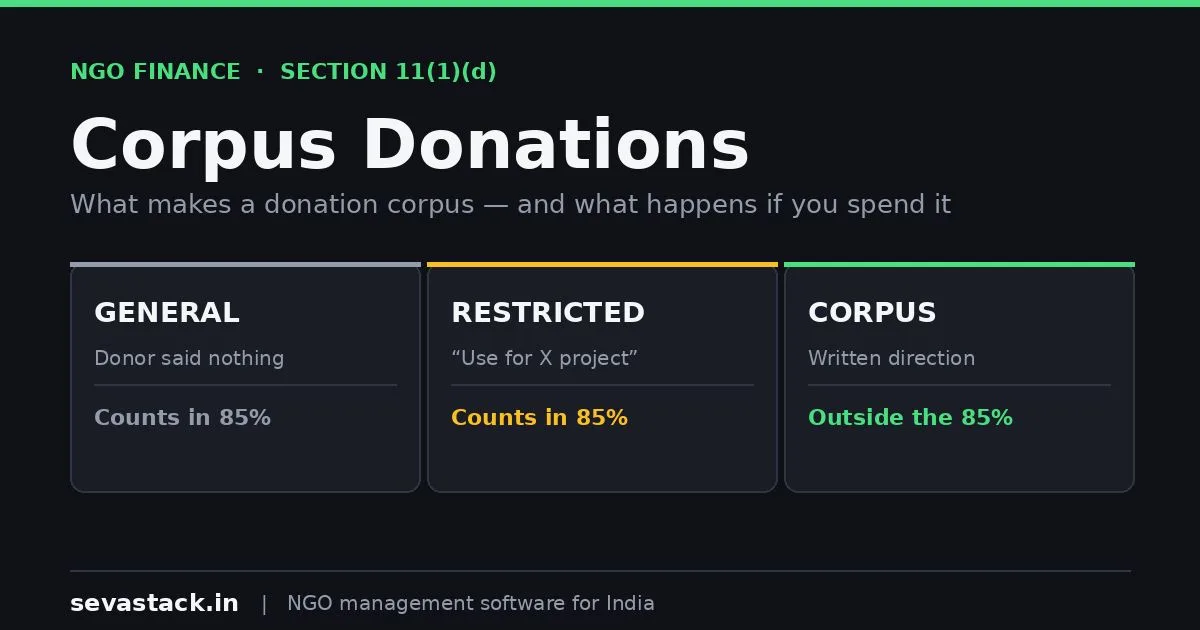
General donation | Restricted donation | Corpus donation | |
|---|---|---|---|
Donor said | Nothing specific | "Use for X project" | "Add to corpus" in writing |
Counted in your 85%? | Yes | Yes | No |
Can you spend it? | Yes, freely | Yes, but only on X | Meant to be kept |
Needs separate account? | No | Good practice | Yes |
Look carefully at the middle column. A donation for a specific project is not corpus. It still counts in your 85% spending target.
This is the number one mistake. NGOs see "the donor gave instructions" and think it is corpus. It is not.
For Nav Jeevan Trust:
Mr. Sharma's ₹25 lakh = corpus. Kept out of the 85% calculation.
The company's ₹10 lakh = restricted. Counts in the 85%.
Local donors' ₹40 lakh = general. Counts in the 85%.
So their income for the 85% rule is ₹50 lakh, not ₹75 lakh.
What actually makes a donation "corpus"
Only one thing:
The donor must give a specific written direction that the money is for your corpus.
Not a phone call. Not an assumption. Not your own decision.
You cannot make a donation into corpus by yourself. If a donor gives ₹5 lakh and says nothing, you cannot decide later to call it corpus. It is general income and you must spend 85% of it.
One rule that surprises people
Money from a donation box cannot be corpus — even if you write "Corpus Donation" on the box.
Why? Because nobody can identify who gave it or show their written direction. Donation box money is general income.
The 4 rules for corpus money
Once you accept a corpus donation, four things apply.
Rule 1: Keep it separate
Corpus money must be invested or deposited separately from your normal funds. It cannot be mixed into your general bank account.
The simplest way: open a separate bank account only for corpus. A savings or current account is fine — a bank deposit is an approved way of holding corpus.
If you mix it up, you will not be able to prove it was corpus, and the exemption can be lost.
Rule 2: Keep the donor's letter
Get it in writing at the time of the donation. Not later.
A simple letter or signed form saying:
"I am donating ₹____ to [NGO name]. This amount is towards the corpus fund of the organisation."
Keep it in your files. Your auditor will ask for it.
Rule 3: Report it in Form 10BD
When you file your annual donation statement, corpus donations must be reported with the donation type marked as corpus. Do not report them as ordinary donations.
Rule 4: Be careful before spending it
This is where NGOs get hurt. See the next section.
What happens if you spend corpus money?
Nav Jeevan Trust had an emergency. A hospital generator failed. They took ₹4,00,000 from the corpus account to replace it.
Reasonable decision. But here is what the tax rules say.
That ₹4 lakh does NOT count as your spending this year.
Even though the money left your bank. Even though it was used for genuine hospital work. It does not count towards your 85%.
So is the money lost?
No — but you have to earn it back.
You get to count it later, when you put the money back into the corpus account.
The conditions:
You must deposit it back into your corpus account from that year's income
You must do this within 5 years from the end of the year you spent it
Only the amount you actually put back counts
So Nav Jeevan Trust spent ₹4 lakh from corpus this year. If they put ₹4 lakh back into the corpus account next year, that ₹4 lakh counts as their spending next year.
If they never put it back within 5 years, they simply lose the benefit — and their corpus is permanently smaller.
Simple rule to remember: Spending corpus does not count. Putting corpus back does count.
Extra conditions when you replenish
When you put the money back, the original spending must also have followed the normal rules:
TDS deducted where required
No cash payment above ₹10,000 to one person in a day
Money spent in India
No benefit to trustees or their relatives
Not given as a corpus donation to another NGO
The mistake that costs the most
Never give a corpus donation to another NGO.
If your NGO donates to another NGO's corpus fund, none of it counts as your spending. Not 85%, not any part. Zero.
Compare:
What you do | How much counts as your spending |
|---|---|
Normal donation to another registered NGO | 85% of it |
Corpus donation to another NGO | Nothing |
If you support partner organisations, always give normal donations, never corpus donations.
What about interest earned on corpus?
Nav Jeevan Trust's ₹25 lakh corpus earns ₹1,50,000 in bank interest.
That interest is normal income. It counts in your 85% calculation and should be spent on your work.
The only exception is if the donor specifically wrote that the interest should also be added to the corpus. Then it stays as corpus.
Common mistakes to avoid
Mistake | What to do instead |
|---|---|
Calling a project grant "corpus" | Only donor's written corpus direction counts |
Deciding a donation is corpus yourself | Get it in writing from the donor |
Keeping corpus in the main bank account | Open a separate corpus account |
Writing "corpus" on a donation box | Box money is general income |
Spending corpus and forgetting about it | Track it and plan to put it back within 5 years |
Giving corpus donations to partner NGOs | Give normal donations instead |
Reporting corpus as normal in Form 10BD | Mark the type correctly |
Common questions
Is corpus money completely tax free? Yes, as long as you keep it in an approved form and maintain it separately for corpus. It does not enter your income at all.
Can a donor claim 80G on a corpus donation? Generally yes, if your NGO has valid 80G registration. Confirm the details with your CA.
What if the donor gave money verbally as corpus? Then it is not corpus. Get the written direction before you record it. If the donor is willing, ask them to send a short email or letter.
Can we use corpus money in a real emergency? Yes, nothing stops you from spending it. Just understand that it will not count as your 85% spending until you replace it, and you have 5 years to do that.
We have had corpus in our general account for years. What now? Speak to your CA immediately and move it to a separate account. Do not wait for the audit.
Does corpus reduce our 85% target? Yes, and that is the real benefit. Corpus is removed from your income before the 85% is calculated, so your spending target is lower.
Is a big corpus a good thing? Financially, yes — it gives your NGO stability and shows funders you are serious. But do not let a large corpus become an excuse for low spending on your actual work. Funders look at that too.
The simple version
If you remember only four things:
Corpus needs the donor's written instruction. Nothing else makes it corpus.
Keep it in a separate bank account. Always.
Corpus stays out of your 85% calculation. That is its big advantage.
Spending corpus does not count. Putting it back does. Within 5 years.
Most corpus problems come from one place: not knowing which money is which. When corpus, restricted and general funds all sit in the same account, the truth only comes out during the audit — when it is too late to fix.
Sevastack keeps corpus, restricted and general funds separate from the moment money arrives, stores each donor's corpus direction against their record, and marks the correct type when you file Form 10BD. Start free — no credit card needed.
This article is general information, not tax advice. Please check your NGO's exact position with your Chartered Accountant.
Related guides
New law, same rule. From 1 April 2026 the Income-tax Act, 2025 replaced the Income-tax Act, 1961. Form 10BD is now filed as Form 113 under Section 354(1). Only the number changed, not what you have to do. People still say "Form 10BD", so we use it here too. Filing close to the change-over? Check the form with your CA.
Vivek Bhos
Written by the Sevastack team, who build and maintain the 80G receipt, FCRA, and Form 10BD/10BE automation used by Indian NGOs on the platform every day. Compliance guidance is reviewed against current Income Tax Act and FCRA rules before publishing.
Read next
Finance
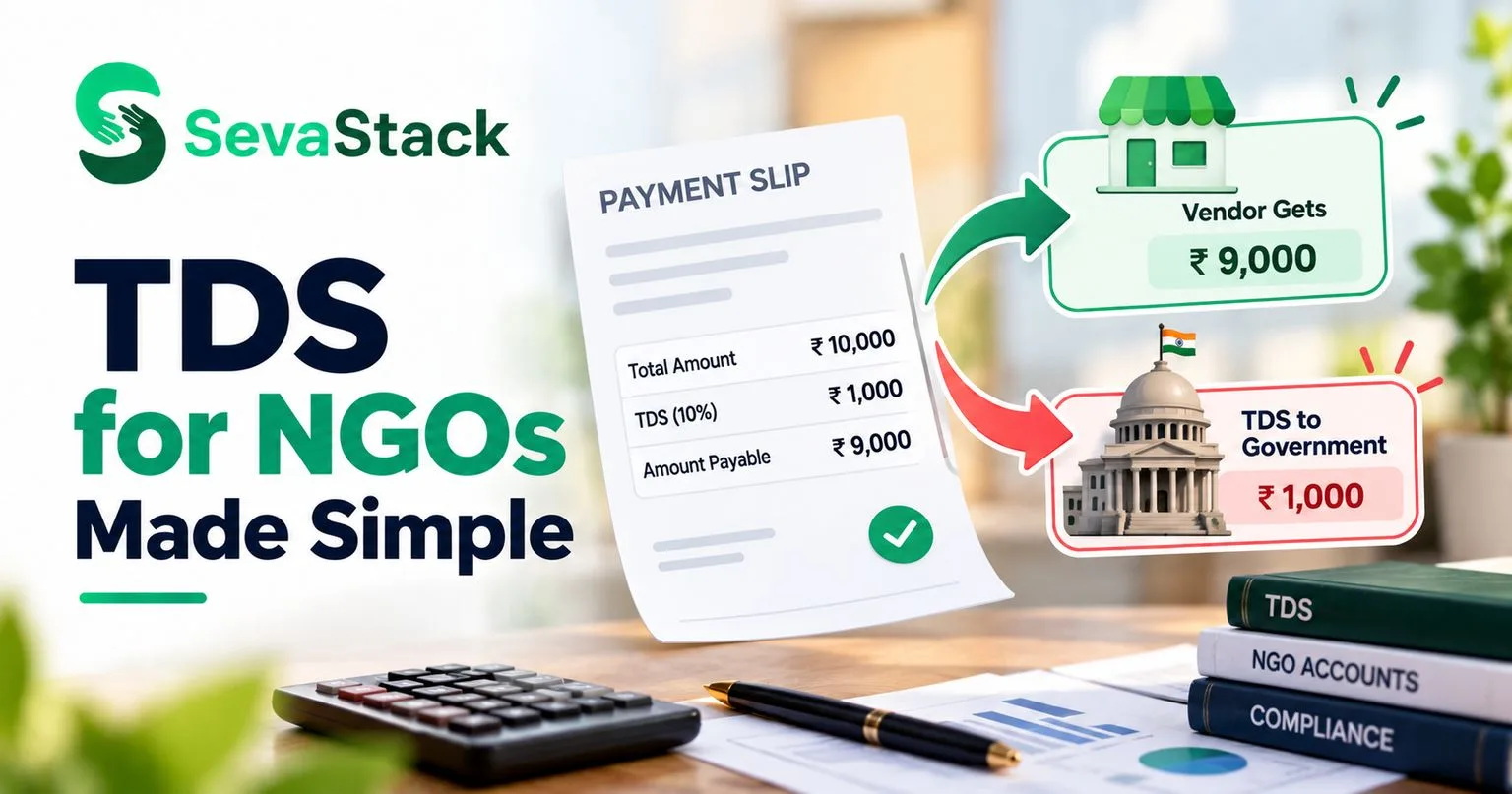
TDS on Vendor Payments: A Simple Guide for NGOs (2026)
Does your NGO need to cut TDS when paying vendors, contractors or professionals? A simple 2026 guide with rates, limits, due dates and mistakes to avoid.

Finance
Payment Gateway Charges: How NGOs Should Record Them
Online donation reached your bank with some money cut? Learn in simple words how NGOs should record payment gateway charges, with an easy example.

Finance
Receipts and Payments Account: A Simple Guide for NGOs
What is a Receipts and Payments Account? Learn in simple words how NGOs prepare it, how it differs from Income and Expenditure, with an easy example.
Never miss a filing date
Sevastack keeps your NGO's compliance calendar and reminds you by email and WhatsApp before each return is due. Donors, 80G receipts and accounts sit in the same place.