

80G Is Now Section 133: What Changes on Your NGO Receipts
Section 80G is now Section 133 under the new Income-tax Act. Learn in simple words what changes for NGO receipts, Form 113 and Form 114, and what stays the same.
Vivek Bhos
5 min read
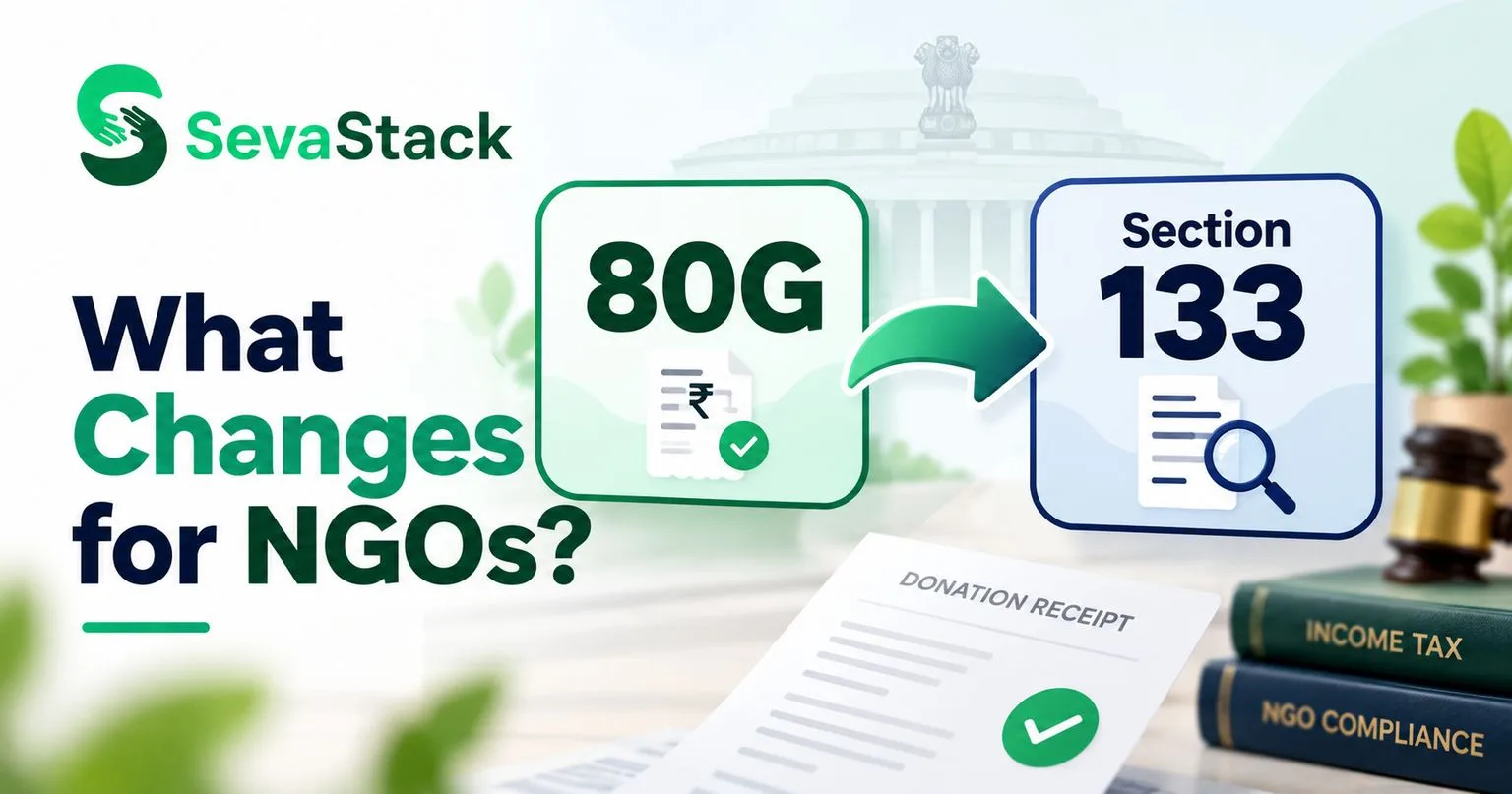
If your NGO gives 80G receipts, you may have heard that "80G is now Section 133". You may also have heard of new forms called Form 113 and Form 114. Many NGOs are confused.
Do not worry. In this post, we explain what has changed and what has not changed, in very simple words.
Important: This post is for general information. Please check your own case with your CA.
What has changed? The short answer
India has a new law, the Income-tax Act, 2025. It started on 1 April 2026 and replaces the old Income-tax Act, 1961.
Because of this, many section numbers and form numbers have changed. Here is the simple list for NGOs:
Topic | Old name (till 31 March 2026) | New name (from 1 April 2026) |
|---|---|---|
Donor tax deduction | Section 80G | Section 133 |
NGO registration (12A) | Section 12A | Section 332 |
Approval for donor deduction | 80G approval | Section 354 |
Donation statement filed by NGO | Form 10BD | Form 113 |
Donation certificate for donor | Form 10BE | Form 114 |
Application for registration or approval | Form 10AB | Form 105 |
Most of the old rules are carried forward in the new law. The names and numbers are mostly what changed.
Which donations fall under which law?
This is the most important part. Please read it carefully.
Donations given up to 31 March 2026: the old law applies. That means Section 80G, Form 10BD and Form 10BE.
Donations given from 1 April 2026: the new law applies. That means Section 133, Form 113 and Form 114.
So your NGO will work with both systems for some time. For example, when you file for FY 2025-26 (April 2025 to March 2026), you still use the old forms. For donations received this year, from April 2026 onwards, you use the new ones.
What stays the same for donors?
Good news: the basic idea has not changed.
Donors still get a tax deduction for donations to approved NGOs.
There are still two types of deduction, 100% and 50%, depending on the type of institution or fund.
Cash donations above ₹2,000 are not eligible for deduction. Ask donors to pay by UPI, bank transfer, cheque or card.
The donor's claim in their return should match the details your NGO reports. If your report has a mistake, the donor may face a problem.
Also, as before, the donor deduction is generally available only if the donor chooses the old tax regime. Donors should confirm this with their own CA.
What changes for your NGO?
1. New form numbers
Your yearly donation statement is now Form 113 (earlier Form 10BD). After you file it, you issue Form 114 to each donor (earlier Form 10BE).
2. Your receipt details
Your receipt should show your NGO's registration and approval details correctly. Ask your CA how the references should be written now, as the old 80G wording is being replaced with the new section names. Do not guess. A wrong reference can confuse donors and officers.
3. Accuracy matters even more
Because the donor's claim is matched with your statement, make sure these are right for every donor:
Full name
PAN (or other ID, as required)
Amount and date
Mode of payment
4. Your software and records
If you make receipts by hand or in Excel, check that your templates are updated. If you use software, check that it has the new forms and wording. In Sevastack, you can keep donor details in one place, so your yearly statement is easier to prepare.
What should your NGO do now? A simple checklist
Talk to your CA about the new rules for your NGO.
Check your registration details. Your 12A and 80G approvals continue, but note their new section references.
Update your receipt format as your CA advises.
Keep old and new separate. Mark donations as "up to 31 March 2026" and "from 1 April 2026".
Collect complete donor details (name, PAN, address) at the time of donation.
Avoid cash donations above ₹2,000.
Plan for Form 113 early. Ask your CA for the due date and prepare data before it.
Tell your donors that their receipts may now show new section names, so they are not worried.
Common mistakes to avoid
Using old forms for new donations. Check the date of each donation.
Wrong PAN or name. This can cause mismatch trouble for donors.
Accepting large cash donations. They are not eligible for deduction.
Waiting till the last moment to prepare the donation statement.
Not telling your accountant about the law change.
Quick summary
80G is now Section 133 from 1 April 2026
Form 10BD is now Form 113, and Form 10BE is now Form 114
Donations up to 31 March 2026 follow the old law
Donations from 1 April 2026 follow the new law
The basic donor benefit remains, but the details must match
Cash above ₹2,000 is not eligible
Talk to your CA
Frequently asked questions
Is 80G cancelled?
No. The donor deduction continues, but under a new section number, Section 133, in the new Income-tax Act, 2025.
What is Form 113?
It is the donation statement your NGO files. It is the new version of Form 10BD.
What is Form 114?
It is the donation certificate you give to each donor after filing Form 113. It is the new version of Form 10BE.
Do I need to apply for 80G again?
Do not assume anything. Ask your CA whether your existing approval needs any action under the new law.
Which law applies to donations I received in March 2026?
The old law, Section 80G. Anything up to 31 March 2026 follows the old rules.
Can donors still pay in cash?
They can, but cash donations above ₹2,000 are not eligible for tax deduction.
Keep your receipts and records clean
Sevastack helps Indian NGOs keep donor details, receipts and records in one place. Start free and be ready for donation reporting without the last-minute rush.
Under the Income-tax Act, 2025 (effective 1 April 2026, replacing the Income-tax Act, 1961), Form 10BD is now filed as Form 113, governed by Section 354(1) of the new Act. "Form 10BD" remains the commonly used and searched term during the transition — the underlying requirement is unchanged, only the section/form numbering has moved. Confirm the applicable form with your CA if you're filing close to the transition date.
Vivek Bhos
Written by the Sevastack team, who build and maintain the 80G receipt, FCRA, and Form 10BD/10BE automation used by Indian NGOs on the platform every day. Compliance guidance is reviewed against current Income Tax Act and FCRA rules before publishing.
Read next

Compliance
ITR-7 Due Date Extended to 21 November: What NGOs Must Do
CBDT has extended the ITR-7 due date to 21 November 2026 and the audit report date to 21 October. Here is what your NGO should do now, step by step.
Compliance
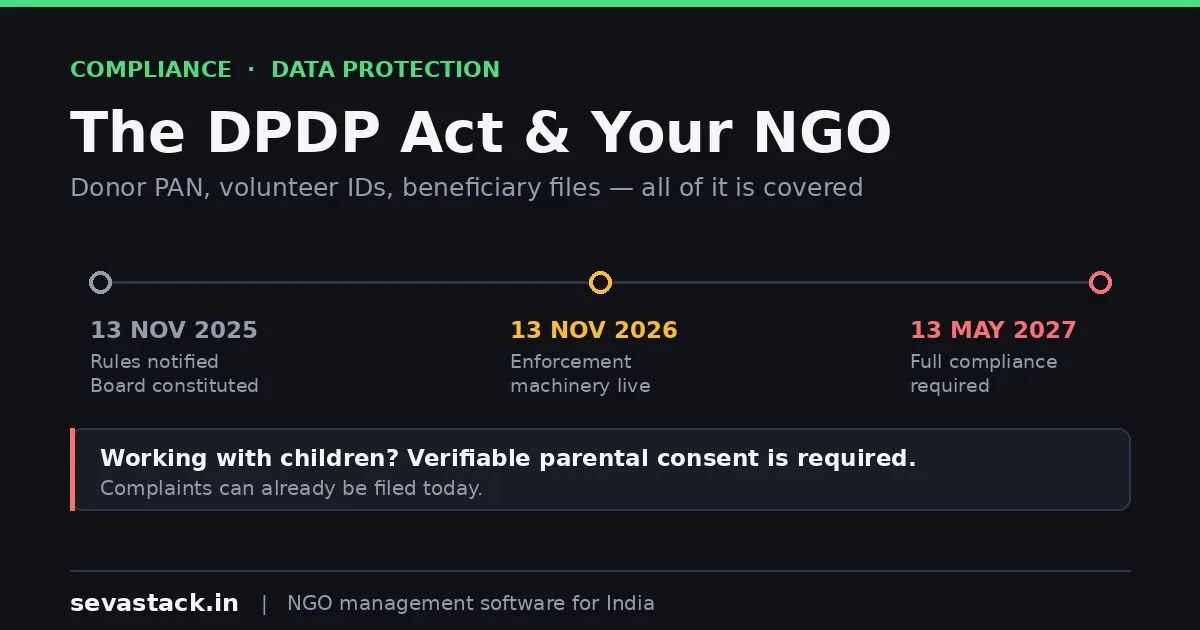
DPDP Act for NGOs in India: A Simple Compliance Guide
Your NGO holds donor PAN, phone numbers and beneficiary records. India's data protection law now covers all of it. Here is what to do, and by when.
Compliance
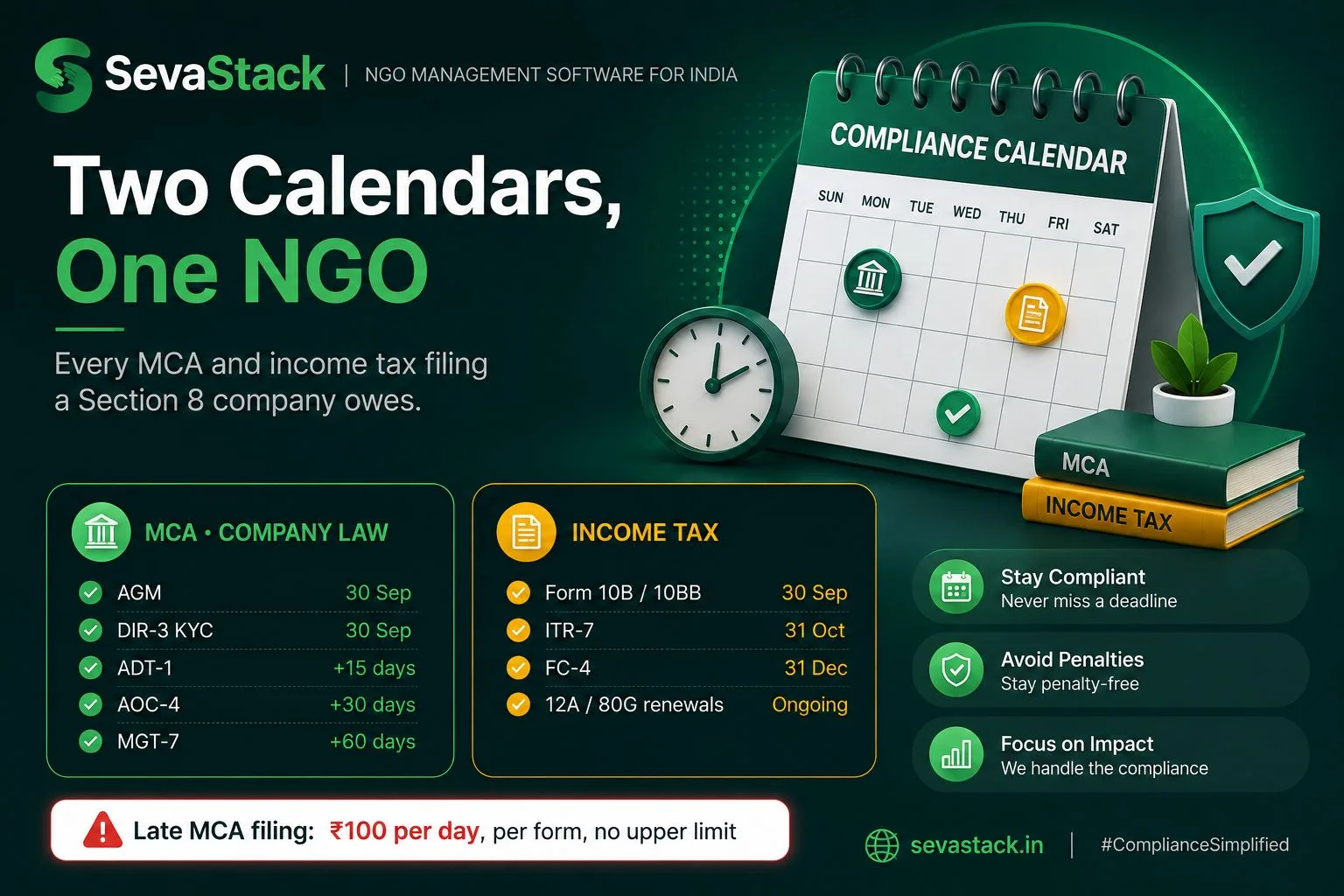
Section 8 Company Compliance: Every Filing and Due Date
Section 8 companies have two separate compliance calendars. Here is every MCA and income tax filing, the due dates, and what late filing costs you.
Never miss a filing date
Sevastack keeps your NGO's compliance calendar and reminds you by email and WhatsApp before each return is due. Donors, 80G receipts and accounts sit in the same place.