

Beneficiary Management: How NGOs Should Track Their Work
Can you prove the numbers in your annual report? A simple guide to beneficiary records, avoiding double counting, and measuring outcomes not outputs.
Vivek Bhos
9 min read
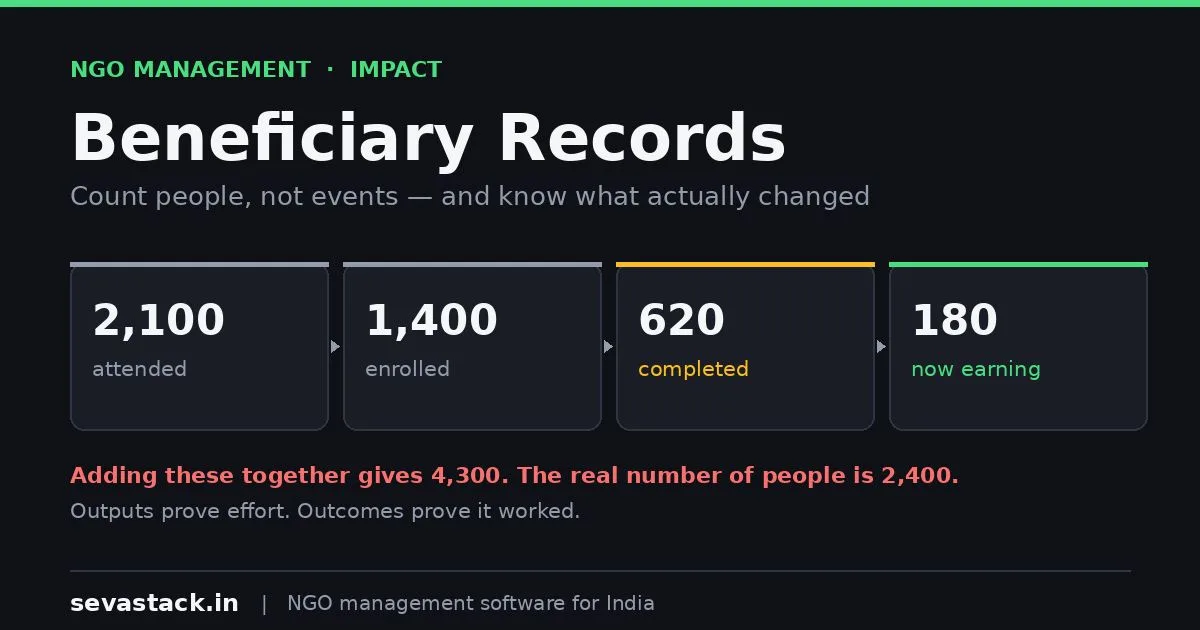
Every NGO annual report in India contains a sentence like this:
"This year we reached over 10,000 beneficiaries."
Now ask the hard question: could you prove it?
Could you produce a list? Could you show that the same person was not counted three times across three programmes? Could you show what actually changed for any of them?
For most NGOs the honest answer is no. The number came from adding up attendance registers, and nobody has looked at it too closely.
That was survivable ten years ago. It is becoming a problem now — funders check, CSR partners audit, and the number in your report is the one thing everyone reads.
This guide explains how to fix it, simply.
Meet Kaushal Vikas Sangh
Kaushal Vikas Sangh runs skill training in two districts. Their annual report said 4,200 beneficiaries.
A corporate funder asked for the breakdown before releasing the next tranche. Here is what came out:
What they counted | People |
|---|---|
Attended awareness sessions | 2,100 |
Enrolled in training | 1,400 |
Completed training | 620 |
Got a job or started earning | 180 |
All four numbers were added together. But most of the 620 who completed had also attended an awareness session, and all of them had enrolled. The same person was counted three times.
The real number of distinct people was closer to 2,400. And the number who actually got what the programme promised was 180.
The funder did not walk away. But they asked why the report said 4,200, and Kaushal Vikas Sangh had no good answer.
The two ideas that fix most of this
Idea 1: Count people, not events
An attendance register counts visits. It does not count people.
If the same woman attends four sessions, your register shows four. Your report should show one person, four times engaged.
The fix is a unique ID for every person you work with. Once someone is in your records, they keep that ID across every programme, every year. Then you can answer honestly: how many distinct people, and how many touchpoints.
Idea 2: Know the difference between output and outcome
This is the single most useful distinction in the sector, and it is simple.
Level | Question it answers | Example |
|---|---|---|
Output | What did we do? | 620 people completed training |
Outcome | What changed for them? | 180 are now earning |
Impact | What changed in the wider world? | Household incomes in the village rose |
Most NGO reports are entirely outputs. Sessions held, kits distributed, people trained. Outputs are easy to count and they prove effort, not effect.
Funders increasingly want outcomes. And outcomes are what actually tell you whether your programme works.
You do not need to measure impact — that is hard, expensive and often contested. But every NGO should be able to state at least one outcome per programme.
What to record for each person
Keep it minimal. A long form you never complete is worse than a short one you always do.
The essentials:
Unique ID
Name
Age or date of birth
Gender
Village, ward or locality
Contact number, where appropriate
Which programme, and date they joined
Add only if you genuinely use it:
Household size or income band
Education level
Disability status
Anything specific to your programme
Then, over time:
Attendance or participation dates
Milestones — enrolled, completed, certified
Outcome — placed, earning, enrolled in school, treated, whatever your programme promises
Be strict about extra fields. If you collect caste, income or health details, you must be able to explain why you need each one. Under India's data protection rules you are responsible for everything you hold — and beneficiary data is the most sensitive data your NGO has. More on the DPDP Act for NGOs.
Measuring change without a research budget
You do not need an M&E consultant to do this well. You need two snapshots.
Baseline — where the person was when they joined. Endline — where they are when they finish, or a year later.
The gap between them is your outcome.
Keep the questions few and concrete. For a skills programme, three questions asked at both points might be enough:
Are you currently earning? Yes / No
Roughly how much per month?
What work are you doing?
For an education programme: is the child enrolled, attending regularly, and at what level.
The trap to avoid: collecting the baseline and then never doing the endline. This happens constantly. Half the NGOs in India have baseline surveys sitting in files with no follow-up. A baseline with no endline is wasted effort — and wasted time for the person you asked.
Decide the endline date when you collect the baseline, and put it in a calendar.
Collecting data without harming people
This part gets skipped, and it matters more than the methodology.
Explain why. Tell people what you are collecting and what it is for. "This helps us show funders that the programme works" is honest and most people accept it.
Take consent, and record it. Especially for photographs and stories. For anyone under 18, that means the parent or guardian's consent, obtained verifiably.
Do not make help conditional on data. Nobody should have to hand over their income details to receive a meal.
Be careful with sensitive categories. Health status, caste, disability, experience of violence. Collect these only where the programme genuinely requires it, and restrict who can see them.
Never use a photograph in a way that strips someone's dignity. The test is simple: would you be comfortable if this were your family member, seen by their neighbours?
Store it properly. Not in a WhatsApp group. Not in a spreadsheet on a field worker's personal phone. Not in a shared folder half the office can open.
Common mistakes
Mistake | What to do instead |
|---|---|
Adding up attendance to get "beneficiaries" | Count unique people using IDs |
Counting the same person across programmes | One ID per person, across everything |
Reporting only outputs | State at least one outcome per programme |
Baseline with no endline | Fix the endline date at the start |
Data in separate files per programme | One central record per person |
Collecting fields you never use | Cut the form down |
No consent record for photos | Written consent, parental for children |
Rounding up "about 10,000" | Report the real number, however small |
On that last one: a specific, defensible number beats an impressive vague one. "2,412 people, of whom 180 are now earning" is far more credible than "over 10,000 reached" — and a funder can tell the difference immediately.
What funders actually ask for
If you have never been through serious due diligence, expect these:
How many distinct individuals did you serve? Show the list structure, not the names
How do you avoid counting people twice?
What changed for them, and how do you know?
What proportion dropped out, and why?
How do you store personal data, and who can access it?
Can we speak to some beneficiaries?
The dropout question catches people out. NGOs report completers and stay quiet about the people who left. Funders find honesty about dropout more reassuring than a suspiciously clean number — every real programme loses people, and knowing why is a sign you are paying attention.
Start this week
If your beneficiary records are currently attendance registers and memory, do these four things:
1. Make one list. Every person you currently work with, in one place, one row each.
2. Give each person an ID. Any consistent format works — programme code plus number is fine.
3. Deduplicate. Match on name, village and phone. You will find more overlaps than you expect, and that is a good thing to discover privately rather than during an audit.
4. Pick one outcome per programme. One thing you would want to prove is true. Then work out how you would measure it.
That is a week's work and it changes what you are able to say about yourself for years.
Common questions
We work with people who have no ID and no phone. How do we track them? Use your own internal ID. It does not need to link to any government document. Name, approximate age, village and a household reference is usually enough to match reliably.
Is it wrong to count awareness session attendees as beneficiaries? Not wrong, but report them separately. "12,000 people reached through awareness, 620 trained, 180 now earning" is honest and actually more impressive than one blended number.
We run relief work where people come once and leave. How do we measure outcomes? For relief, outputs are legitimate — meals served, kits distributed. Do not force an outcome framework where it does not fit. Focus instead on counting accurately and not double-counting across distributions.
Should we use a formal framework like a theory of change or logframe? Useful if a funder asks for one, or when designing a new programme. But do not start there. Get accurate counts and one measurable outcome first — a beautiful logframe over unreliable data helps nobody.
How long should we keep beneficiary records? As long as you have a genuine reason, then delete them. Keeping files from a programme that closed six years ago is a risk with no benefit.
Our funder wants photos and case studies of beneficiaries. Is that allowed? With proper consent, yes. For children, parental consent is required. Be prepared to say no to a funder request that would compromise someone's safety or dignity — good funders respect that, and it is the right answer regardless.
We are very small. Is a spreadsheet enough? For a few hundred people, a well-structured spreadsheet with unique IDs beats a badly-used system. The problems start when you have several programmes, several spreadsheets and no way to match people across them.
The point of all this
Better beneficiary records are usually sold as a funder requirement. That is true, but it is the smaller reason.
The real reason is that you cannot improve what you cannot see. If 620 people completed your training and only 180 are earning, that gap is the most valuable information your organisation has. It tells you where the programme breaks. Without records, you never find it — and you keep running the same programme, reporting the same output number, for years.
Sevastack keeps one record per person across every programme, gives each beneficiary a unique ID so nobody is double counted, tracks milestones and outcomes over time, and keeps sensitive data behind role-based access. Start free — no credit card needed.
Related guides
Vivek Bhos
Written by the Sevastack team, who build and maintain the 80G receipt, FCRA, and Form 10BD/10BE automation used by Indian NGOs on the platform every day. Compliance guidance is reviewed against current Income Tax Act and FCRA rules before publishing.
Read next
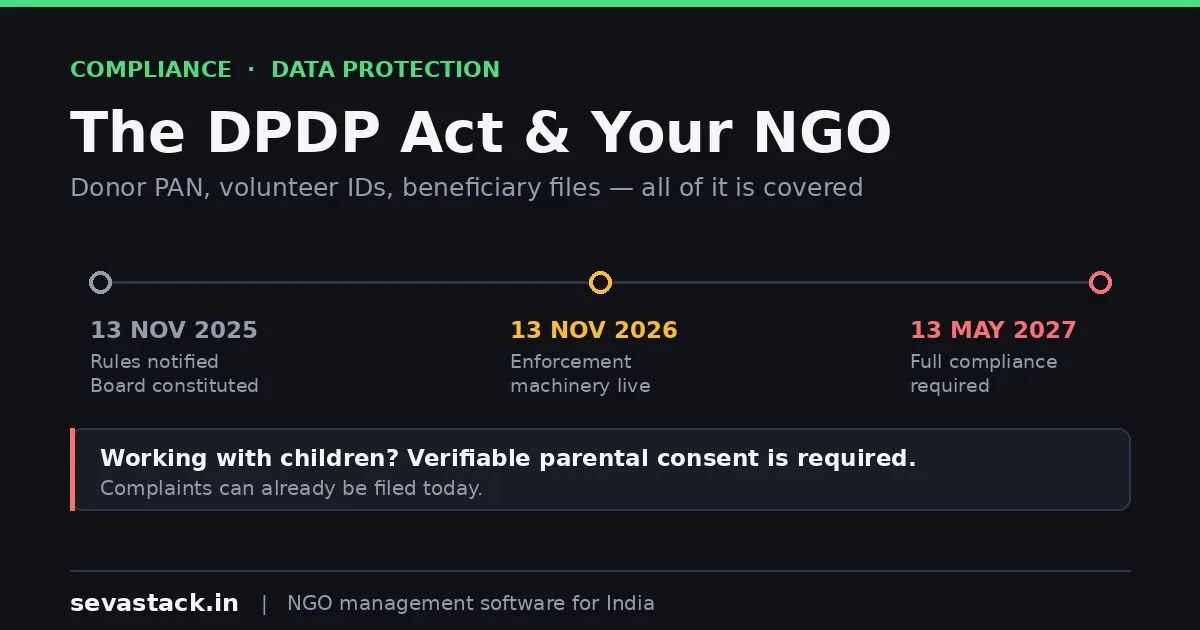
Compliance
DPDP Act for NGOs in India: A Simple Compliance Guide
Your NGO holds donor PAN, phone numbers and beneficiary records. India's data protection law now covers all of it. Here is what to do, and by when.
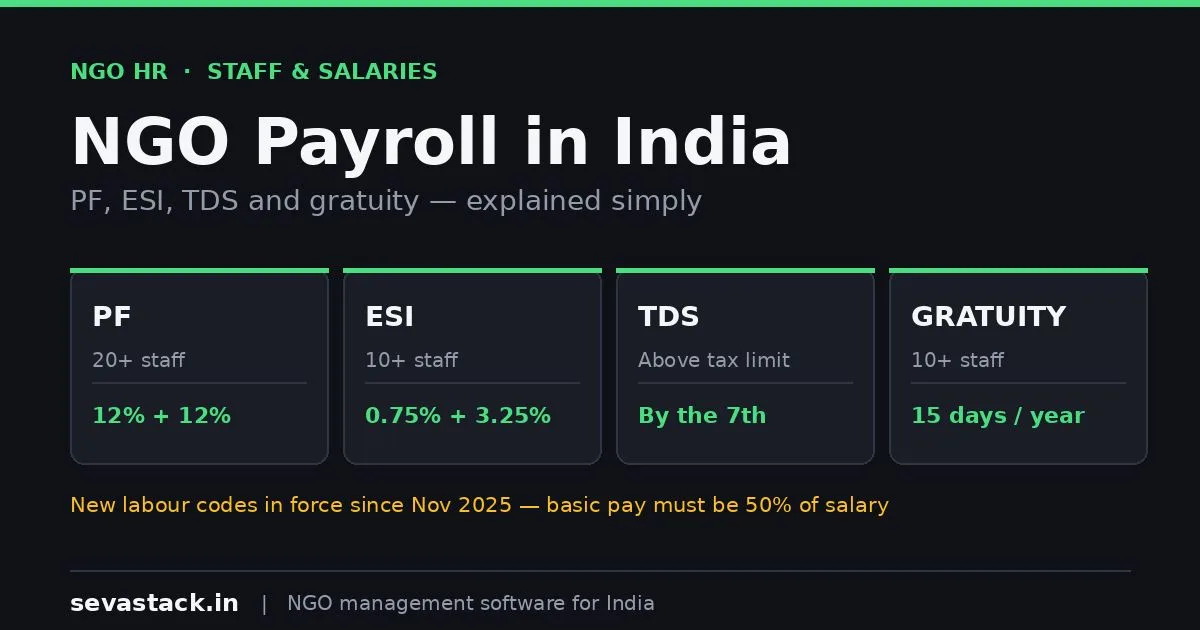
NGO Management
NGO Payroll in India: PF, ESI, TDS and Gratuity Made Simple
A simple guide to NGO payroll in India. When PF and ESI apply, how much to deduct, TDS on salary, gratuity rules and the new labour code changes.
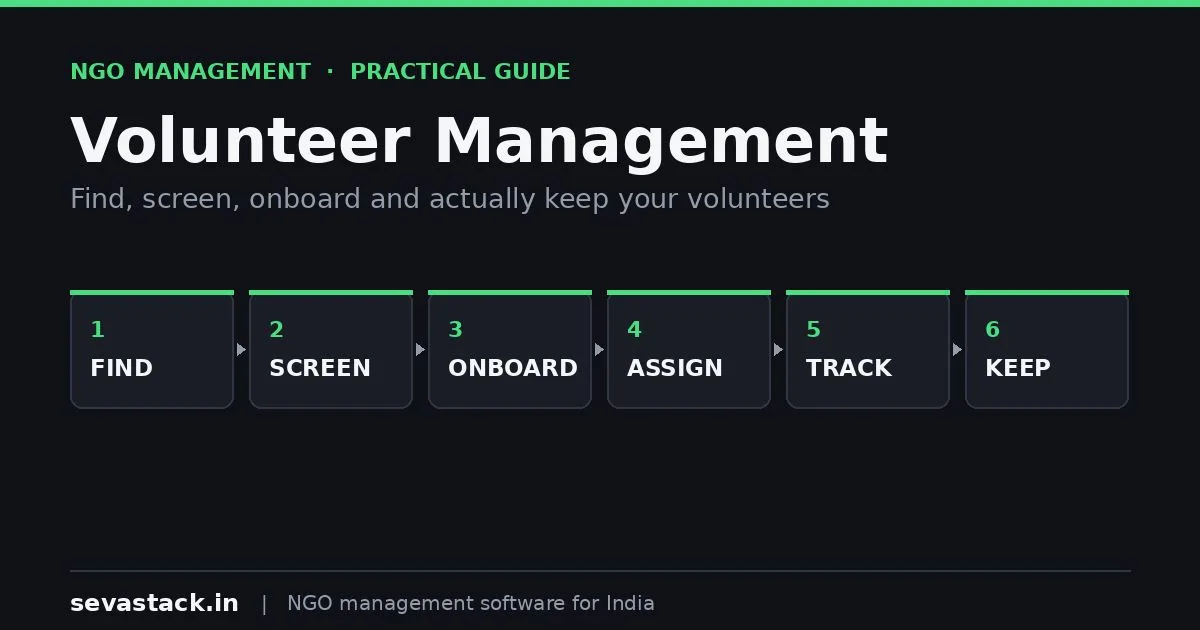
NGO Management
Volunteer Management for NGOs: A Simple Practical Guide
How to find, screen, onboard and keep volunteers at your NGO. A simple guide to hour tracking, certificates, safety rules and what actually works.
Never miss a filing date
Sevastack keeps your NGO's compliance calendar and reminds you by email and WhatsApp before each return is due. Donors, 80G receipts and accounts sit in the same place.