

Volunteer Management for NGOs: A Simple Practical Guide
How to find, screen, onboard and keep volunteers at your NGO. A simple guide to hour tracking, certificates, safety rules and what actually works.
Vivek Bhos
Updated 8 min read
Most NGOs do not have a volunteer shortage.
They have a volunteer follow-up problem.
People sign up. They come once. Then nobody calls them again, nobody tells them what to do, and slowly they stop coming. Six months later the NGO says "we cannot find volunteers."
The volunteers were there. The system was not.
This guide explains how to build that system, step by step, in simple language.
Meet Prerna Seva Sangh
Prerna Seva Sangh runs weekend education centres in three areas. They had 120 people fill their "Volunteer With Us" form last year.
Here is what happened:
Stage | People |
|---|---|
Filled the form | 120 |
Got a reply | 45 |
Came once | 28 |
Came more than 3 times | 9 |
Still active after 6 months | 4 |
They lost 75 people at the very first step — nobody replied to them.
That is not a people problem. That is a process problem, and it can be fixed.
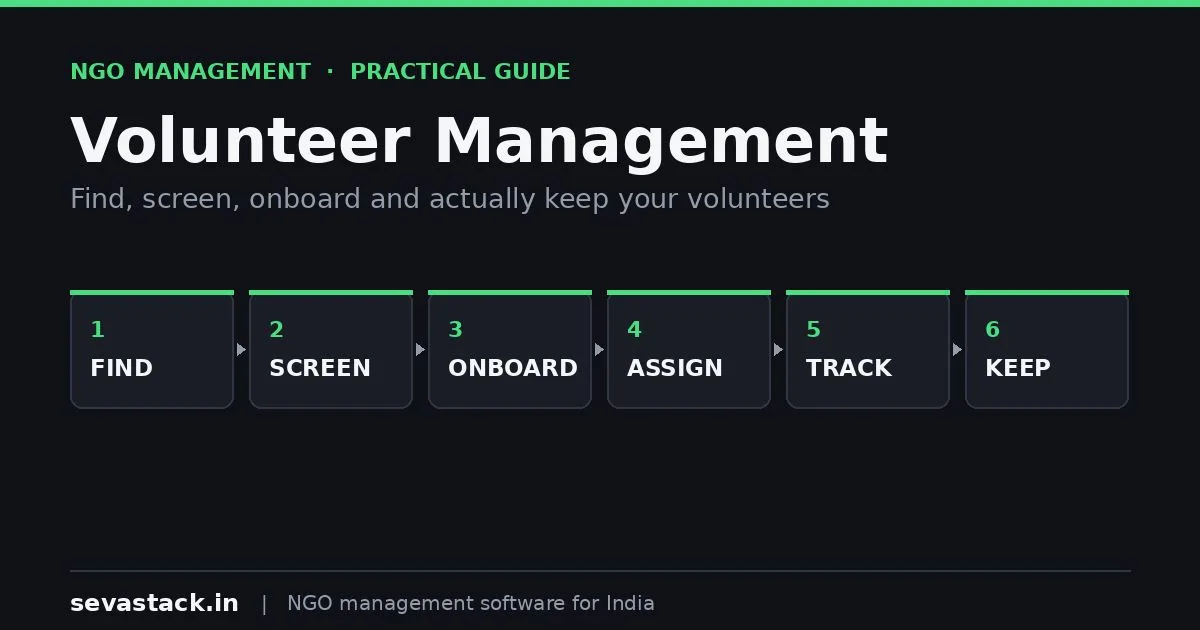
The 6 stages of volunteer management
Every volunteer goes through the same journey. Your job is to make sure nobody falls off in the middle.
Find → Screen → Onboard → Assign → Track → Keep
Let us go through each one.
Stage 1: Find volunteers
You do not need a big campaign. Most NGOs find their best volunteers in four places:
Your existing donors. Someone already giving money is your warmest volunteer lead. Ask them.
Colleges. Many courses now require social work hours. Contact the placement or NSS office directly.
Corporate employees. Companies running CSR programmes often want employee volunteering days. This can also open a funding conversation.
Your own beneficiaries' families. Often the most committed people of all.
Keep the signup form short. Name, phone, email, city, what they want to help with, when they are free. That is it. Long forms lose people.
Stage 2: Screen properly
Not everyone who signs up should be placed. This matters most if your work involves children, women in distress, elderly people, or people with disabilities.
Basic screening for every volunteer:
A short phone or video conversation — 15 minutes is enough
Government ID copy
Two references you actually call
Clear explanation of what the role involves
Extra steps if they will work with children:
Stricter reference checks
No volunteer alone with a child, ever
A written child protection policy that they read and sign
Clear reporting process if something feels wrong
Do not skip this because you are short of people. One bad placement can end your organisation. Being slow is better than being sorry.
Stage 3: Onboard them properly
This is the step most NGOs skip, and it is the reason volunteers disappear.
Reply within 48 hours. Even a short message. Prerna Seva Sangh lost 75 people here.
Give them a proper induction, even if it is 30 minutes on a video call:
What your NGO does and why
What their specific role is
Who their point of contact is
Practical details — timings, location, what to wear, what to bring
Safety rules and the do-not-do list
Sign a volunteer agreement. Not an employment contract — a simple document covering:
The role and expected time commitment
That this is voluntary and unpaid
Confidentiality about beneficiaries
Code of conduct
Photo and data consent
Stage 4: Give them real work
Volunteers leave when they feel useless.
Be specific. "Come help out on Saturday" is weak. "Teach Class 5 maths from 10am to 12pm at the Kurla centre, to 12 children" is strong.
Match the role to the person. A chartered accountant should not be stuffing envelopes. Ask what skills they have and use them — accounts, design, translation, photography, teaching, IT.
Create small roles too. Not everyone can give a full day. A two-hour-a-month role keeps someone connected for years.
Stage 5: Track hours — and take this seriously
Most Indian NGOs do not track volunteer hours. This is a real loss, because those hours are valuable in four different ways.
1. Grant applications. Many funders ask how many volunteers you have and how many hours they contribute. "Around 30 people, I think" is a weak answer. "1,840 hours from 47 volunteers last year" is a strong one.
2. CSR partnerships. Companies want to report employee volunteering. If you can send them a clean report of their employees' hours, you become the easy partner to work with — and easy partners get renewed.
3. Your annual report. Volunteer hours show community trust in a way money cannot.
4. Understanding your own capacity. You cannot plan next year's programme if you do not know how much help you actually have.
What to record for each session: volunteer name, date, activity, location, hours, and who supervised. That is enough.
Stage 6: Keep them coming back
Retention is mostly small things done consistently.
What to do | How often |
|---|---|
Say thank you after each session | Every time |
Share what their work achieved | Monthly |
Volunteer WhatsApp or email group | Ongoing |
Issue certificates | Every 6 months, or on request |
Small recognition — mention in newsletter, a card | Occasionally |
Ask them what is not working | Twice a year |
About certificates: do not treat these as a formality. For a college student, a volunteer certificate goes into their placement file. For a corporate employee, it goes to their HR team. Issue them promptly, on your letterhead, with the actual hours and dates. People remember NGOs that did this properly.
Legal points every NGO should know
Volunteer work is informal, but a few rules still apply.
The POSH Act covers volunteers. The Sexual Harassment of Women at Workplace Act, 2013 defines "employee" broadly enough to include people working on a voluntary basis, whether paid or not. If your organisation has 10 or more people, you need an Internal Committee, and your volunteers are protected by it. Your policy should say so clearly.
Be careful with stipends. Genuine reimbursement of travel or food costs is fine. But a fixed monthly payment for regular work can start to look like employment, which brings PF, ESI and TDS questions. If you pay volunteers a regular amount, check the arrangement with your CA.
Consider insurance. If volunteers travel to field locations, work at heights, handle equipment or work in disaster settings, basic accident cover is worth the small cost.
Data protection. You are holding volunteers' names, phone numbers and ID copies. Store them securely, take consent for photos before publishing them, and delete what you no longer need. India's data protection rules are being enforced from late 2026, and they apply to NGOs too.
FCRA note. If you use foreign contribution funds for volunteer-related costs, remember these usually fall under your administrative expense limit. Track them separately.
Common mistakes
Mistake | Fix |
|---|---|
Not replying to signups | Reply within 48 hours, always |
Vague roles | Write a one-line role description |
No screening | Basic checks for everyone, strict checks near children |
Hours tracked nowhere | Simple attendance record per session |
Certificates only when asked | Issue proactively every 6 months |
One person handles everything | Name a volunteer coordinator |
Volunteer data in five WhatsApp groups | One central list |
Common questions
How many volunteers do we need? Fewer than you think, if they are consistent. Ten reliable volunteers are worth more than a hundred names on a list.
Should we pay volunteers? Reimburse genuine costs like travel and food. Avoid fixed regular payments unless you have taken advice, because that changes the legal nature of the relationship.
Can volunteers be counted as staff in grant applications? Usually reported separately, not as staff. But do report their numbers and hours — funders value it.
What if a volunteer behaves badly? Have a written code of conduct signed at the start. That gives you a clear basis to end the arrangement. Never keep someone on because you are short of people.
Can we use volunteer photos on social media? Only with consent. Take it in writing in the volunteer agreement. Be much stricter about photos of beneficiaries, especially children.
How do we restart a volunteer programme that died? Go back to your old list. Send one honest message: what you are doing now, what help you need, and a specific role. People who volunteered before are far more likely to say yes than strangers.
Where to start this week
If your volunteer system is currently a WhatsApp group and a notebook, do these three things:
Make one list of every volunteer with name, phone, skills and last date they helped.
Reply to everyone who signed up in the last six months, even if it is late.
Start recording hours from the next session onward.
That alone will put you ahead of most NGOs your size.
Sevastack keeps your volunteers in one place — signups, screening status, hour logs, certificates and communication — so nobody gets forgotten at step one. Start free — no credit card needed.
Related guides
Vivek Bhos
Written by the Sevastack team, who build and maintain the 80G receipt, FCRA, and Form 10BD/10BE automation used by Indian NGOs on the platform every day. Compliance guidance is reviewed against current Income Tax Act and FCRA rules before publishing.
Read next
NGO Management
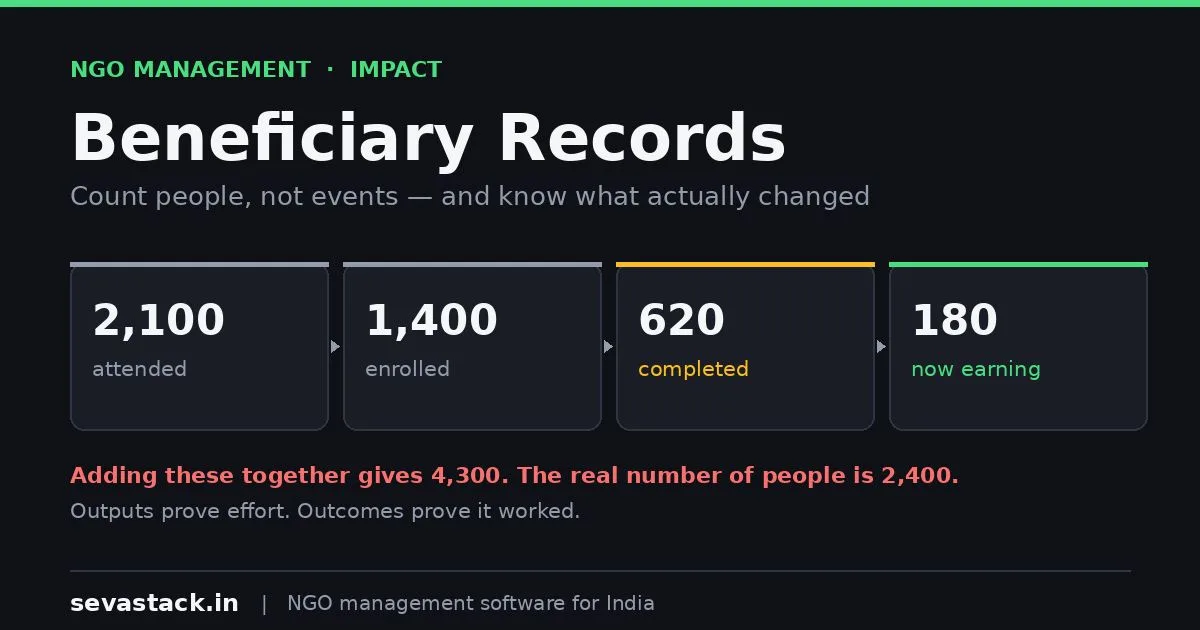
Beneficiary Management: How NGOs Should Track Their Work
Can you prove the numbers in your annual report? A simple guide to beneficiary records, avoiding double counting, and measuring outcomes not outputs.
NGO Management
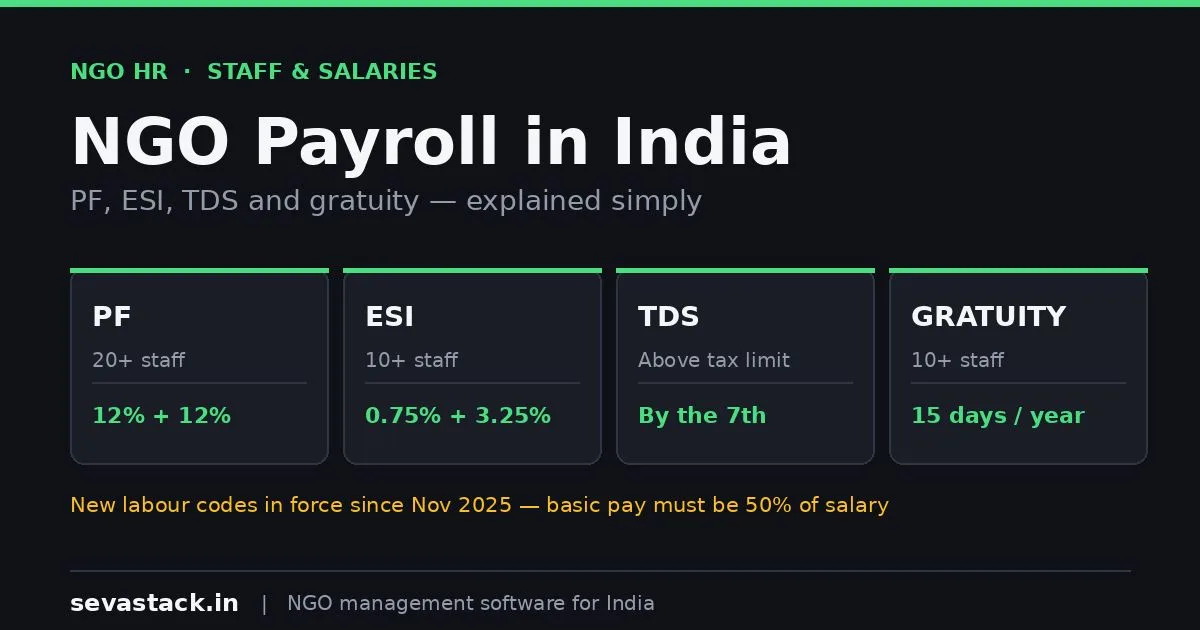
NGO Payroll in India: PF, ESI, TDS and Gratuity Made Simple
A simple guide to NGO payroll in India. When PF and ESI apply, how much to deduct, TDS on salary, gratuity rules and the new labour code changes.
NGO Management
NGO vs RNPO: What’s the Real Difference? A Simple Guide for Founders & Donors
Understand the real difference between NGO and RNPO in simple language. Learn registration types, tax benefits, funding opportunities, and which structure is best for your social initiative.
Never miss a filing date
Sevastack keeps your NGO's compliance calendar and reminds you by email and WhatsApp before each return is due. Donors, 80G receipts and accounts sit in the same place.