

NGO Payroll in India: PF, ESI, TDS and Gratuity Made Simple
A simple guide to NGO payroll in India. When PF and ESI apply, how much to deduct, TDS on salary, gratuity rules and the new labour code changes.
Vivek Bhos
Updated 9 min read
Many NGOs pay their staff a fixed amount every month, transfer it by bank, and think payroll is done.
It is not.
The moment you cross certain staff numbers, PF and ESI become compulsory. TDS may need to be deducted. Gratuity starts building up quietly in the background. And if you get it wrong, the penalty is not just money — it can affect your FCRA standing and your funder due diligence.
This guide explains NGO payroll in simple language.
Quick summary
Rule | When it applies | Who pays |
|---|---|---|
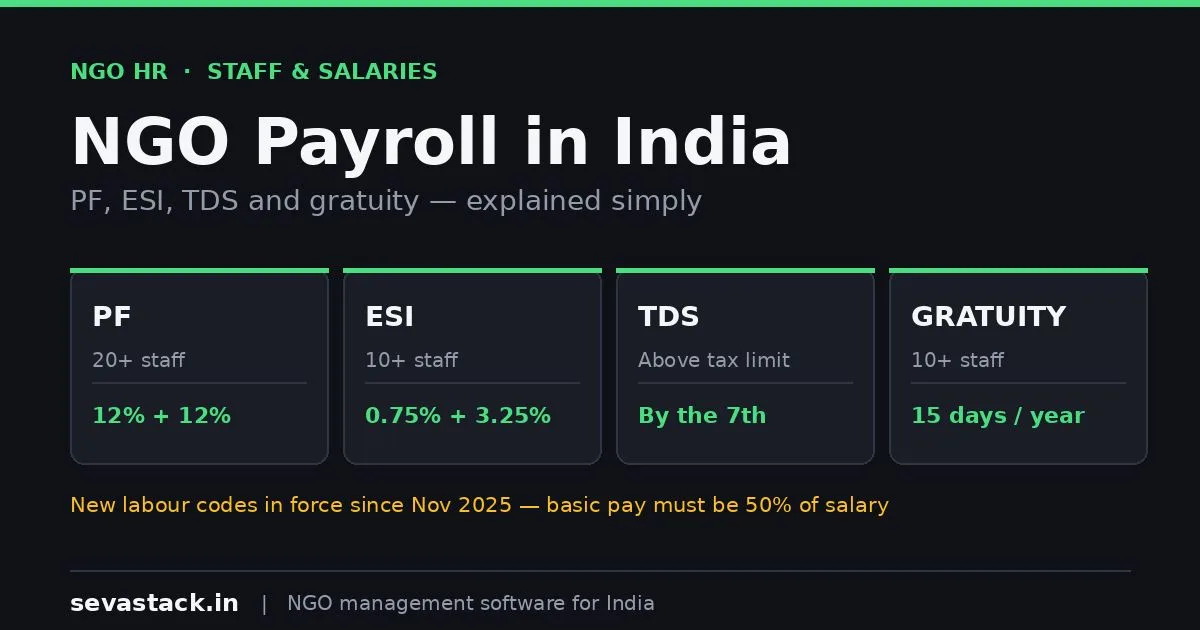
PF (EPF) | 20 or more employees | Employee 12% + NGO 12% |
ESI | 10 or more employees | Employee 0.75% + NGO 3.25% |
TDS on salary | If staff salary crosses the tax limit | Deducted from salary |
Gratuity | 10 or more employees | NGO pays, on exit |
Professional tax | Depends on your state | Deducted from salary |
Due dates: TDS by the 7th. PF and ESI by the 15th. Every month.
Meet Ujjwal Foundation
Ujjwal Foundation has 14 staff — 6 field workers, 4 teachers, 2 office staff, a programme manager and an accountant.
Salaries range from ₹12,000 to ₹55,000 per month.
Let us work out what applies to them.
PF: applies at 20 or more employees
Provident Fund becomes compulsory once you have 20 or more employees.
Ujjwal Foundation has 14. So PF is not compulsory for them yet.
But they can register voluntarily, and many NGOs do — good staff increasingly expect it, and funders view it as a sign of a properly run organisation.
How PF works when it applies
Employee pays 12% of basic wages — deducted from salary
The NGO pays 12% on top — this is your cost, not the employee's
Applies to wages up to ₹15,000 per month. Above that it is optional, though most organisations continue it
The NGO's 12% splits into pension and provident fund
Small administrative charges are added on top
Watch your headcount. The 20 limit counts everyone — full time, part time, contract, and often consultants who work like staff. Many NGOs cross the line without realising.
ESI: applies at 10 or more employees
Employees' State Insurance is health insurance. It becomes compulsory at 10 or more employees.
Ujjwal Foundation has 14. ESI applies to them.
Who is covered
Only staff earning up to ₹21,000 per month. Staff above that are outside ESI.
For Ujjwal Foundation, that means their 6 field workers and 2 office staff are covered. The programme manager, accountant and teachers on higher salaries are not.
The rates
Employee pays 0.75% of wages
The NGO pays 3.25% of wages
Example: A field worker earning ₹15,000. Employee contribution: ₹112 (0.75%) NGO contribution: ₹487 (3.25%) Total going to ESI: ₹599
For that ₹112, the worker and their family get medical treatment, sickness benefit, maternity benefit and disability cover. For low-paid staff this is genuinely valuable.
TDS on salary
If a staff member's annual salary crosses the income tax exemption limit, you must deduct TDS before paying them.
This surprises many NGO leaders. Your NGO is tax exempt — but that exemption is about the NGO's income. It does not remove your duty to deduct tax from your employees' salaries.
What you must do:
Estimate each employee's annual salary at the start of the year
Collect their investment declarations
Deduct the right tax each month
Deposit it by the 7th of the next month
File a TDS return every quarter
Issue Form 16 to each employee by June
If you do not deduct TDS: interest and penalties apply. And under the 85% spending rule, 30% of that payment stops counting as your spending — which can push you below your 85% target.
Gratuity
Gratuity is a lump sum you pay a staff member when they leave, as a thank you for long service.
Applies when you have 10 or more employees. Once it applies, it keeps applying even if your numbers drop later.
Traditional rule: payable after 5 years of continuous service, at roughly 15 days' wages for each completed year.
Example: A teacher with 8 years of service and last drawn basic + DA of ₹30,000. Gratuity ≈ ₹30,000 ÷ 26 × 15 × 8 = ₹1,38,461
Important: gratuity is not a surprise cost. It builds up every year a person works. Set money aside for it annually. NGOs that ignore this face a painful bill when a long-serving staff member retires.
Professional tax
This is a state tax, so the rules differ. Some states charge it, some do not. Where it applies, you deduct a small amount from salary each month and deposit it with the state.
Check the rule for your state — in many states the maximum is ₹2,500 per year per employee.
Important: the labour codes have changed things
This is the part most NGOs have not caught up with.
In November 2025, India replaced 29 old labour laws with four new labour codes. This includes the laws that governed PF, ESI, gratuity and bonus.
What this means in practice, as of now:
The codes are notified, but full enforcement depends on rules being finalised at central and state level, and states are moving at different speeds. Some states have notified final rules; several major states have not. So the practical position varies by where you operate.
The two changes NGOs should plan for:
1. The 50% wage rule. Wages — basic pay plus dearness allowance — must be at least 50% of total salary. If your allowances are more than half the package, the excess gets treated as wages anyway.
Why this matters: PF, ESI and gratuity are all calculated on wages. Many organisations kept basic pay low, around 25-30%, and paid the rest as allowances to reduce costs. That approach no longer works. Expect your statutory costs to rise if your basic pay is currently low.
2. Gratuity for fixed-term staff. Staff on fixed-term contracts become eligible for gratuity on a pro-rata basis without waiting five years. For NGOs that hire project staff on one and two year grant-funded contracts, this is a real change in cost.
What to do now: review your salary structures, check whether your state has notified its rules, and speak to your CA or a labour consultant before restructuring anything. Do not copy a template from the internet — this genuinely varies by state.
What good NGO payroll looks like
Every month:
☐ Salaries paid by bank transfer, never cash
☐ Payslip issued to every staff member
☐ TDS deducted and deposited by the 7th
☐ PF and ESI deposited by the 15th
☐ Attendance and leave recorded
Every quarter:
☐ TDS return filed
☐ Staff costs allocated correctly across projects and grants
Every year:
☐ Form 16 issued to all staff by June
☐ Gratuity liability calculated and provided for
☐ Salary structures reviewed against current rules
☐ Appointment letters updated
Two mistakes that cost NGOs the most
1. Paying salaries in cash. Field staff are often paid in cash because it feels simpler. It creates three problems: no proof of payment for auditors, trouble under FCRA if foreign funds are involved, and cash payments above ₹10,000 to one person in a day do not count as your spending under the 85% rule. Pay by bank, always.
2. Calling employees "consultants". Some NGOs put staff on consultancy agreements to avoid PF and ESI. If the person works fixed hours, at your office, under your supervision, they are an employee regardless of what the contract says. Labour authorities look at the reality, not the paperwork. This is one of the most common findings in NGO inspections.
Common questions
Our NGO is tax exempt. Do we still deduct TDS from salaries? Yes. Your exemption applies to the NGO's income, not to your staff's salaries.
We have 9 employees. Should we register for ESI now? You are just below the limit. Register as soon as you cross 10. Some NGOs register slightly early to avoid a scramble.
Do interns and volunteers count in the headcount? Genuine unpaid volunteers generally do not. Paid interns and contract staff often do. Get advice before assuming — this is exactly where NGOs miscount.
Can we pay staff salaries from FCRA funds? Yes, but salary and administrative costs from foreign contribution are subject to the administrative expense limit. Track them separately from programme costs.
What if we have never registered for PF or ESI and we should have? Speak to a professional now. Voluntary correction is far cheaper than being caught in an inspection, which brings arrears, interest and damages.
Is a bonus compulsory for NGO staff? Organisations not established for profit have historically been treated differently on bonus. But the bonus law is one of those consolidated into the new codes, so confirm the current position for your state before deciding.
The simple version
Payroll is not complicated — it is just unforgiving about dates.
Count your staff honestly, register when you cross the limits, pay everything by bank, deposit on time, and keep a payslip trail. Do that and payroll never becomes a problem.
Sevastack handles NGO payroll end to end — salary structures, PF and ESI calculations, TDS, payslips and staff cost allocation across projects and grants. Start free — no credit card needed.
This article is general information, not legal or tax advice. Labour rules vary by state and are currently changing. Please confirm your NGO's position with your Chartered Accountant or a labour law consultant.
Related guides
Vivek Bhos
Written by the Sevastack team, who build and maintain the 80G receipt, FCRA, and Form 10BD/10BE automation used by Indian NGOs on the platform every day. Compliance guidance is reviewed against current Income Tax Act and FCRA rules before publishing.
Read next
NGO Management
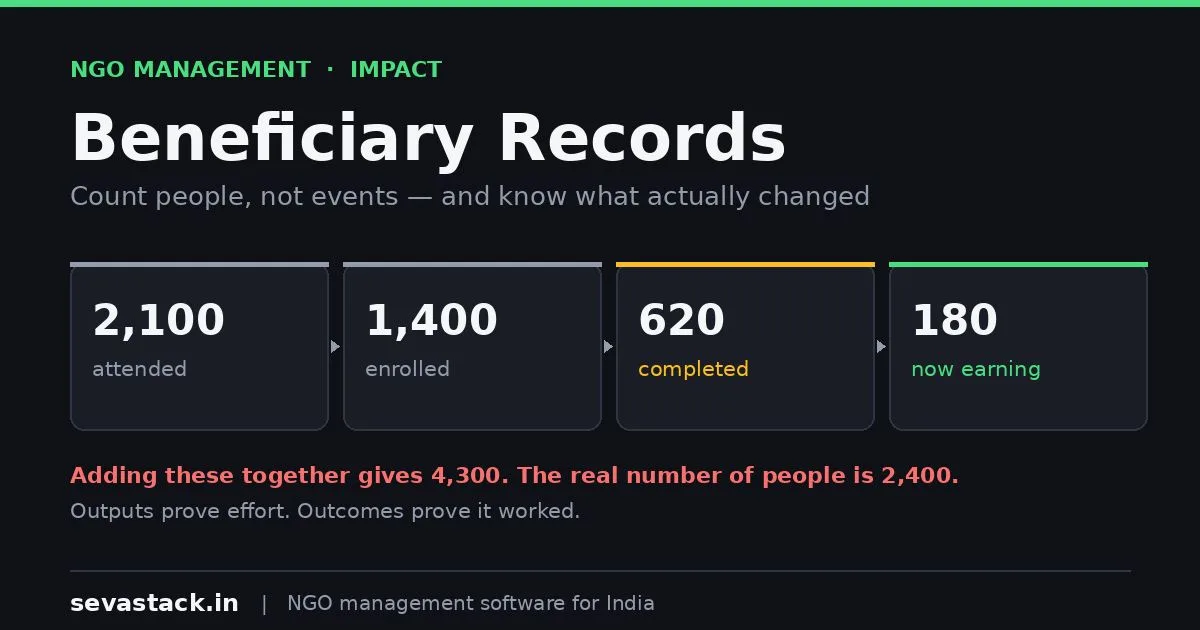
Beneficiary Management: How NGOs Should Track Their Work
Can you prove the numbers in your annual report? A simple guide to beneficiary records, avoiding double counting, and measuring outcomes not outputs.
NGO Management
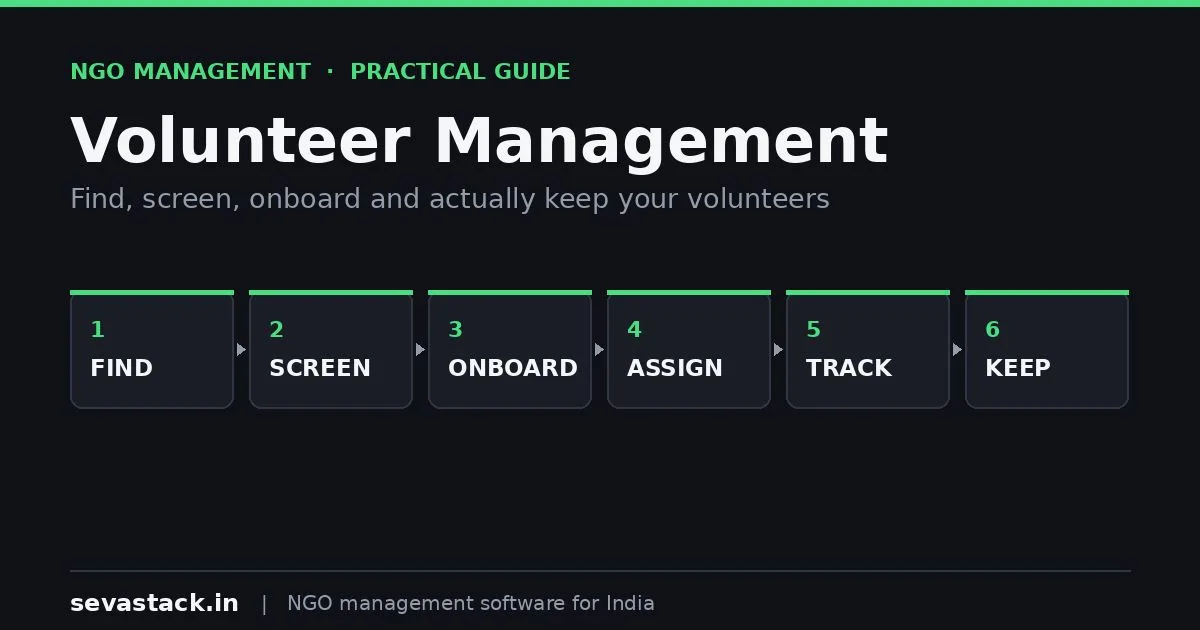
Volunteer Management for NGOs: A Simple Practical Guide
How to find, screen, onboard and keep volunteers at your NGO. A simple guide to hour tracking, certificates, safety rules and what actually works.
NGO Management
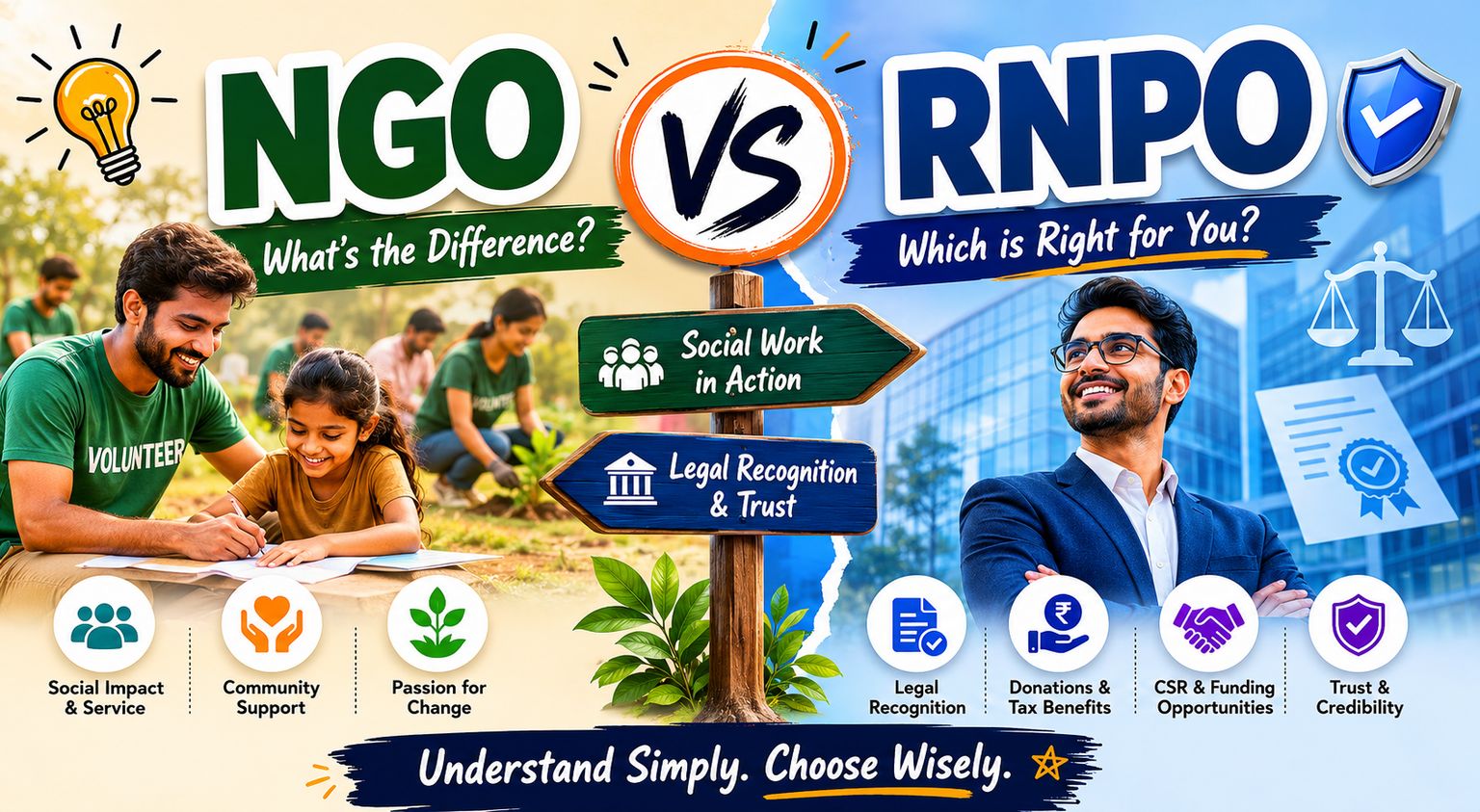
NGO vs RNPO: What’s the Real Difference? A Simple Guide for Founders & Donors
Understand the real difference between NGO and RNPO in simple language. Learn registration types, tax benefits, funding opportunities, and which structure is best for your social initiative.
Never miss a filing date
Sevastack keeps your NGO's compliance calendar and reminds you by email and WhatsApp before each return is due. Donors, 80G receipts and accounts sit in the same place.