

Form 10B vs Form 10BB: Which Must Your NGO File in 2026?
Confused between Form 10B and Form 10BB? Here is the simple 3-question test to know which audit report your NGO must file before 30 September 2026.
Vivek Bhos
Updated 9 min read
Form 10B / 10BB statutory due date30/09/2027
Statutory due date
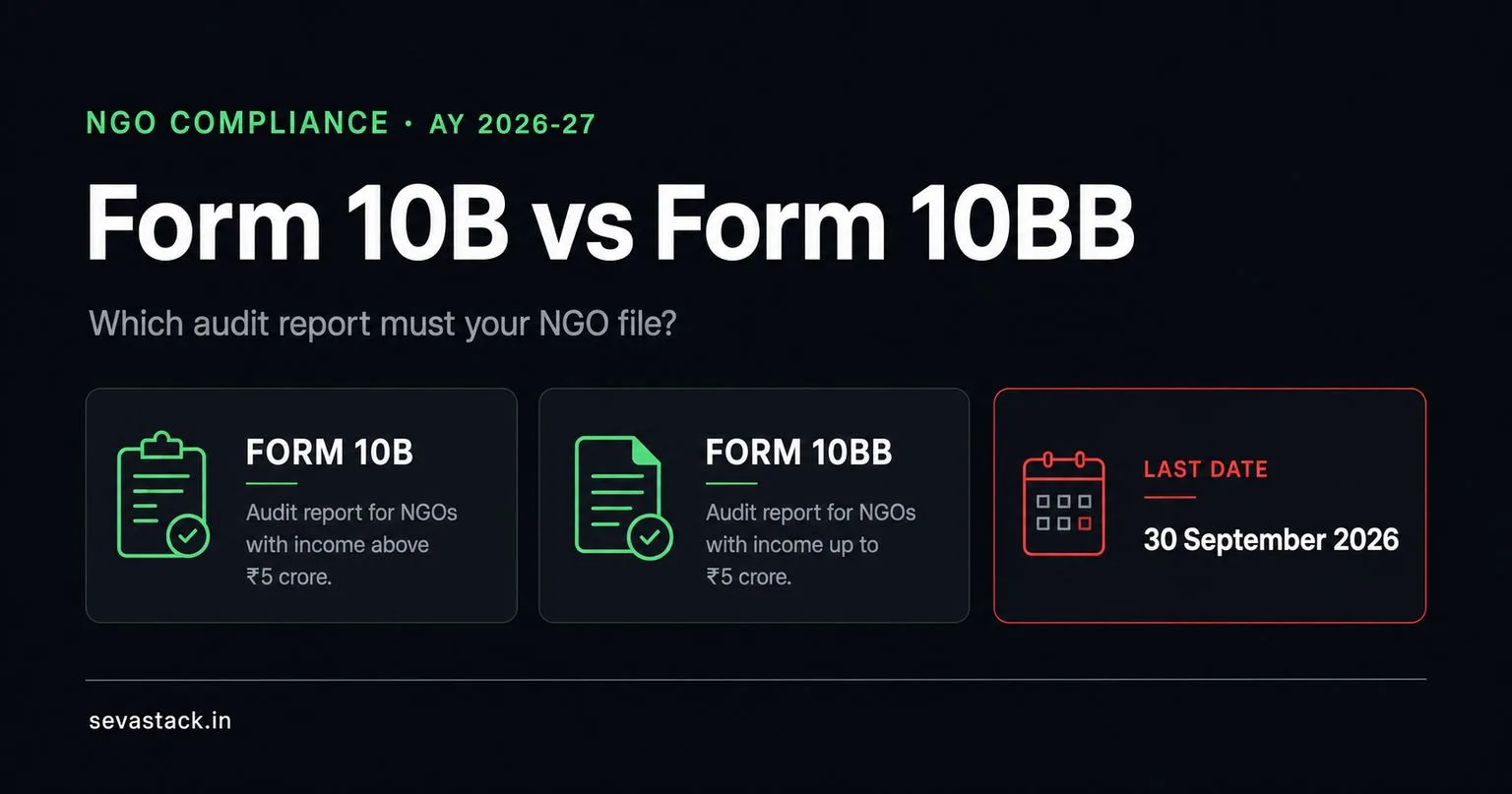
Short answer: File Form 10B if any one of these three things happened last year — your income crossed ₹5 crore, you received foreign funding, or you spent money outside India. If none of them happened, file Form 10BB.
The last date is 30 September 2026.
Sounds simple. But thousands of NGOs pick the wrong form every year, and the penalty is brutal: the Income Tax Department treats a wrong form exactly like no form at all. Your tax exemption can be cancelled — on money you have already spent on your beneficiaries.
This guide explains the rule in plain language, with no tax jargon.
Quick summary
Question | Answer |
|---|---|
Who must file? | Every NGO registered under 12A / 12AB or approved under 10(23C) |
Which form? | 10B if any of the 3 triggers apply. Otherwise 10BB |
Last date | 30 September 2026 (for FY 2025-26) |
Who files it? | Your Chartered Accountant, online |
ITR-7 last date | 31 October 2026 |
If you file wrong or late | Tax exemption can be denied |
What is Form 10B and Form 10BB?
Both are audit reports.
If your NGO has 12A/12AB registration, the law says a Chartered Accountant must check your accounts every year and submit a report to the Income Tax Department. Only after that report is filed can you file your income tax return (ITR-7) and claim your exemption.
Earlier, there was just one form for everyone. In 2023, the CBDT split it into two — Form 10B and Form 10BB.
Think of it this way: 10B is the detailed report. 10BB is the shorter one. Which one you get depends on your NGO's activity last year.
The biggest mistake NGOs make
Ask most trustees which form they file and they will say:
"We are a 12A trust, so we file 10B. Only 10(23C) institutions file 10BB."
This is wrong. It was the old rule, before 2023. Many websites still repeat it.
Today, your form is not decided by your registration section. It is decided by what happened in your accounts last year.
Two trusts, both registered under 12A, can end up filing different forms. That is normal.
How to know which form your NGO must file
Answer these three questions about FY 2025-26 (1 April 2025 to 31 March 2026).
Question 1: Was your income more than ₹5 crore?
Important: this means income before you subtract your exemption.
Add up everything that came in — donations, grants, interest, rent, any other receipts. Do this before applying Section 11 or 12.
Most NGOs check the wrong number here. After exemption, a well-run NGO's taxable income is often close to zero. That is not the figure to use. Use the gross figure.
Example: Your NGO received ₹5.4 crore in grants and spent almost all of it on programmes. Your taxable income is nil. But your income before exemption is ₹5.4 crore, so you cross the limit. You file Form 10B.
Question 2: Did you receive any foreign funding?
Any amount at all. There is no minimum.
If even one FCRA donation came into your SBI New Delhi account last year, you file Form 10B — even if your total income was only ₹20 lakh.
Question 3: Did you spend any money outside India?
Again, no minimum amount.
This one surprises many NGOs. It includes things like funding a partner organisation in another country, sponsoring a student abroad, or paying an international consultant for project work.
If yes, you file Form 10B.
Now check your answers
Any one "yes" → File Form 10B
All three "no" → File Form 10BB
That is the whole test.
One thing to remember: Form 10BB is not the "small NGO form." It is simply what you file when none of the three triggers apply. A ₹6 crore NGO with no foreign funding still files 10B because of the income limit — and a ₹15 lakh NGO with one foreign donation also files 10B.
What information does each form ask for?
Both forms need audited accounts. Form 10B just asks your CA to certify a lot more.
Form 10BB asks for:
Your 12AB or 10(23C) registration details
Income received and how you spent it
Whether you met the 85% spending rule
Corpus donations received
Transactions with trustees and related persons
Form 10B asks for all of the above, plus:
Every trustee's name and PAN
Foreign contribution received and how it was used
Money spent outside India
Anonymous donations (Section 115BBC)
Related-party transactions in much more detail
Business activity details, if any
TDS deducted and deposited during the year
What this means for you: Form 10B takes longer. It is not just a bigger version of the same file — your CA will ask for records you may not have kept properly. If your donor and expense data is spread across five Excel sheets, start early.
Step-by-step: how to file before 30 September
Step 1 — Close your books Finish your ledgers. Match your bank statements. Keep restricted funds, unrestricted funds and corpus separate. Your CA cannot audit accounts that are still open.
Step 2 — Add your CA on the income tax portal Log in to incometax.gov.in, go to My CA, add your Chartered Accountant, and assign the form. Both forms can only be filed online, from the CA's login.
Do this in early September. Portal problems in the last week of the month are very common.
Step 3 — Your CA completes the audit and uploads the form
Step 4 — You accept the form (do not skip this) After your CA uploads it, the form sits in your account as pending. You must accept it using DSC or EVC.
An uploaded form that you never accepted is not a filed form. This is one of the most common reasons NGOs get notices. The CA finished the work, everyone assumed it was done, and nobody clicked accept.
Step 5 — File ITR-7 Only after the audit report is accepted. ITR-7 picks up numbers directly from the audit report, so filing the return first usually means revising it later.
Target: finish Steps 1 to 4 by 15 September. That gives you two weeks to fix anything that goes wrong.
What happens if you file the wrong form or file late?
Wrong form: Treated as if you filed nothing. Your exemption under Section 11 and 12 can be denied. The department then processes your ITR-7 without exemption and raises a tax demand — on money you have already spent on your work.
Late filing: Same risk. There is a relief process called condonation of delay, and CBDT has allowed it in genuine cases, but you have to apply for it, it takes months, and it is not guaranteed. Do not treat it as a backup plan.
The damage does not stop there. An exemption problem shows up later in FCRA checks, in your 80G renewal, and in CSR due diligence when a company reviews your last three years of filings before funding you. One missed audit report can cost you a corporate partner two years later.
Checklist before your CA starts
Go through this list now, not in the last week of September:
☐ Income before exemption calculated — is it above ₹5 crore?
☐ Foreign funding received? Yes or no, confirmed
☐ Money spent outside India? Yes or no, confirmed
☐ Correct form confirmed with your CA in writing
☐ Trustee list updated, with PAN for each trustee
☐ Corpus donations recorded separately
☐ Related-party transactions listed
☐ Anonymous donations identified
☐ TDS deducted, deposited and returns filed
☐ Form 10BD filed and Form 10BE certificates sent to donors
☐ CA added under My CA on the portal
☐ Reminder set to accept the form after upload
Frequently asked questions
Can I file Form 10B even if Form 10BB applies to me? No. Filing the wrong form — either way around — is treated as not filing at all. There is no "safer option."
Who files the form, me or my CA? Your CA files it from their login. But you must nominate them first, and you must accept the form after they upload it.
My NGO had zero income last year. Do I still file? Discuss it with your CA. Your audit and filing requirement depends on your income before exemption, not your final taxable income. Do not assume you are exempt from filing.
What is the difference between Form 10B and Form 10BD? Completely different things. Form 10B/10BB is your audit report, due 30 September. Form 10BD is your donation statement listing every donor, due 31 May. You need both.
Can I file ITR-7 first and the audit report later? Technically possible, practically a bad idea. ITR-7 takes figures from the audit report. Filing out of order almost always means revising your return.
What if I already filed the wrong form last year? Speak to your CA immediately about a revised filing or a condonation application. Do not wait for a notice.
How to make next year easier
The NGOs that stay calm in September are not the ones with the best CA. They are the ones whose donations, receipts, fund allocations and expenses were already recorded correctly through the year.
Your Form 10BD, your audit report and your ITR-7 all describe the same money. When those three do not match, the Income Tax Department sees it almost automatically — and a mismatch in Form 10BD can also cost your donors their 80G deduction.
If your records currently live in spreadsheets, fix that after this filing is done.
Sevastack tracks your 10B, 10BB, 10BD and ITR-7 deadlines for you, keeps corpus and restricted funds separate as you record them, and gives your CA read-only access to your books through a dedicated portal. Start free — no credit card needed.
This article is general information, not tax advice. Please confirm your NGO's position with your Chartered Accountant before filing.
Related guides
Vivek Bhos
Written by the Sevastack team, who build and maintain the 80G receipt, FCRA, and Form 10BD/10BE automation used by Indian NGOs on the platform every day. Compliance guidance is reviewed against current Income Tax Act and FCRA rules before publishing.
Read next

Compliance
ITR-7 Due Date Extended to 21 November: What NGOs Must Do
CBDT has extended the ITR-7 due date to 21 November 2026 and the audit report date to 21 October. Here is what your NGO should do now, step by step.
Compliance
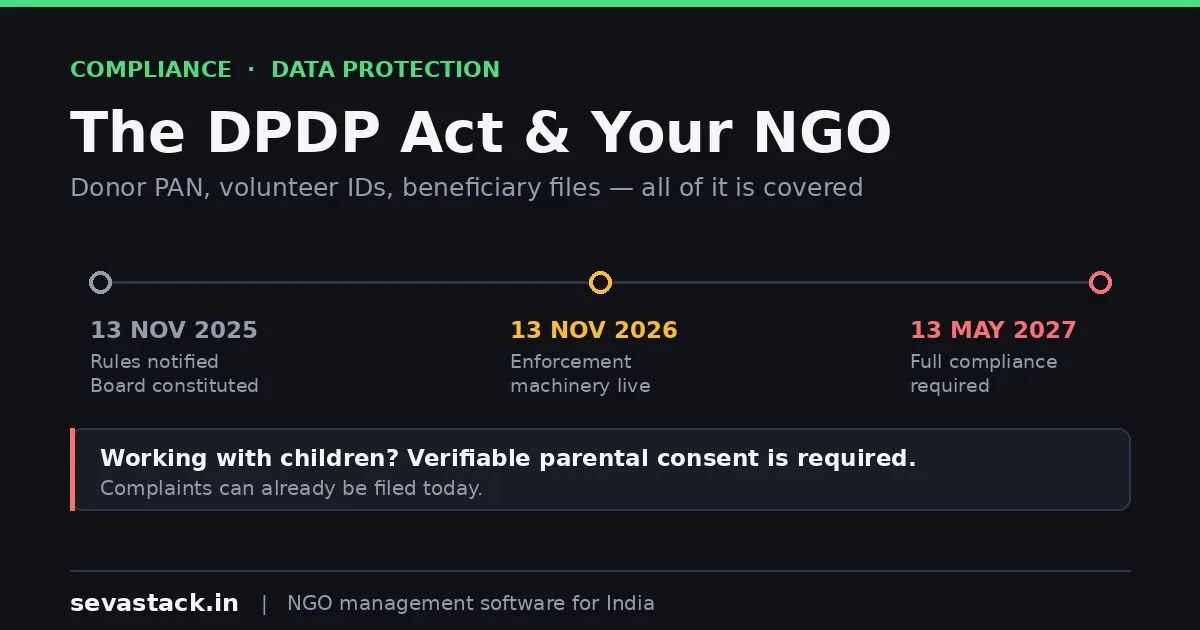
DPDP Act for NGOs in India: A Simple Compliance Guide
Your NGO holds donor PAN, phone numbers and beneficiary records. India's data protection law now covers all of it. Here is what to do, and by when.
Compliance
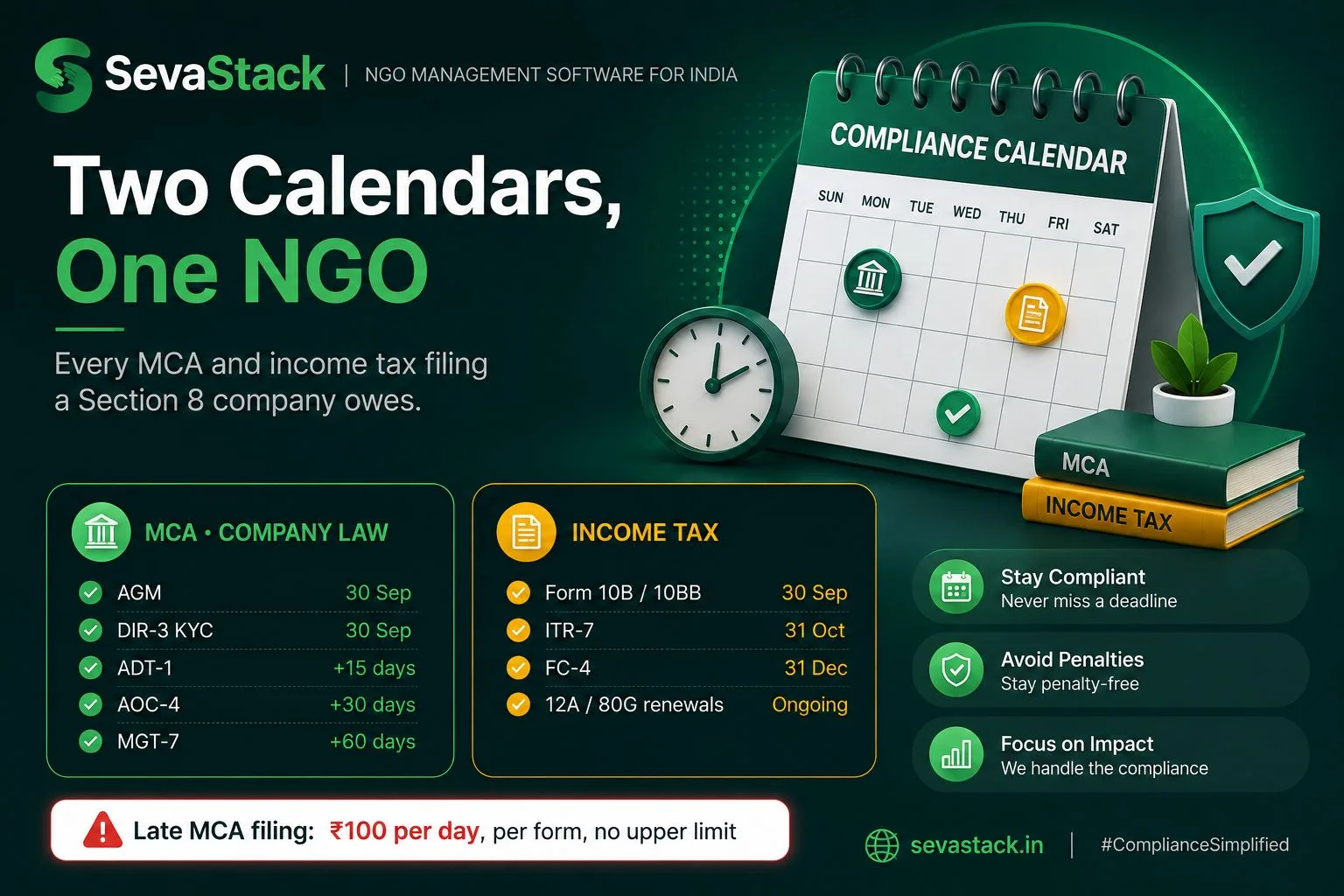
Section 8 Company Compliance: Every Filing and Due Date
Section 8 companies have two separate compliance calendars. Here is every MCA and income tax filing, the due dates, and what late filing costs you.
Never miss a filing date
Sevastack keeps your NGO's compliance calendar and reminds you by email and WhatsApp before each return is due. Donors, 80G receipts and accounts sit in the same place.