

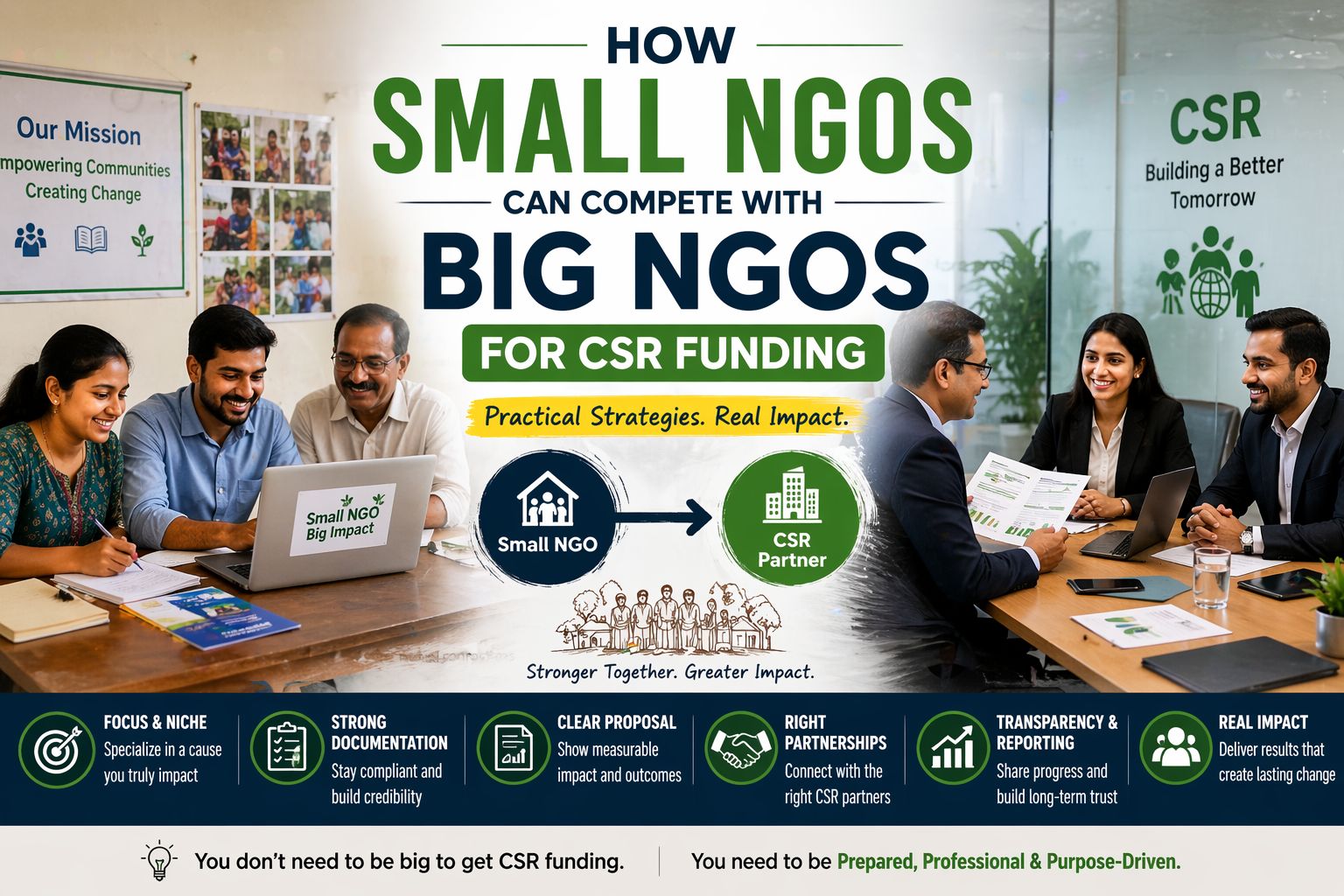
How Small NGOs Can Compete with Big NGOs for CSR Funding (2026 Guide)
Struggling to get CSR funding as a small NGO? Learn practical strategies to compete with big NGOs and win CSR projects in India.
Vivek Bhos
Updated 4 min read
If you’re running a small NGO in India, you’ve probably felt this:
👉 “Big NGOs get all the CSR funding.”
👉 “We don’t have connections.”
👉 “Companies don’t take us seriously.”
And honestly — this feeling is valid.
Large NGOs have:
Established reputation
Dedicated fundraising teams
Strong documentation
Existing CSR partnerships
But here’s the truth most people don’t talk about:
👉 Small NGOs can absolutely win CSR funding — if they play smart.
This blog will show you how.
Why Big NGOs Usually Win CSR Funding
Before we talk about strategy, let’s understand reality.
Companies prefer big NGOs because:
They look more “reliable”
They have past project experience
They can handle large budgets
Their reporting systems are strong
👉 It’s not always about impact.
👉 It’s about trust and structure.
The Advantage Small NGOs Actually Have
This is where things get interesting.
Small NGOs are:
✔ More connected to ground reality
✔ More flexible
✔ Faster in execution
✔ More focused on specific communities
👉 And companies know this.
In fact, many CSR teams are actively looking for local implementation partners.
The problem is not your size.
👉 The problem is how you present yourself.
7 Practical Ways Small NGOs Can Compete
1. Focus on a Niche (Don’t Try to Do Everything)
Most small NGOs make this mistake.
They try to:
Work in education
Health
Women empowerment
Skill development
👉 All at once.
This weakens your positioning.
Instead:
👉 Pick ONE clear focus.
Example:
“Digital literacy for rural girls in Maharashtra”
This makes your NGO:
Easy to understand
Easy to fund
Easy to trust
2. Build Strong Documentation (This Changes Everything)
CSR teams care about:
Proper NGO registration
12A & 80G
CSR-1 certificate
Financial records
Activity reports
If your documentation is weak:
👉 You won’t even reach proposal stage.
Even as a small NGO:
Keep clean records
Maintain basic reports
Show proof of work
👉 This alone puts you ahead of many NGOs.
3. Create a Clear, Outcome-Based Proposal
Most NGOs send generic proposals.
Big mistake.
Instead of writing:
“We want to help rural communities”
Write:
“We will train 500 rural women in digital skills over 6 months at ₹2,000 per beneficiary.”
👉 Specific = powerful
Your proposal should clearly show:
Problem
Solution
Measurable impact
Budget
4. Target the Right Companies (Don’t Spam Everyone)
Small NGOs often send proposals to 100+ random companies.
That doesn’t work.
Instead:
👉 Research properly:
Companies funding your cause
Companies in your region
Mid-sized companies (less competition)
👉 Focus on 30–50 relevant companies.
Quality > quantity.
5. Use Warm Introductions (Game Changer)
Cold emails have very low success.
Instead, try:
LinkedIn connections
Alumni networks
Existing donors
Local business contacts
👉 One good introduction can do more than 100 cold emails.
6. Show Credibility Without Big Brand
You may not have a big name.
But you can still build trust.
Show:
Real photos from field
Testimonials
Small success stories
Community impact
👉 Authenticity beats branding.
7. Be Fast and Professional
This is where small NGOs can win easily.
When a company responds:
Reply quickly
Share documents on time
Be clear in communication
Big NGOs are sometimes slow.
👉 Your speed can be your advantage.
What CSR Teams Actually Look For
Let’s simplify this.
Companies don’t just fund “big NGOs”.
They fund NGOs that are:
✔ Reliable
✔ Clear in communication
✔ Strong in compliance
✔ Able to show impact
👉 Size is secondary.
👉 Structure is primary.
Common Mistakes Small NGOs Must Avoid 🚫
Applying without CSR-1
Sending same proposal everywhere
Poor documentation
No follow-up
Overpromising results
👉 These mistakes reduce your chances drastically.
How SevaStack Helps Small NGOs Compete Better
Let’s be practical.
Most small NGOs struggle because:
Everything is manual
Data is scattered
Reporting is difficult
That’s exactly what SevaStack solves.
With SevaStack, you can:
Maintain compliance (12A, 80G, CSR-1)
Track donors and funding
Create structured reports
Stay audit-ready
👉 So even a small NGO can look professional and ready for CSR funding.
Final Thoughts
You don’t need to become a “big NGO” to get CSR funding.
You need to become a structured NGO.
Start with:
Clear focus
Strong documentation
Smart outreach
And over time:
👉 Funding will follow.
💬 Question for You
Are you currently trying to get CSR funding?
Or still preparing your NGO for it?
Vivek Bhos
Written by the Sevastack team, who build and maintain the 80G receipt, FCRA, and Form 10BD/10BE automation used by Indian NGOs on the platform every day. Compliance guidance is reviewed against current Income Tax Act and FCRA rules before publishing.
Read next
Fundraising
Diwali Fundraising for NGOs: A Simple 3-Week Campaign Plan
Diwali is on 8 November. Here is a simple 3-week plan for Indian NGOs to run a Diwali fundraising campaign, with ideas, messages and a daily checklist.
Fundraising
After Daan Utsav: How to Thank and Keep Your New Donors
Daan Utsav is over, but your work is not. Learn simple ways to thank new donors, share your impact and keep them giving all year.
Fundraising
Best Fundraising Platforms for NGOs in India (2026)
Ketto, Milaap, GiveIndia, Donatekart and more. A simple guide to the best fundraising platforms for NGOs in India in 2026, with fees and tips.
Never miss a filing date
Sevastack keeps your NGO's compliance calendar and reminds you by email and WhatsApp before each return is due. Donors, 80G receipts and accounts sit in the same place.