

How to Raise Your First ₹10 Lakhs of CSR Funds — A Step-by-Step Guide for Indian NGOs (2026)
Raising your first ₹10 lakhs of CSR funding is the toughest milestone for any Indian NGO. This step-by-step guide covers compliance, proposals, outreach, and real strategies that actually work.
Vivek Bhos
Updated 4 min read
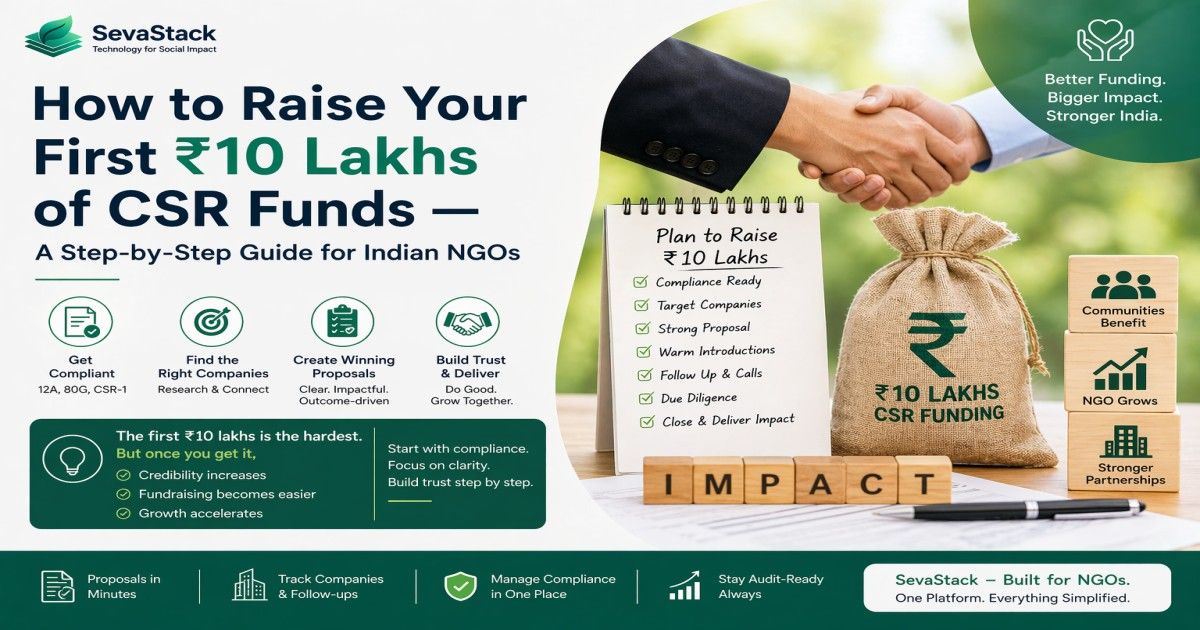
Every NGO founder remembers their first CSR cheque.
Not the third. Not the fifth.
The first ₹10 lakhs is the milestone that changes everything.
It’s what allows you to:
Hire your first team member
Run your first serious program
Build credibility for future funding
But here’s the truth —
this first ₹10 lakhs is also the hardest to raise.
If you’re a new NGO without connections or brand recognition, it can feel almost impossible.
This guide breaks down exactly how to do it — step by step.
Why the First ₹10 Lakhs is So Hard
India has over ₹25,000+ crore in CSR funding every year under Section 135 of the Companies Act.
So the problem is not lack of money.
The real challenges are:
Companies fund NGOs they already trust
Compliance requirements are strict
Most proposals look the same
Many NGOs apply without CSR-1
👉 Fix these — and your chances increase massively.
Before You Start: 3 Must-Have Registrations
Before even thinking about CSR funding, make sure you have these:
1. 12A Registration
Gives your NGO income tax exemption
👉 Without this, your income gets taxed — red flag for companies
2. 80G Certificate
Allows donors to claim tax benefits
👉 Makes your NGO more attractive for funding
3. CSR-1 Registration
This is mandatory for CSR funding
👉 Without CSR-1, no company can legally fund you
✅ Ideal Order:
NGO Registration → 12A + 80G → CSR-1
👉 Timeline: 2–3 months
Step-by-Step Plan to Raise Your First ₹10 Lakhs
Step 1: Fix Your Compliance First
This is non-negotiable.
Most NGOs get rejected before proposal review —
just because documents are incomplete.
👉 Get everything ready before outreach.
Step 2: Define a Clear Problem & Outcome
Don’t try to do everything.
Your pitch should be crystal clear:
One target group (e.g., rural women)
One problem (e.g., lack of digital literacy)
One outcome (e.g., 500 trained women)
One cost (e.g., ₹2,000 per beneficiary)
👉 If you can’t explain this in 30 seconds, refine it.
Step 3: Build a Target List of Companies
Don’t spam everyone.
Instead:
Find companies already funding similar causes
Check their CSR reports
Focus on companies in your region
Target mid-sized companies (₹50L–₹5Cr CSR budgets)
👉 Aim: 50 companies
Step 4: Get Warm Introductions
Cold emails rarely work.
Warm introductions = game changer.
Where to find them:
LinkedIn connections
Alumni networks
Existing donors
NGO partnerships
👉 This increases reply rate from 2% → 30%+
Step 5: Create a High-Quality CSR Proposal
Most NGOs lose here.
Your proposal should be:
Short (6–8 pages max)
Clear and structured
Outcome-driven
Must Include:
Problem statement
Solution
Measurable impact
Budget breakdown
Compliance details
👉 First page matters most.
Step 6: Handle the First Call Smartly
When you get a call:
Listen first (understand their priorities)
Pitch clearly (30-sec explanation)
Share real examples
Ask for next step
👉 Never end without a clear action.
Step 7: Clear Due Diligence Fast
Be ready with:
Registration documents
Financials
Activity proof
Team details
👉 Respond within 24 hours — speed builds trust.
Step 8: Close & Deliver
Once approved:
Sign MoU
Follow reporting timelines
Track impact properly
👉 Your first project decides your future funding.
Common Mistakes to Avoid 🚫
Applying without CSR-1
Sending same proposal to everyone
Overpromising results
Weak financial records
Not following up
Giving up too early
👉 CSR fundraising is a numbers game.
Realistic Timeline
Month 1–3 → Compliance setup
Month 4 → Target research
Month 5–6 → Outreach
Month 7–9 → Calls & due diligence
Month 10–12 → First funding
👉 Yes, it takes time — but it compounds fast after first win.
How SevaStack Helps You Do This Faster
Let’s be honest —
most NGOs struggle because everything is manual.
That’s exactly what we’re solving.
With SevaStack, you can:
Generate CSR proposals in minutes
Track companies and follow-ups
Manage compliance in one place
Stay audit-ready always
👉 No spreadsheets. No chaos.
👉 Just one clean system built for NGOs.
Final Thoughts
The first ₹10 lakhs is the hardest.
But once you get it:
Credibility increases
Fundraising becomes easier
Growth accelerates
👉 Start with compliance
👉 Focus on clarity
👉 Build trust step by step
💬 Question for You
Are you currently trying to raise CSR funding?
Or still preparing your NGO for it? Complete NGO Registration Pricing
Vivek Bhos
Written by the Sevastack team, who build and maintain the 80G receipt, FCRA, and Form 10BD/10BE automation used by Indian NGOs on the platform every day. Compliance guidance is reviewed against current Income Tax Act and FCRA rules before publishing.
Read next
Fundraising
Diwali Fundraising for NGOs: A Simple 3-Week Campaign Plan
Diwali is on 8 November. Here is a simple 3-week plan for Indian NGOs to run a Diwali fundraising campaign, with ideas, messages and a daily checklist.
Fundraising
After Daan Utsav: How to Thank and Keep Your New Donors
Daan Utsav is over, but your work is not. Learn simple ways to thank new donors, share your impact and keep them giving all year.
Fundraising
Best Fundraising Platforms for NGOs in India (2026)
Ketto, Milaap, GiveIndia, Donatekart and more. A simple guide to the best fundraising platforms for NGOs in India in 2026, with fees and tips.
Never miss a filing date
Sevastack keeps your NGO's compliance calendar and reminds you by email and WhatsApp before each return is due. Donors, 80G receipts and accounts sit in the same place.