

The Identity Shift: Why India’s NGOs Are Rebranding as NPOs
India’s social sector is evolving. Discover why NGOs are increasingly rebranding as NPOs and how this shift reflects a move toward professionalism, compliance, and scalable impact.
Vivek Bhos
Updated 3 min read
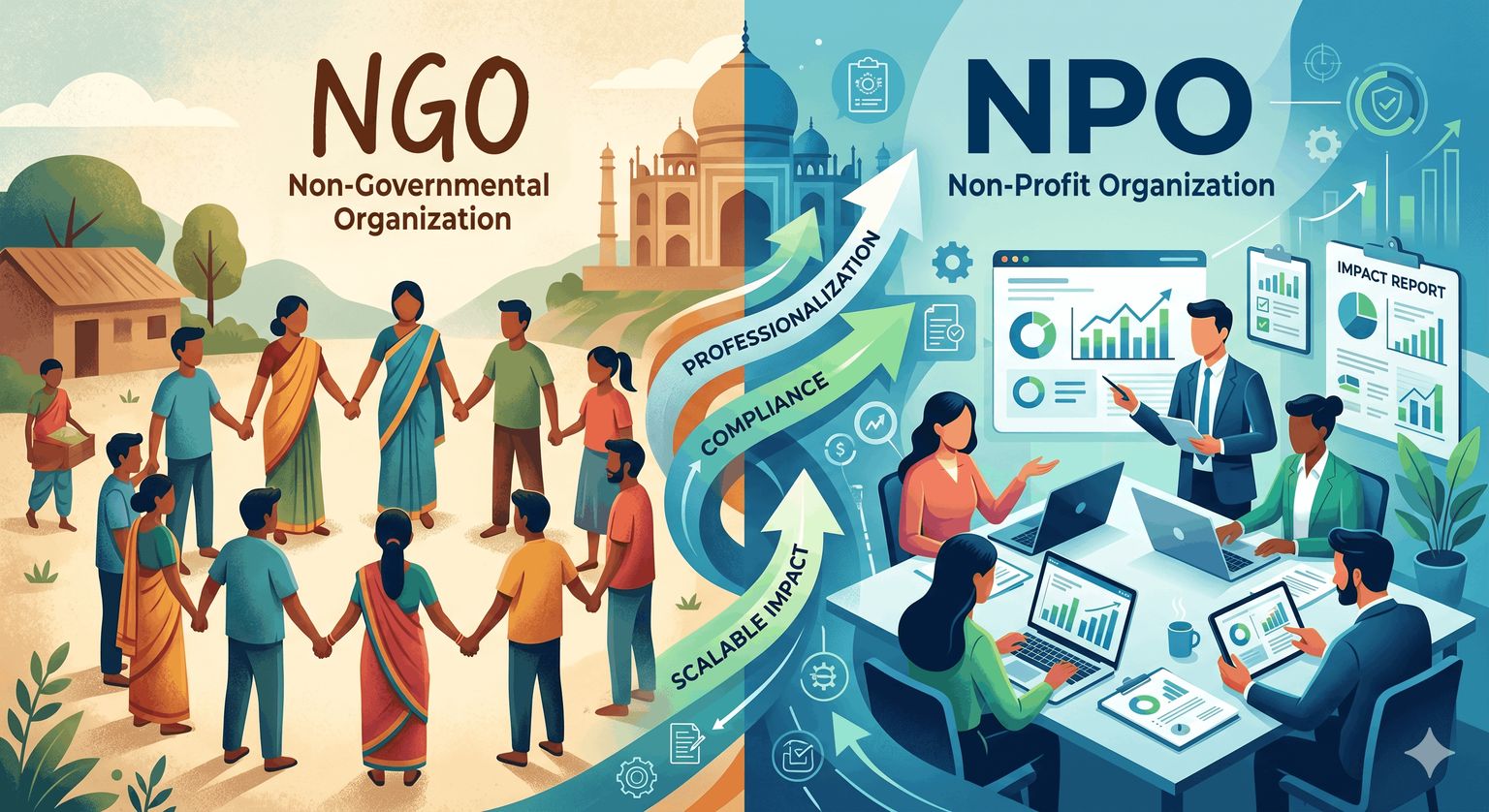
If you’ve read a recent CSR report, impact document, or even a Section 8 filing… you might’ve noticed something subtle:
👉 The word “NGO” is slowly disappearing.
Instead, you’ll see “NPO” (Non-Profit Organization) everywhere.
Interestingly, people still say NGO in conversations…
but professionally, the shift is real.
So what’s actually changing?
The Corporate Influence: Rise of Section 8 Companies
The turning point came with the Companies Act, 2013.
With the introduction of Section 8 Companies, organizations started becoming more structured and governance-driven.
Earlier, NGOs were often:
Informal
Founder-led
Documentation-light
Now, they are expected to:
Maintain proper governance
Keep structured records
Operate professionally
👉 “NGO” started feeling informal
👉 “NPO” aligned better with structure and accountability
The CSR Connection: Speaking the Language of Corporates
India is the first country to mandate CSR.
And when corporates enter the ecosystem, expectations change.
Companies today look for:
Clear reporting
Measurable impact
Compliance-ready systems
In boardrooms:
👉 “NGO” feels broad
👉 “NPO” feels structured and reliable
So organizations naturally adapt —
because funding today depends on credibility and presentation.
NGO vs NPO: The Perception Shift
Let’s be real 👇
NGO often implies:
Activism-driven
Emotion-led
Informal operations
NPO represents:
Data-driven impact
Structured processes
Audit readiness
Professional execution
👉 NGO = Passion
👉 NPO = Passion + Systems
And today, systems are what unlock scale.
The Real Shift: From Effort to Systems
This isn’t just a name change.
It’s an operational transformation.
To truly function as an NPO, organizations need:
Donor management systems
Clean accounting
Automated 80G receipts
FCRA tracking
Impact reporting
This is where platforms like SevaStack play a crucial role.
With SevaStack, NGOs can:
Automate compliance (12A, 80G, FCRA)
Track donors and funds in real-time
Generate audit-ready reports
Manage beneficiaries, projects, and teams in one place
👉 Moving from manual NGO operations
👉 To system-driven NPO infrastructure
Legal and Tax Reality
From a legal standpoint, the Income Tax Department doesn’t focus on labels.
It focuses on:
Non-profit nature of income
12A and 80G compliance
Proper fund utilization
👉 “Non-Profit” is the functional identity
And operating like one requires structured systems.
Quick Comparison
Aspect | NGO | NPO |
|---|---|---|
Tone | Informal / Grassroots | Professional / Structured |
Perception | Activism-driven | Data-driven & accountable |
Usage | Common language | Corporate & legal context |
Operations | Manual / scattered | System-driven / organized |
Conclusion
At its core, the mission hasn’t changed:
👉 Create impact
👉 Solve real problems
👉 Serve communities
But how we operate is evolving.
The shift from NGO to NPO reflects a bigger transformation:
👉 India is professionalizing social impact
And tools like SevaStack are helping organizations make this transition —
from effort-driven operations to system-driven impact.
Because today, doing good isn’t enough.
👉 You need to track it, prove it, and scale it.
💬 Final Thought
Do you think this shift makes the sector more professional…
or are we slowly losing the grassroots spirit of NGOs?
Vivek Bhos
Written by the Sevastack team, who build and maintain the 80G receipt, FCRA, and Form 10BD/10BE automation used by Indian NGOs on the platform every day. Compliance guidance is reviewed against current Income Tax Act and FCRA rules before publishing.
Read next
Finance
NGO Accounting in India (2026): The Complete Guide to Fund Accounting, 80G, FCRA & Financial Management
Learn everything about NGO accounting in India—from fund accounting and financial statements to 80G, Form 10BD/10BE, FCRA, CSR grants, audits, and accounting best practices for trusts, societies, and
Fundraising
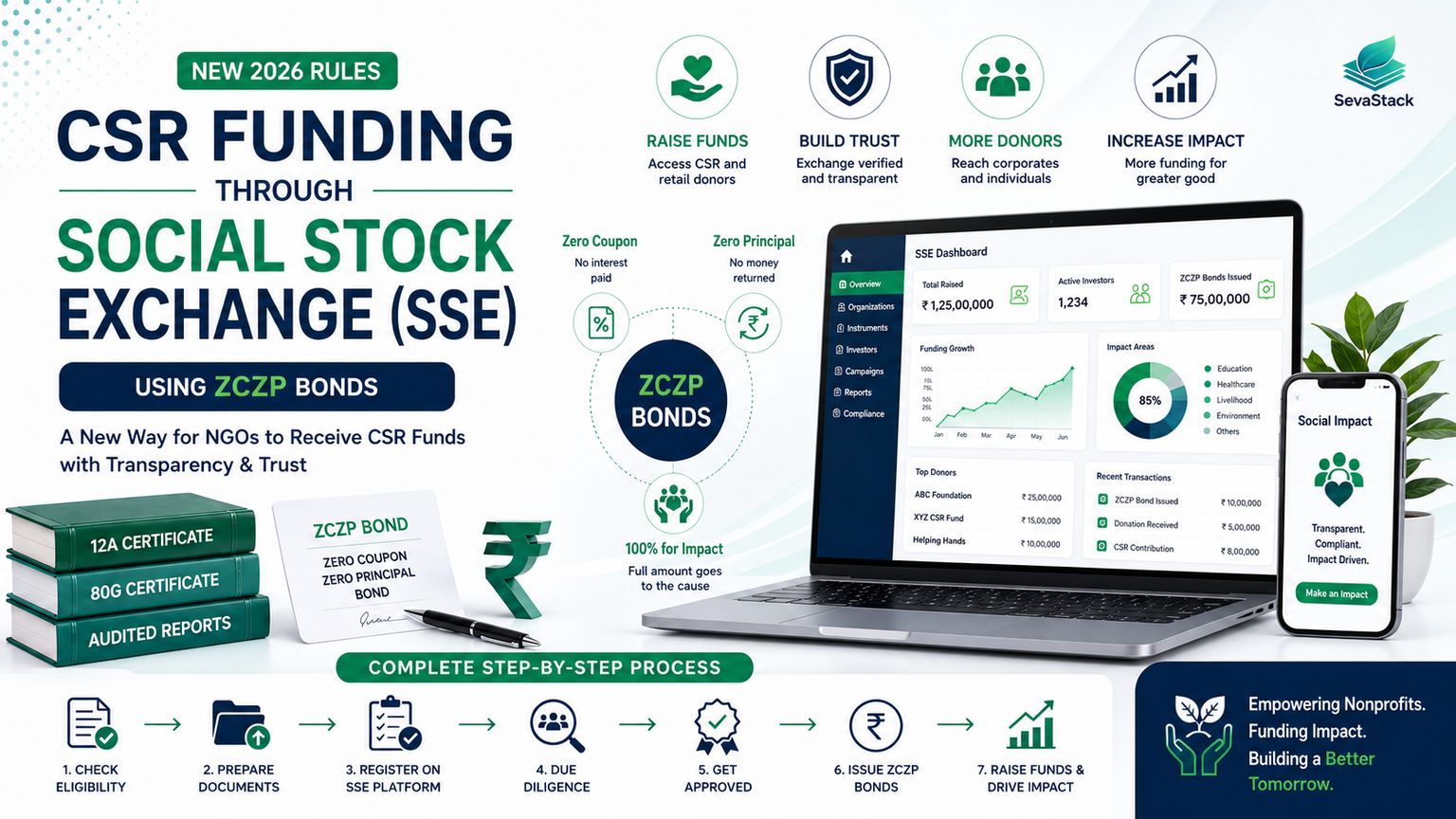
How NGOs Can Receive CSR Funds Through Social Stock Exchange (SSE) and ZCZP Bonds: Complete Guide (2026)
Learn how NGOs can receive CSR funds through India's Social Stock Exchange (SSE) using Zero Coupon Zero Principal (ZCZP) bonds. Understand eligibility, the new 2026 rules, and how the funding process
CSR
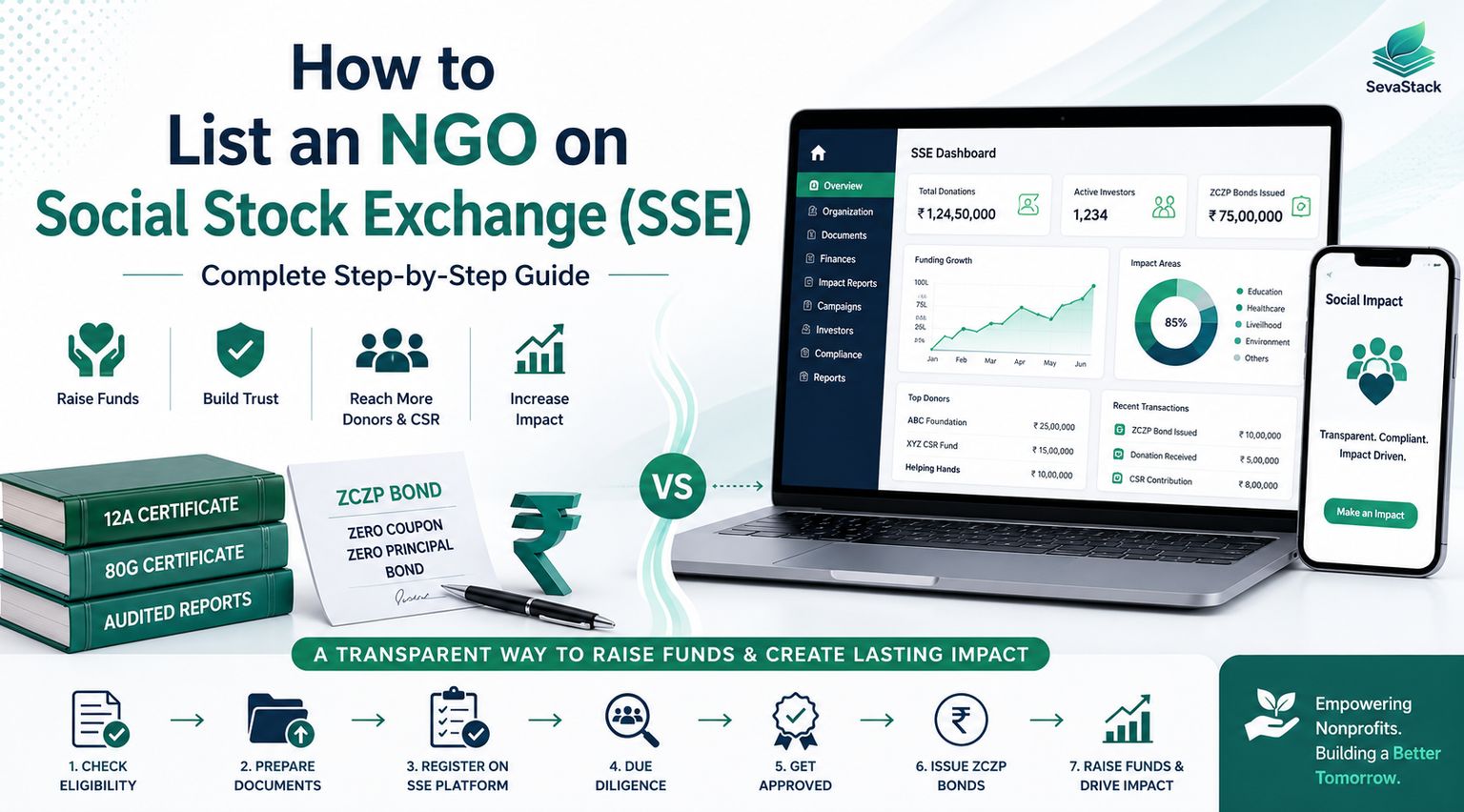
How to List an NGO on India's Social Stock Exchange (SSE): Complete Step-by-Step Guide
Learn how NGOs and Section 8 companies can list on India's Social Stock Exchange (SSE). Understand eligibility, required documents, ZCZP bonds, fundraising opportunities, and the complete step-by-step
Never miss a filing date
Sevastack keeps your NGO's compliance calendar and reminds you by email and WhatsApp before each return is due. Donors, 80G receipts and accounts sit in the same place.