

Receipts and Payments Account: A Simple Guide for NGOs
What is a Receipts and Payments Account? Learn in simple words how NGOs prepare it, how it differs from Income and Expenditure, with an easy example.
Vivek Bhos
6 min read
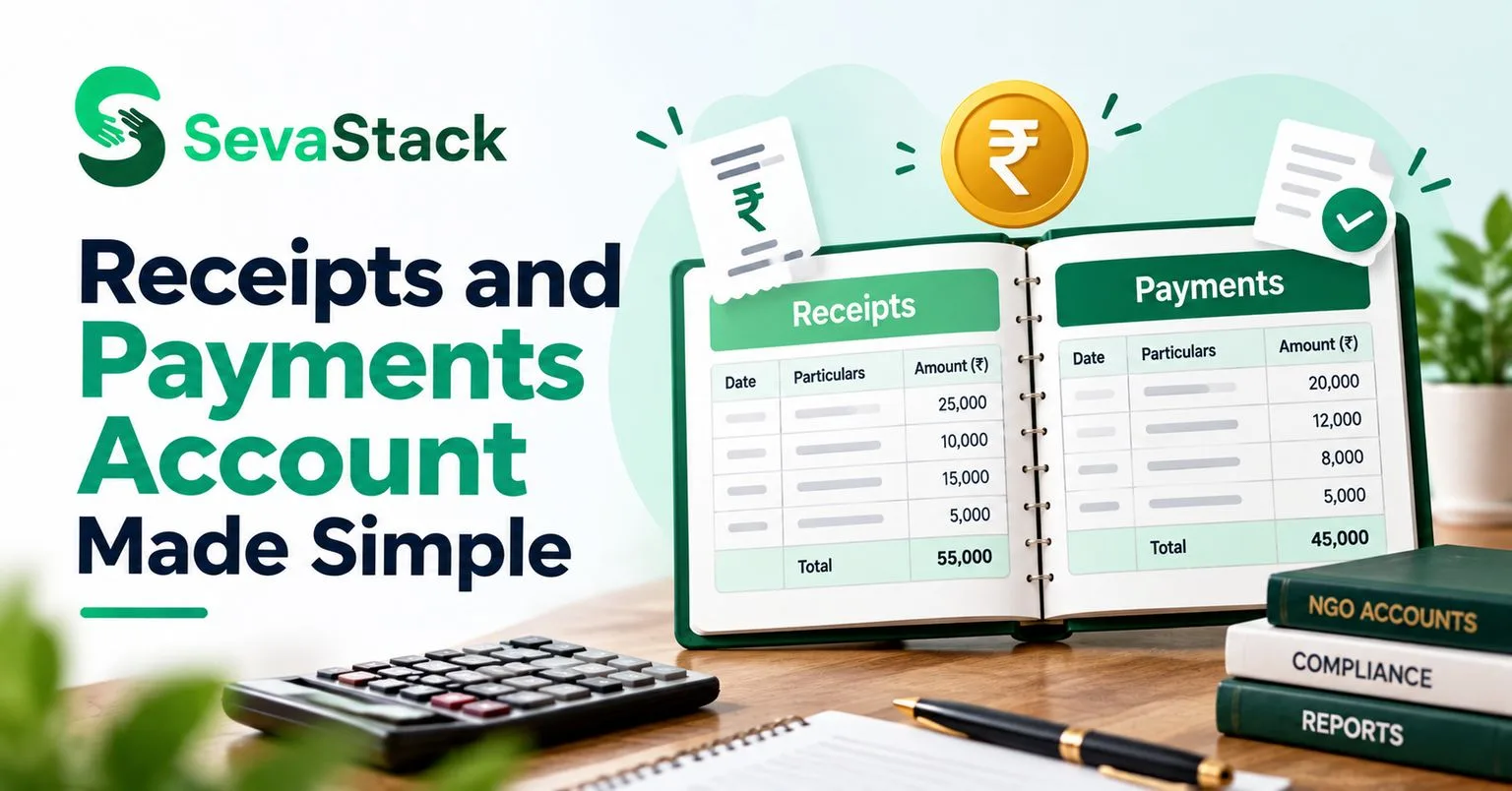
If your NGO is preparing for its audit, your CA has probably asked you for a "Receipts and Payments Account". Many NGOs hear this name and feel worried.
The good news: it is one of the simplest statements in accounting. In this post, we explain it in very easy words, with an example you can copy.
What is a Receipts and Payments Account?
A Receipts and Payments Account is a summary of all the money that came in and went out of your NGO during the year, through cash and bank.
Think of it like your bank passbook, but sorted into neat heads.
It shows:
Your opening balance (cash and bank money on 1 April)
All money received during the year
All money paid during the year
Your closing balance (cash and bank money on 31 March)
That is all. If money did not actually move, it does not come here.
Why does your NGO need it?
Your auditor and CA need it to prepare your final accounts.
It gives a clear picture of your cash during the year.
It helps your trustees or committee understand where money came from and where it went.
Donors and funders may ask for it.
It supports your income tax filing and audit report.
How it looks: the basic format
The traditional format has two sides, like a table:
Receipts (money in) | Amount (₹) | Payments (money out) | Amount (₹) |
|---|---|---|---|
Opening cash balance | Salaries | ||
Opening bank balance | Rent | ||
Donations received | Programme expenses | ||
Grants received | Electricity and phone | ||
Membership fees | Office expenses | ||
Interest on bank deposit | Purchase of assets (computer, furniture) | ||
Other income | Closing cash balance | ||
Closing bank balance | |||
Total | X | Total | X |
Golden rule: The total of the left side must equal the total of the right side. If they do not match, something is missing.
A simple example
Let us take a small NGO, "Asha Trust", for the year 1 April 2025 to 31 March 2026. The numbers are only an example.
Receipts (money in)
Opening cash: ₹5,000
Opening bank: ₹95,000
Donations: ₹6,00,000
Grants: ₹3,00,000
Interest on bank deposit: ₹10,000
Total receipts: ₹10,10,000
Payments (money out)
Salaries: ₹4,00,000
Programme expenses: ₹3,50,000
Rent: ₹60,000
Office expenses: ₹30,000
Purchase of computer: ₹40,000
Closing cash: ₹3,000
Closing bank: ₹1,27,000
Total payments: ₹10,10,000
Both sides are ₹10,10,000, so the account is balanced.
Receipts and Payments vs Income and Expenditure
Many NGOs mix these two up. Here is the difference:
Receipts and Payments | Income and Expenditure | |
|---|---|---|
What it shows | Actual cash and bank movement | Income earned and expenses incurred for the year |
Basis | Cash basis (money actually received or paid) | Accrual basis (includes dues and unpaid bills) |
Includes purchase of assets? | Yes | No (only depreciation is shown) |
Includes opening and closing balance? | Yes | No |
Result | Closing cash and bank balance | Surplus or deficit |
Simple way to remember:
Receipts and Payments tells you where the cash went.
Income and Expenditure tells you whether you earned a surplus or a loss.
For example, if you paid for a computer of ₹40,000, it shows fully in Receipts and Payments. In Income and Expenditure, only a small yearly depreciation is shown.
Your CA will prepare the Income and Expenditure Account and Balance Sheet from this statement and your other records, so a clean Receipts and Payments Account makes the whole audit faster.
Step-by-step: how to prepare it
Step 1: Collect your opening balances
Take the closing balance from last year's accounts. This is your opening balance for cash and bank.
Step 2: List all bank accounts
Include savings accounts, current accounts and any FD interest received. Do not leave out any account, even a small one.
Step 3: Sort receipts into heads
Group money received under clear heads, such as donations, grants, membership fees, interest and other income. Keep foreign contribution (FCRA) and special project funds separate.
Step 4: Sort payments into heads
Group money paid under heads like salaries, rent, programme costs, office costs, travel and purchase of assets.
Step 5: Match with your bank statements
Make sure each bank entry is in your books. Match the closing balance of your books with the bank statement. If they differ, find the reason, for example a cheque not yet cleared.
Step 6: Check your cash balance
Count your actual cash in hand. It should match the closing cash in your books.
Step 7: Make sure both sides total the same
If not, look for missing or wrong entries.
Step 8: Give it to your CA
Share the account, bank statements, bills and vouchers.
Common mistakes to avoid
Mixing cash and accrual. Only include money that actually moved. Unpaid bills do not belong here.
Forgetting a bank account. Include all accounts, even small ones.
Putting restricted funds with general funds. Keep project funds and FCRA money separate.
Not recording small cash expenses. Small amounts add up. Keep a petty cash book.
Missing vouchers and bills. Every payment needs proof.
Wrong opening balance. It must match last year's closing balance.
Leaving it to the last week. Your audit report deadline is 21 October 2026, so start now.
Quick summary
It is a summary of actual cash and bank money in and out
It starts with your opening balance and ends with your closing balance
Both sides must have the same total
It is different from Income and Expenditure
Keep funds separate and match everything with bank statements
Share it with your CA in time for the audit
Frequently asked questions
What is a Receipts and Payments Account in simple words?
It is a summary of all cash and bank receipts and payments of your NGO during the year, starting with opening balance and ending with closing balance.
Is Receipts and Payments Account the same as Income and Expenditure Account?
No. Receipts and Payments shows actual cash movement. Income and Expenditure shows your surplus or deficit on an accrual basis.
Does an NGO need to prepare it?
Most NGOs prepare it, especially when accounts are audited. Ask your CA what format they want.
Does it show a profit or loss?
No. It only shows money in, money out and the closing balance. The surplus or deficit comes from the Income and Expenditure Account.
Who prepares it, the NGO or the CA?
Your accountant usually keeps the books, and your CA reviews and finalises the statements. The cleaner your records, the faster the audit.
Can I make it in Excel?
Yes, small NGOs often do. As your NGO grows, accounting software saves time and reduces mistakes. See our guide on the best NGO accounting software in India.
Make audit time easier
Sevastack keeps your donations, receipts and records in one place, so you can give your CA clean data when audit time comes. Start free and spend less time on paperwork.
Vivek Bhos
Written by the Sevastack team, who build and maintain the 80G receipt, FCRA, and Form 10BD/10BE automation used by Indian NGOs on the platform every day. Compliance guidance is reviewed against current Income Tax Act and FCRA rules before publishing.
Read next
Finance
Best NGO Accounting Software in India (2026): Simple Guide
Confused about which accounting software to pick for your NGO? Here is a simple 2026 guide to Tally, Zoho Books, Excel and NGO-specific tools in India.
Finance
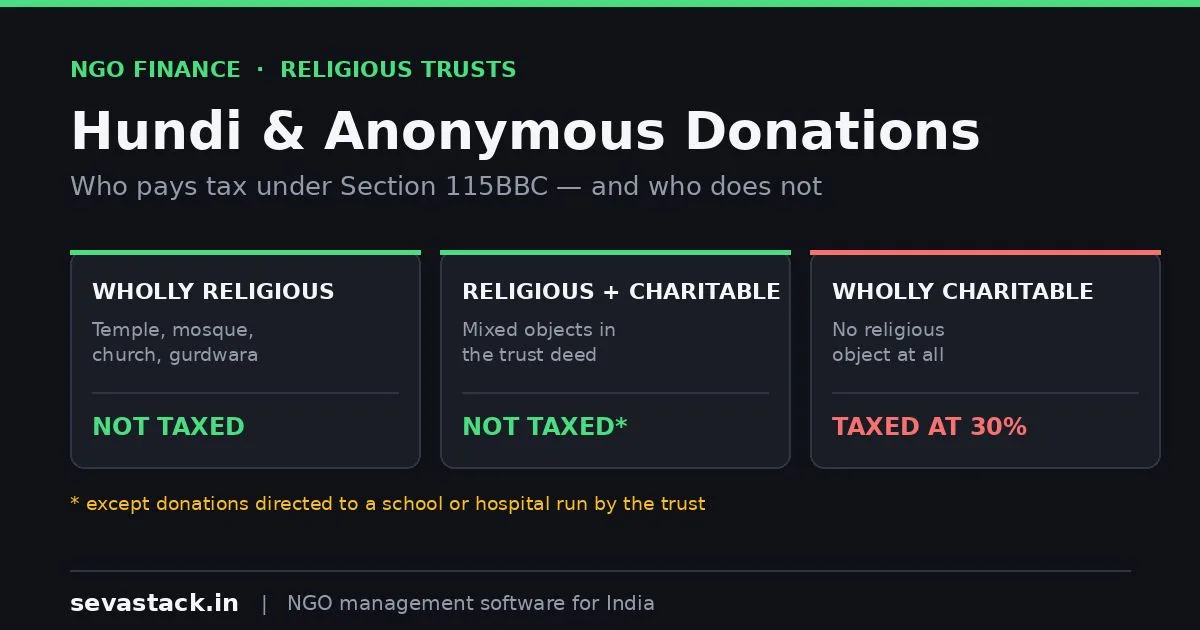
Temple and Religious Trust Accounting: A Practical Guide
Hundi collections, anonymous donations and Section 115BBC explained. Why wholly religious trusts are treated differently, and how to record offerings.
Finance
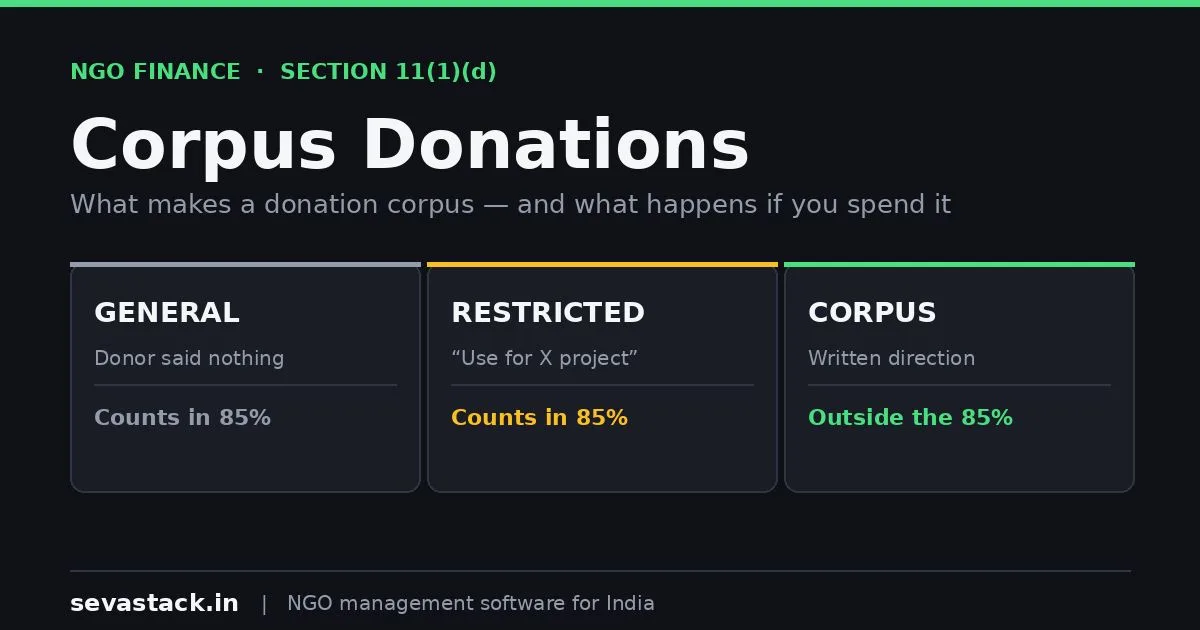
Corpus Donations Explained Simply: Rules Every NGO Needs
What is a corpus donation, how is it different from a normal donation, and what happens if you spend it? A simple guide for Indian NGOs with examples.
Never miss a filing date
Sevastack keeps your NGO's compliance calendar and reminds you by email and WhatsApp before each return is due. Donors, 80G receipts and accounts sit in the same place.