

Temple and Religious Trust Accounting: A Practical Guide
Hundi collections, anonymous donations and Section 115BBC explained. Why wholly religious trusts are treated differently, and how to record offerings.
Vivek Bhos
10 min read
A temple trust opens its hundi. Inside is ₹18 lakh in cash, some gold, and a few hundred coins.
Nobody knows who gave any of it. There are no names, no addresses, no receipts.
Is that ₹18 lakh taxable?
Most people assume yes — it is unrecorded cash, so the tax department must want a share. Several assessing officers have assumed the same thing.
Usually, the answer is no. And the rule that decides it is one of the least understood provisions affecting Indian religious institutions.
This guide explains it simply, along with how to actually run the accounts of a temple, church, gurdwara, mosque or math.
The anonymous donation rule
An anonymous donation is one where you do not have a record of the donor's name and address.
Hundi money is the classic example. So are donation boxes, coin trays and cash dropped at a shrine.
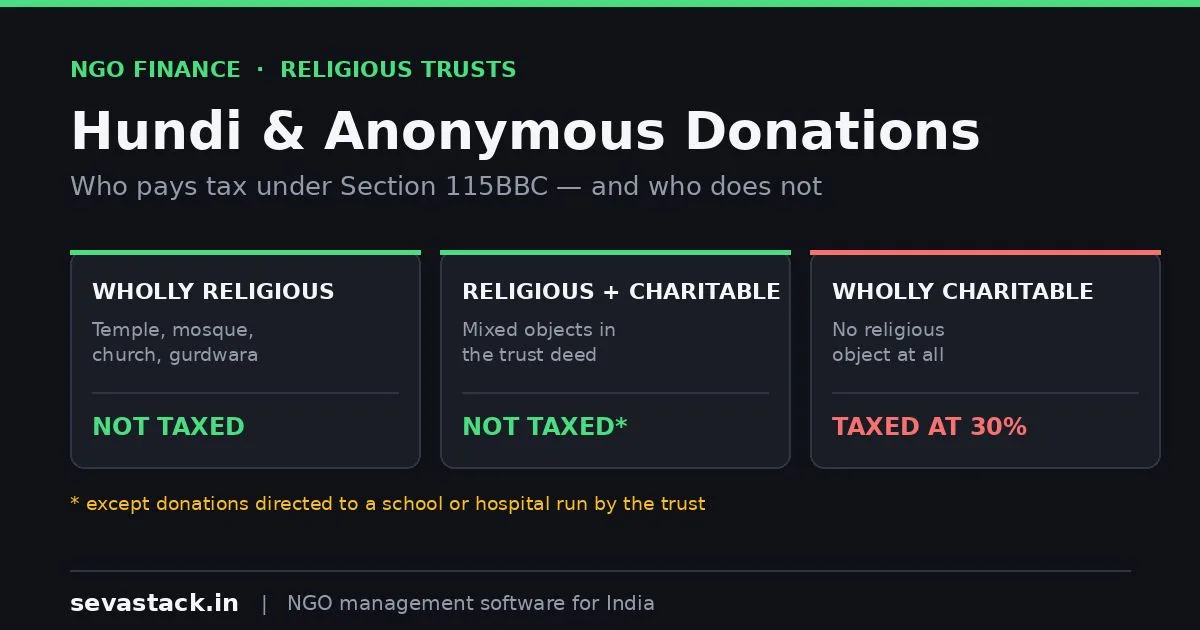
Section 115BBC taxes anonymous donations at 30% — but only for some organisations. Which one you are changes everything.
The three categories
Type of trust | Does 115BBC apply? |
|---|---|
Wholly religious | No. Anonymous donations are not taxed under this section |
Partly religious, partly charitable | No — except for donations specifically directed to a university, school, hospital or medical institution the trust runs |
Wholly charitable (no religious purpose) | Yes. Taxed at 30% above the threshold |
So a temple, gurdwara, mosque or church receiving hundi money from devotees is generally outside this tax. A purely charitable NGO with a collection box is not.
The threshold, when it does apply
For wholly charitable organisations, tax applies only on anonymous donations exceeding the higher of:
₹1,00,000, or
5% of total donations received during the year
Example: A charitable trust receives ₹40 lakh in total donations, of which ₹5 lakh is anonymous. 5% of ₹40 lakh = ₹2 lakh. That is higher than ₹1 lakh, so the threshold is ₹2 lakh. Taxable anonymous donations = ₹5 lakh − ₹2 lakh = ₹3 lakh, taxed at 30%.
Two things worth knowing: the taxable portion gets no exemption under Sections 11 and 12 even if you spend every rupee of it on your objects. And that taxable portion is not counted in your 85% application requirement.
The 80G misunderstanding — settled by the courts
Here is a dispute that has cost religious trusts real money.
Assessing officers have argued: "You are registered under 80G. 80G is for charitable institutions. Therefore you are a charitable trust, not a religious one, so your hundi money is taxable."
The Bombay High Court rejected this. In a case concerning a well-known temple trust, the court held that Section 80G and Section 115BBC(2)(b) operate independently. Holding 80G registration does not stop a religious-and-charitable trust from claiming the anonymous donation exemption.
The court looked at the trust deed, its objects and its actual activities — temple rituals, festivals, feeding the poor, propagating teachings — and concluded it was genuinely religious and charitable. It also rejected the officer's argument that religious activity formed too small a share of total income to count.
What this means for you: if your trust has both religious and charitable objects, your trust deed and your actual activities are what decide the question. Not your 80G certificate.
Practical takeaway: make sure your trust deed clearly states your religious objects, and keep evidence of religious activity — festival records, ritual expenses, photographs, priest payments. If this is ever questioned, that evidence is your case.
How to actually count hundi money
The tax position may be comfortable, but the governance risk is not. Cash with no donor attached is exactly where trusts get into trouble — with the Charity Commissioner, with their own community, and sometimes with the police.
Build a counting protocol and never deviate from it.
Never open the hundi alone. Minimum two people, ideally three, at least one being a trustee
Fix a schedule — the same day each week or month, announced in advance
Seal the boxes and number the seals. Record the seal number when opening
Count in a fixed place, ideally under camera
Record immediately in a bound, numbered register: date, box, seal number, amounts by denomination, total, and signatures of everyone present
Bank the same day or the next working day. Cash sitting overnight is the highest-risk moment in the whole cycle
Rotate who counts. Never let the same person handle it every time
This costs nothing and prevents almost every problem that arises with hundi collections.
Offerings that are not cash
Temples receive gold, silver, ornaments, sarees, coconuts, grain and food.
Keep a separate register for valuables, with description, weight and date
Get metal valued by an approved valuer and record the valuation
Perishables — record quantity, and record how they were used or distributed
Store valuables under dual custody, never with one person
Foreign currency in a hundi needs care. Money from a foreign source is foreign contribution, and receiving it without FCRA registration creates a problem. Segregate any foreign currency, do not bank it with normal collections, and take advice.
The rest of the accounting
Income to track separately
Hundi and donation box collections
Named donations with receipts
Corpus donations, with the donor's written direction
Pooja, archana and ceremony fees
Hall, room and shop rent
Annadanam and prasadam contributions
Interest and investment income
Keeping these separate is what makes your audit straightforward instead of painful.
The 85% rule still applies
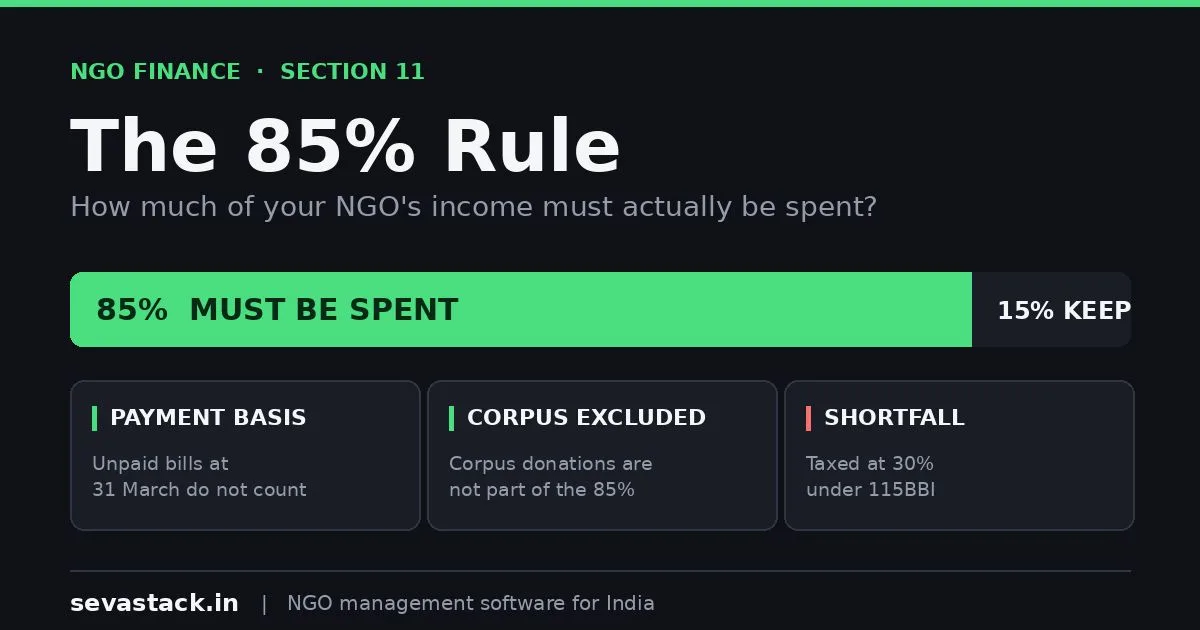
Being religious does not exempt you from the requirement to apply 85% of income towards your objects. Temple maintenance, priest salaries, festival costs, annadanam and building repair all count as application.
The 85% rule explained simply.
Corpus donations
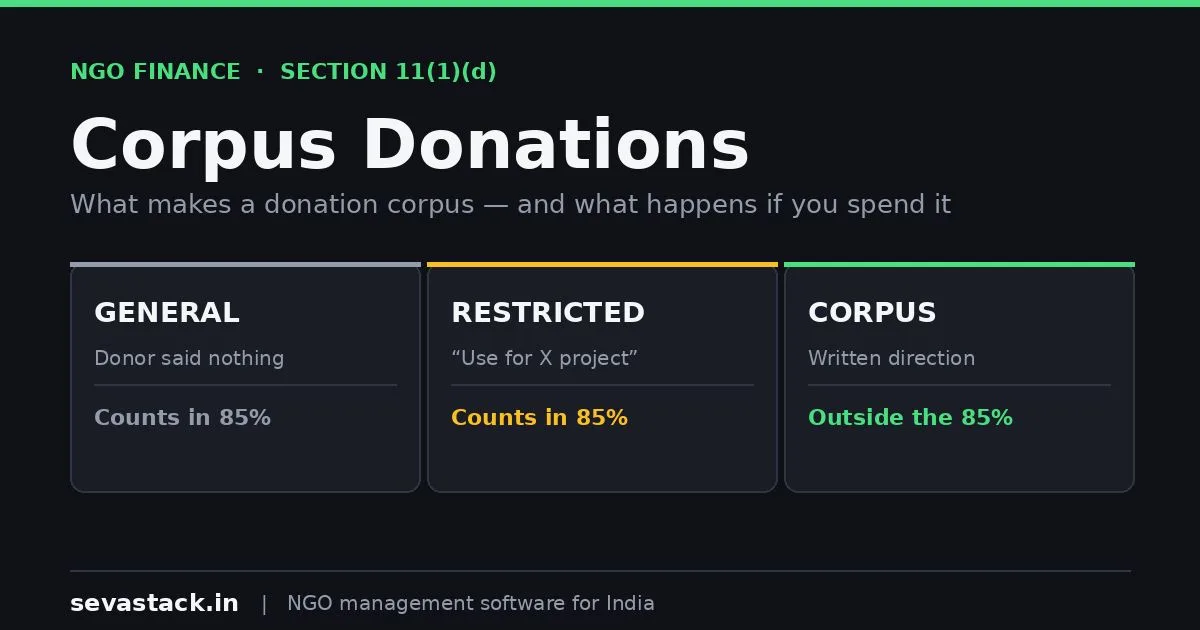
The same rules apply as for any trust: a corpus donation needs the donor's specific written direction, must be kept separately, and must be invested in the permitted modes.
Money from a hundi can never be corpus. You cannot identify the donor, so there is no direction. Writing "Corpus Donation" on the box does not change this.
There is a separate provision for contributions received specifically for the renovation or repair of a notified temple, mosque, gurdwara or church, which can be treated differently. If you are running a renovation appeal, ask your CA about it — the treatment is favourable but conditional.
GST on renting
If your religious place is owned by a registered trust and open to the general public, renting is exempt within limits — broadly rooms below ₹1,000 per day, a hall or open area below ₹10,000 per day, and shops below ₹10,000 per month. Above those figures it becomes taxable.
Income from conducting religious ceremonies is generally exempt.
Keeping 80G alive
Trusts with religious objects can hold 80G registration, but the rules are specific. A trust may spend up to 5% of its total income on religious purposes and retain 80G. And 80G is not available to an institution established for the benefit of a particular religious community or caste.
If you have both religious and charitable objects and hold 80G, review this proportion with your CA each year.
State law
Most states have their own religious and charitable trust legislation — the Charity Commissioner in Maharashtra, endowment departments in several southern states, and separate boards for wakf and other institutions. These carry their own filings, audit rules and permission requirements, especially for selling or mortgaging property.
Never sell, lease or mortgage trust property without checking whether prior permission is required. This is one of the most common serious mistakes religious trusts make.
Common mistakes
Mistake | Fix |
|---|---|
One person opening the hundi | Minimum two people, register, signatures |
Cash held for days before banking | Bank the same or next working day |
Gold and silver in the cash register | Separate valuables register with valuation |
Treating hundi money as corpus | It cannot be corpus — no donor direction exists |
Assuming 80G makes you "charitable only" | Trust deed and activities decide, not 80G |
No record of religious activity | Keep festival, ritual and priest expense records |
Foreign currency banked with normal cash | Segregate and take FCRA advice |
Selling property without permission | Check state law first, always |
Common questions
Our temple trust also runs a school. Does that change anything? It can. For a mixed religious and charitable trust, anonymous donations specifically directed towards a school, college, hospital or medical institution you run are taxable. General hundi money is not. Keep those streams clearly separated in your books.
A devotee gave ₹5 lakh but refused to give their name. Is that anonymous? Yes, if you have no record of name and address. For a wholly religious or mixed trust it is generally outside 115BBC — but it is much better practice to record the donor even if you issue no publicity.
Can devotees claim 80G on hundi donations? No. Without a receipt in their name and their PAN, there is no way to report them in Form 10BD, and no 80G certificate can be issued. Devotees who want the deduction should give by cheque or online and provide their details.
How often should we open the hundi? Frequently enough that large amounts do not accumulate. Weekly or fortnightly for a busy temple, monthly for a small one. Fix the schedule and stick to it.
Are priest and pujari payments allowed as application of income? Yes, where they are for the trust's religious objects. Pay through the bank, deduct TDS where applicable, and keep proper records.
Do we need an audit? The same income tax audit rules apply as to any 12A-registered trust, plus whatever your state law requires. Being religious does not exempt you.
We have never maintained proper hundi records. Where do we start? Start with the next opening. Set the protocol, buy a bound register, and follow it from that day. Do not attempt to reconstruct the past — begin a clean, defensible record now.
The short version
On tax: wholly religious and mixed religious-charitable trusts are generally outside the anonymous donation tax. Wholly charitable organisations are not. Your trust deed and your actual activities decide which you are — not your 80G certificate.
On governance: the real risk in a religious trust is not tax, it is cash. Two people at every hundi opening, a bound register signed by everyone present, and money in the bank the same day. Do those three things consistently and most problems never arise.
Sevastack records hundi collections, named donations, corpus and ceremony income as separate streams, keeps a valuables register alongside your cash book, and produces the reports your auditor and Charity Commissioner ask for. Start free — no credit card needed.
This article is general information, not tax or legal advice. Religious trust taxation is fact-specific and has been litigated extensively. Please confirm your trust's position with your Chartered Accountant.
Related guides
Under the Income-tax Act, 2025 (effective 1 April 2026, replacing the Income-tax Act, 1961), Section 80G is now governed by Section 354 of the new Act. "Section 80G" remains the commonly used and searched term during the transition — the underlying requirement is unchanged, only the section/form numbering has moved. Confirm the applicable form with your CA if you're filing close to the transition date.
Vivek Bhos
Written by the Sevastack team, who build and maintain the 80G receipt, FCRA, and Form 10BD/10BE automation used by Indian NGOs on the platform every day. Compliance guidance is reviewed against current Income Tax Act and FCRA rules before publishing.
Read next
Finance
Corpus Donations Explained Simply: Rules Every NGO Needs
What is a corpus donation, how is it different from a normal donation, and what happens if you spend it? A simple guide for Indian NGOs with examples.
Finance
The 85% Rule: How Much Must Your NGO Actually Spend?
Indian NGOs must spend 85% of income every year or pay tax on the shortfall. Here is what counts as spending, what does not, and how to fix a gap.
Finance
NGO Accounting in India (2026): The Complete Guide to Fund Accounting, 80G, FCRA & Financial Management
Learn everything about NGO accounting in India—from fund accounting and financial statements to 80G, Form 10BD/10BE, FCRA, CSR grants, audits, and accounting best practices for trusts, societies, and
Never miss a filing date
Sevastack keeps your NGO's compliance calendar and reminds you by email and WhatsApp before each return is due. Donors, 80G receipts and accounts sit in the same place.