

Why NGOs Struggle with Documents and Receipts at Year-End (And How to Fix It)
Discover why NGOs face chaos during financial year-end with documents and receipts, and how using the right software can simplify compliance and save time.
Vivek Bhos
Updated 3 min read
Every NGO starts the year with good intentions.
Proper records. Clean data. Organized processes.
But as the year progresses…
Things start slipping.
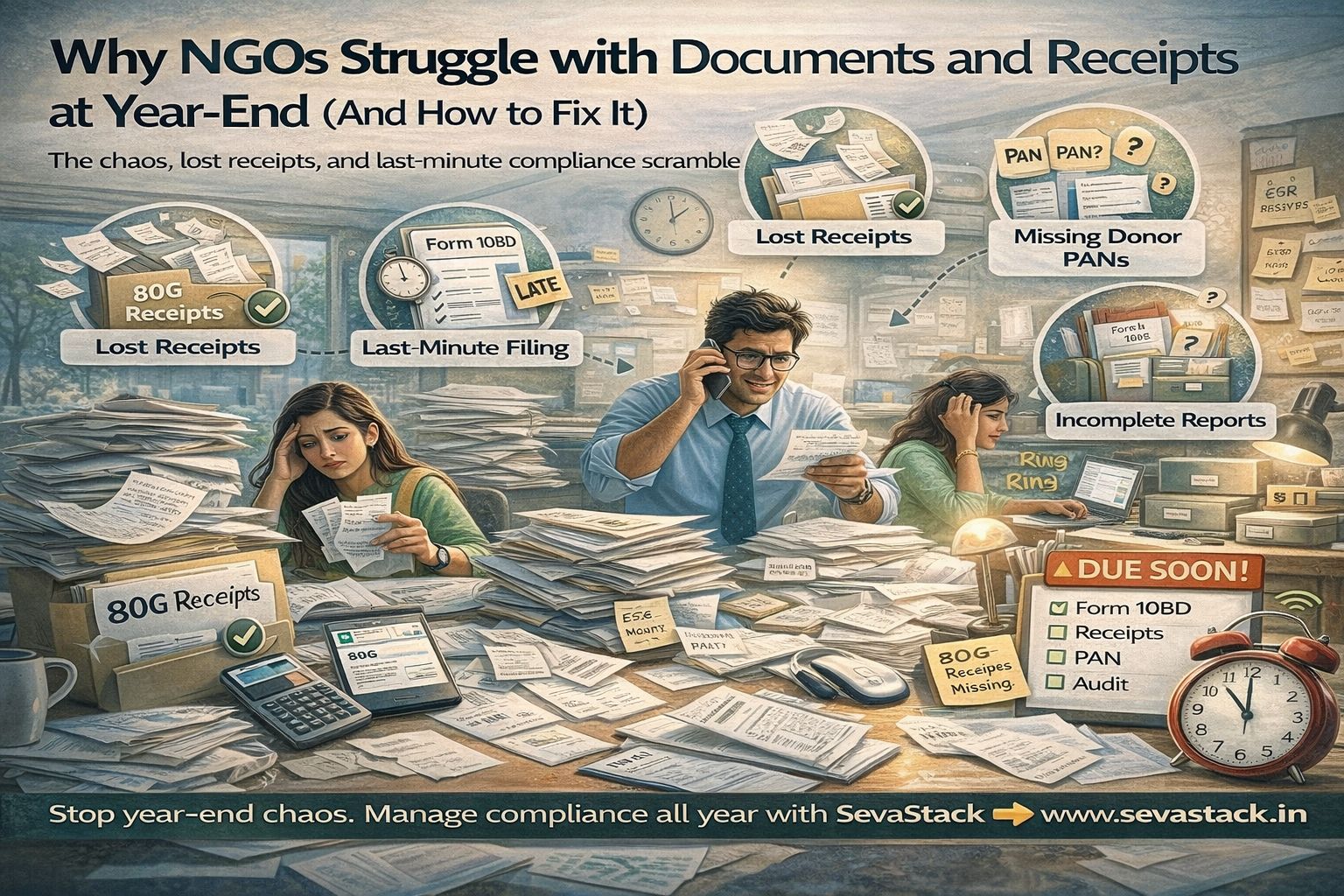
Receipts pile up. Documents go missing. Data gets scattered across Excel sheets, emails, and WhatsApp.
And then comes March.
👉 Panic mode begins.
The Year-End Chaos Every NGO Knows
At the end of the financial year, most NGOs face the same situation:
Searching for missing donation records
Manually generating receipts
Collecting donor PAN details last minute
Preparing data for Form 10BD filing
Handling auditor requests
What should have been a smooth process turns into:
👉 Stress, delays, and errors
The Real Problem Is Not Lack of Effort
It’s easy to blame workload.
But the real issue is something else:
👉 Lack of structured systems
Many NGOs still rely on:
Excel sheets
Manual entries
Unorganized document storage
These methods work at small scale.
But as soon as donations increase…
They break.
The Habit That Creates the Problem
Let’s be honest.
Most NGOs don’t ignore compliance intentionally.
They postpone it.
“We’ll update records later”
“We’ll organize documents at year-end”
“We’ll handle receipts when needed”
This delay builds up over months.
And by year-end…
👉 It becomes unmanageable
Where Things Actually Go Wrong
1. No Real-Time Data Entry
Donations are not recorded immediately.
Details like PAN, email, and amount are often incomplete.
2. Scattered Documents
Receipts and donor details are spread across:
Emails
Google Drive
Local files
WhatsApp chats
There is no single source of truth.
3. Manual Receipt Generation
Instead of automation, NGOs generate receipts one by one.
This leads to:
Errors
Delays
Inconsistent formats
4. Last-Minute Compliance
Form 10BD and related filings are left until the deadline.
This increases pressure and mistakes.
The Cost of This Chaos
This is not just an operational problem.
It directly impacts:
❌ Donor Trust
Delayed or incorrect receipts frustrate donors.
❌ Tax Compliance
Missing data means donors cannot claim 80G benefits.
❌ CSR Opportunities
Companies avoid NGOs with poor systems.
❌ Team Productivity
Staff spends days fixing avoidable issues.
The Better Way: Fix It Before Year-End
The solution is simple:
👉 Don’t manage compliance at year-end
👉 Manage it throughout the year
What Smart NGOs Do Differently
✔ Record Everything in Real-Time
Every donation is logged instantly with complete details.
✔ Centralize Documents
All data and documents are stored in one system.
✔ Automate Receipts
Receipts are generated instantly and sent to donors.
✔ Stay Compliance-Ready
Data is always ready for Form 10BD and audits.
Why Software Is No Longer Optional
In 2026, manual systems are not sustainable.
As NGOs grow, complexity increases.
Without proper tools:
👉 Errors increase
👉 Time is wasted
👉 Opportunities are lost
Using the right platform is not about convenience.
It’s about survival and growth.
Final Thoughts
Year-end chaos is not inevitable.
It’s a result of delayed systems and manual processes.
The good news?
It’s completely fixable.
With the right approach and tools, NGOs can:
Stay organized
Save time
Improve donor experience
Be ready for compliance anytime
🚀 Simplify Your NGO Operations
If you want to avoid year-end chaos and manage everything in one place:
New law, same rule. From 1 April 2026 the Income-tax Act, 2025 replaced the Income-tax Act, 1961. Section 80G is now covered by Section 354. Only the number changed, not what you have to do. People still say "Section 80G", so we use it here too. Filing close to the change-over? Check the form with your CA.
Vivek Bhos
Written by the Sevastack team, who build and maintain the 80G receipt, FCRA, and Form 10BD/10BE automation used by Indian NGOs on the platform every day. Compliance guidance is reviewed against current Income Tax Act and FCRA rules before publishing.
Read next
NGO Management
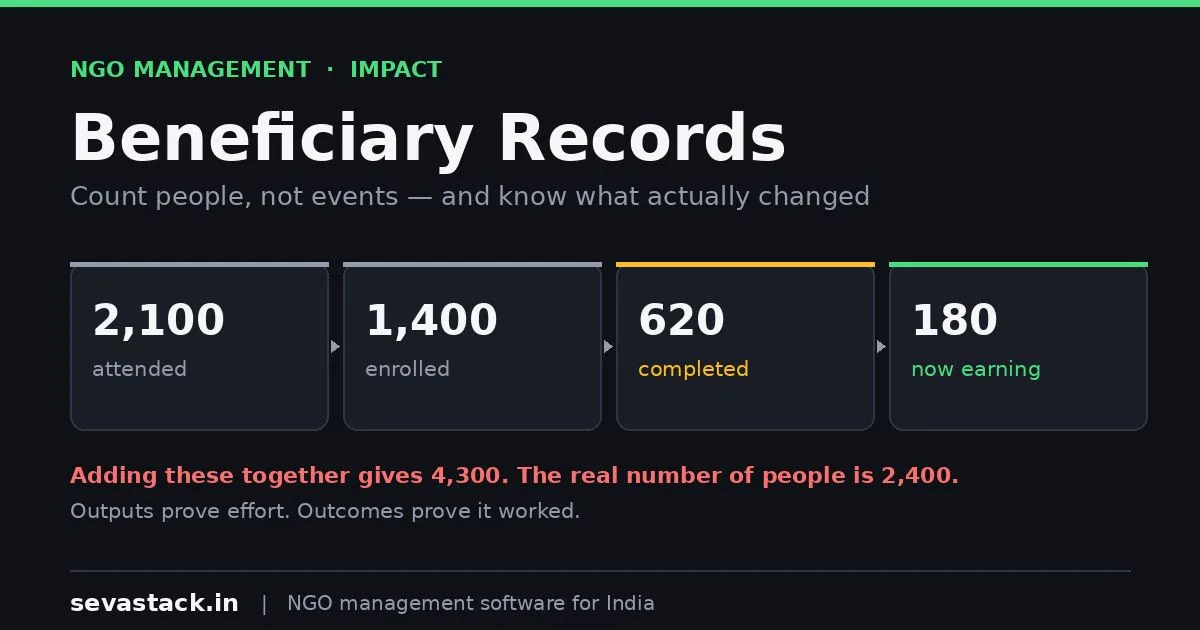
Beneficiary Management: How NGOs Should Track Their Work
Can you prove the numbers in your annual report? A simple guide to beneficiary records, avoiding double counting, and measuring outcomes not outputs.
NGO Management
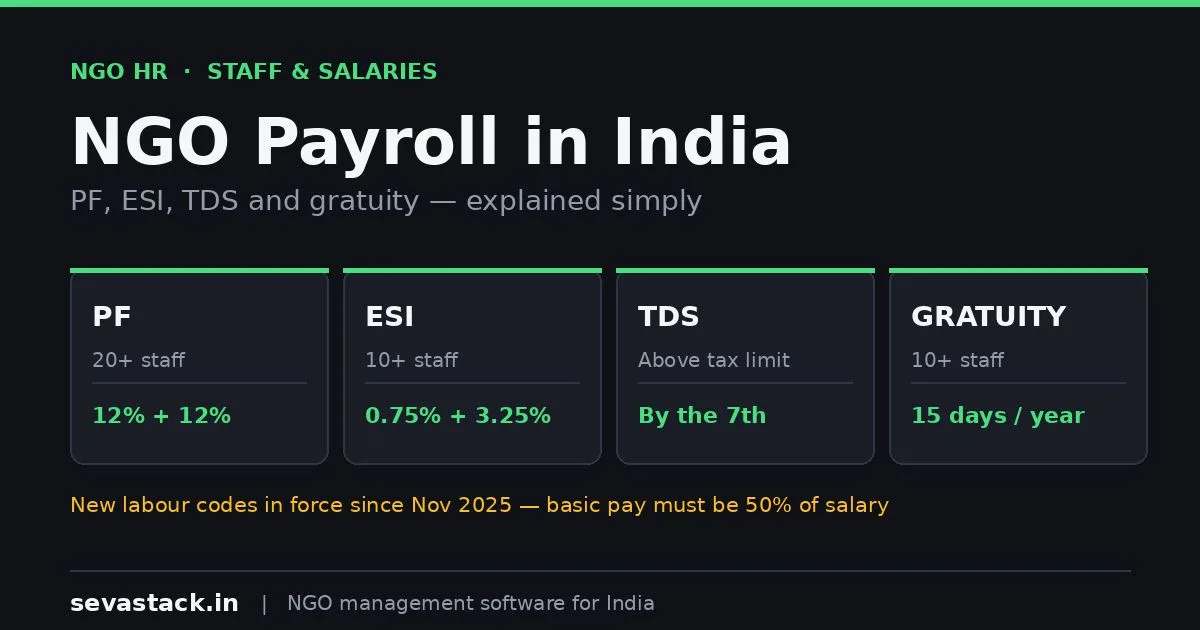
NGO Payroll in India: PF, ESI, TDS and Gratuity Made Simple
A simple guide to NGO payroll in India. When PF and ESI apply, how much to deduct, TDS on salary, gratuity rules and the new labour code changes.
NGO Management
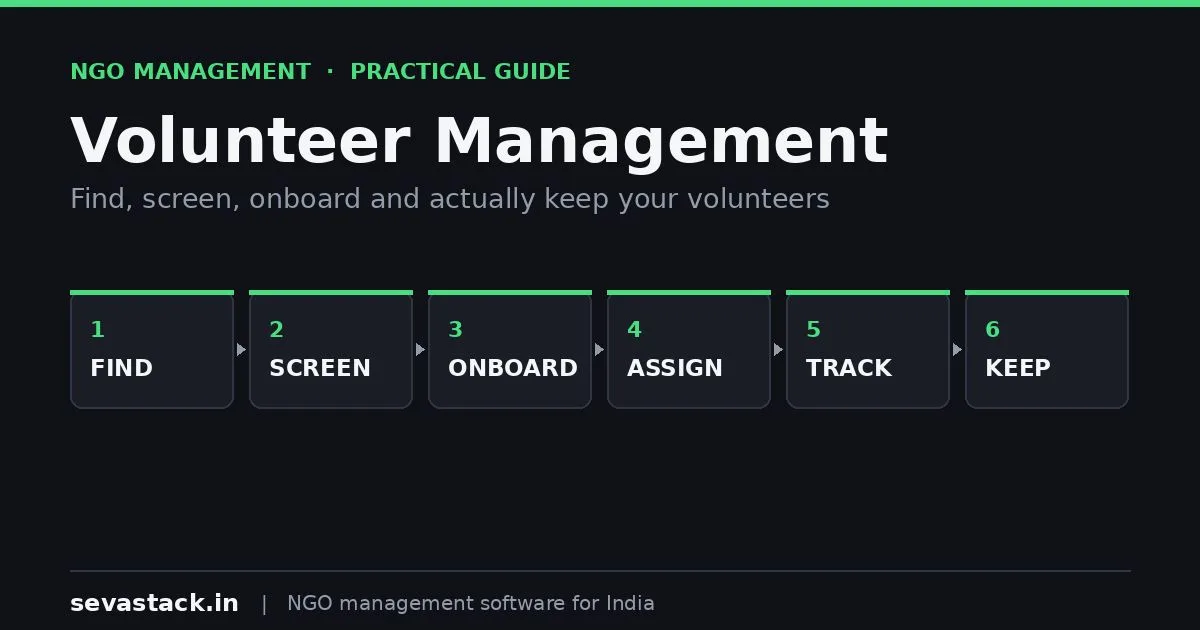
Volunteer Management for NGOs: A Simple Practical Guide
How to find, screen, onboard and keep volunteers at your NGO. A simple guide to hour tracking, certificates, safety rules and what actually works.
Never miss a filing date
Sevastack keeps your NGO's compliance calendar and reminds you by email and WhatsApp before each return is due. Donors, 80G receipts and accounts sit in the same place.