

12A and 80G Renewal: A Simple Guide for Indian NGOs
Your 12A and 80G do not last forever. You must apply to renew six months before the expiry date. Here is how it works, in simple words.
Vivek Bhos
Updated 9 min read
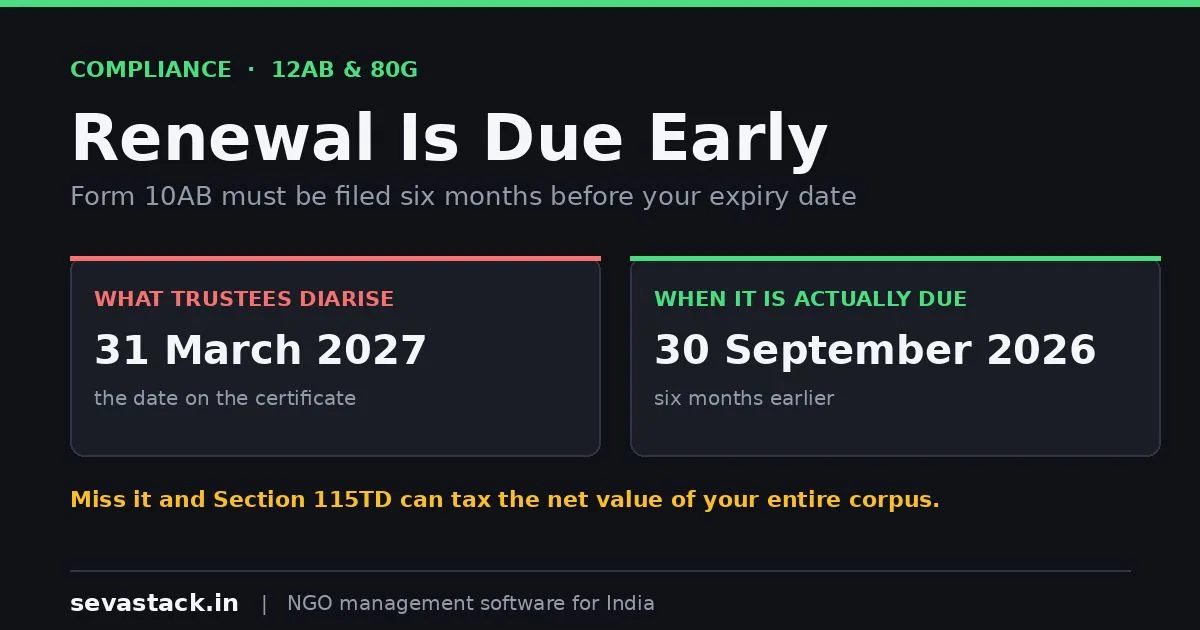
Your 12A and 80G certificates do not last forever any more.
They have an expiry date, like a passport. And there is one rule that catches almost everybody:
You have to apply six months BEFORE the expiry date. Not on it.
If your certificate says 31 March 2027, your last date to apply is around 30 September 2026 — six months earlier.
Most trustees look at the certificate, see March 2027, and write March 2027 in the diary. By then it is far too late.
Here is the whole thing explained simply.
Meet Sneha Trust
Sneha Trust runs a small girls' hostel. They have been registered since 2005.
In 2021 the rules changed and they had to re-register. They got a new certificate saying:
Valid from AY 2022-23 to AY 2026-27
The trustees put the certificate in a file and forgot about it.
We will come back to what happened to them.
Why this changed
Before 2021, 12A registration was permanent. You got it once and never thought about it again.
Now it expires.
From April 2021, every NGO had to re-register. Most did this in 2021 and got certificates valid for five years.
So a whole wave of Indian NGOs have certificates running out around now.
Type of registration | How long it lasts |
|---|---|
Provisional (for new NGOs) | 3 years |
Regular | 5 years |
Step 1: Find your expiry date
Stop reading and go find your certificate. It is called Form 10AC or Form 10AD.
Look for the validity period. It will say something like "AY 2022-23 to AY 2026-27."
What that means in plain dates:
Certificate says valid up to | Your registration ends on | You must apply by |
|---|---|---|
AY 2026-27 | 31 March 2026 | 30 September 2025 (past) |
AY 2027-28 | 31 March 2027 | 30 September 2026 |
AY 2028-29 | 31 March 2028 | 30 September 2027 |
Cannot find the certificate? Log in to the income tax website and look under your registrations. Do this today. Do not assume someone else in the office has it.
Sneha Trust's certificate said AY 2026-27. That meant their registration ended 31 March 2026, and their application was due 30 September 2025. They missed it by more than a year.
Step 2: Understand the six-month rule
This is the part people get wrong, so here it is again.
Wrong thinking: "My certificate expires 31 March 2027, so I will apply in March 2027."
Correct thinking: "My certificate expires 31 March 2027, so I must apply by September 2026."
Why six months? Because the department needs time to review your application and issue a new certificate. If you apply at the last minute, your old registration can run out before the new one arrives — and in that gap, you have no registration at all.
Simple habit: the day your new certificate arrives, look at the expiry date, subtract six months, and put that in your calendar. Then add a reminder one month before that.
Step 3: If you are a new NGO, read this carefully
New NGOs get provisional registration for 3 years.
Almost every new trust assumes: "We have three years. We will convert it in year three."
That is usually wrong.
The real rule is that you must apply for regular registration within 6 months of starting your charitable work — or six months before the provisional registration ends, whichever comes first.
So if you started your programme in your first year, your clock started then. Not at the three-year mark.
Example: A trust gets provisional registration in April 2024 and starts running classes in July 2024. Their deadline is around January 2025 — six months after starting work. Not 2027.
This catches a lot of new NGOs, usually right when their work is beginning to matter.
What happens if you miss it
This is where it gets serious. Three things happen.
1. You lose your tax exemption
Your NGO's income stops being tax free. Donations and grants become taxable.
2. Your donors lose their benefit
Without valid 80G, you cannot give donors their 80G certificate. Everyone who gave you money expecting a tax deduction does not get one.
That is not just a tax problem. That is a trust problem with the people who fund you.
3. There is a tax on everything you own
This is the one nobody expects.
When your registration lapses, the law can tax the net value of your NGO's assets — not just one year's income.
What this looks like: Sneha Trust has built up ₹2 crore over twenty years — the hostel building, fixed deposits, everything.
If they lose their registration, they are not facing tax on last year's ₹40 lakh of donations. They can face a tax calculated on the ₹2 crore itself.
Twenty years of careful work, exposed because nobody read the expiry date.
This is the reason to act today rather than next month.
About the new 10-year rule
You may have heard that registration is now valid for 10 years. It is true, but only in some cases, and it is being widely misunderstood.
The rule: if your income — counted before you apply your exemption — stayed under ₹5 crore in each of the last two years, your renewed registration can be for 10 years instead of 5.
Three things to be clear about:
It applies to new applications made from April 2025 onwards. Your existing 5-year certificate does not automatically become a 10-year one.
The ₹5 crore is your income before exemption, not the taxable amount left at the end.
It applies to 12A only. Not to 80G.
That third point matters most. Even if your 12A is renewed for 10 years, your 80G still runs for 5 years.
So you now have two certificates with two different expiry dates. Track both separately, or you will renew one and lose the other.
How to apply
1. Check your expiry date. Certificate or income tax portal. Work back six months.
2. Clean up pending work first. If you have unfiled tax returns, a missing audit report, or an unfiled donation statement, sort those out before you apply. Applying with gaps open invites questions.
3. Collect your papers. Usually your trust deed or registration certificate, PAN, your current registration order, audited accounts for recent years, activity reports, and trustee details.
4. File Form 10AB online on the income tax portal.
Getting the right option matters here. Renewing an existing registration, converting from provisional to regular, and applying fresh are three different routes on the form. Choosing wrongly causes rejection or delay. Let your CA file it.
5. Follow up. Do not assume silence means approval. Check the status.
6. When the new certificate arrives, note the new expiry, subtract six months, and diarise it immediately.
One more thing worth knowing: when converting from provisional to regular registration, the department is reportedly looking more closely at whether real work is actually happening on the ground. A trust deed and a balance sheet may not be enough. Keep beneficiary records, programme photos and activity reports — they strengthen your application. How to keep beneficiary records.
Common questions
We registered in 2021 and never renewed. What do we do? Call your CA this week. Not next month. Options may still exist, and they get fewer as time passes.
Does 80G renew automatically with 12A? No. They are two separate applications. And they can now run on different timelines. Track both.
Our certificate says March 2027. Is September 2026 really the last date? Yes. Six months before expiry.
The government has extended these dates before. Can we wait? Extensions have happened. But an extension is announced when it happens — it is not something you can plan around. File on time, and treat any extension as a bonus.
We got provisional registration but have not started any work yet. When do we apply? Your six-month clock starts when your activities begin. If you genuinely have not started, talk to your CA about the timing before your three years run down.
Will we get 10 years? Only if your income before exemption stayed under ₹5 crore in each of the last two years — and only for 12A, not 80G.
We also have FCRA. Does that matter here? Yes, indirectly. Problems in one registration can raise questions in another. Keep everything current.
Can we do this ourselves without a CA? The form is online, so technically yes. But picking the wrong option on the form causes rejection, and the cost of getting it wrong is very high. Use a CA.
Do this in the next fifteen minutes
Find your certificate. Note the exact expiry date for 12A and for 80G separately.
Subtract six months. Put that date in your calendar with a reminder one month before.
If that date is close or already gone, call your CA today.
Most NGOs that lose their registration have done nothing wrong. They simply believed the date printed on the certificate was the date that mattered.
It is not. Six months earlier is.
Sevastack watches your 12A and 80G expiry dates for you, warns you six months ahead of each renewal, and keeps your filings and activity records ready so the application is simple when the time comes. Start free — no credit card needed.
This article is general information, not tax advice. These rules have changed several times and deadlines have been extended more than once. Please check your NGO's exact position with your Chartered Accountant.
Related guides
Under the Income-tax Act, 2025 (effective 1 April 2026, replacing the Income-tax Act, 1961), Section 12A/12AB is now governed by Section 332 of the new Act. "Section 12A/12AB" remains the commonly used and searched term during the transition — the underlying requirement is unchanged, only the section/form numbering has moved. Confirm the applicable form with your CA if you're filing close to the transition date.
Vivek Bhos
Written by the Sevastack team, who build and maintain the 80G receipt, FCRA, and Form 10BD/10BE automation used by Indian NGOs on the platform every day. Compliance guidance is reviewed against current Income Tax Act and FCRA rules before publishing.
Read next
Compliance
80G Is Now Section 133: What Changes on Your NGO Receipts
Section 80G is now Section 133 under the new Income-tax Act. Learn in simple words what changes for NGO receipts, Form 113 and Form 114, and what stays the same.

Compliance
ITR-7 Due Date Extended to 21 November: What NGOs Must Do
CBDT has extended the ITR-7 due date to 21 November 2026 and the audit report date to 21 October. Here is what your NGO should do now, step by step.
Compliance
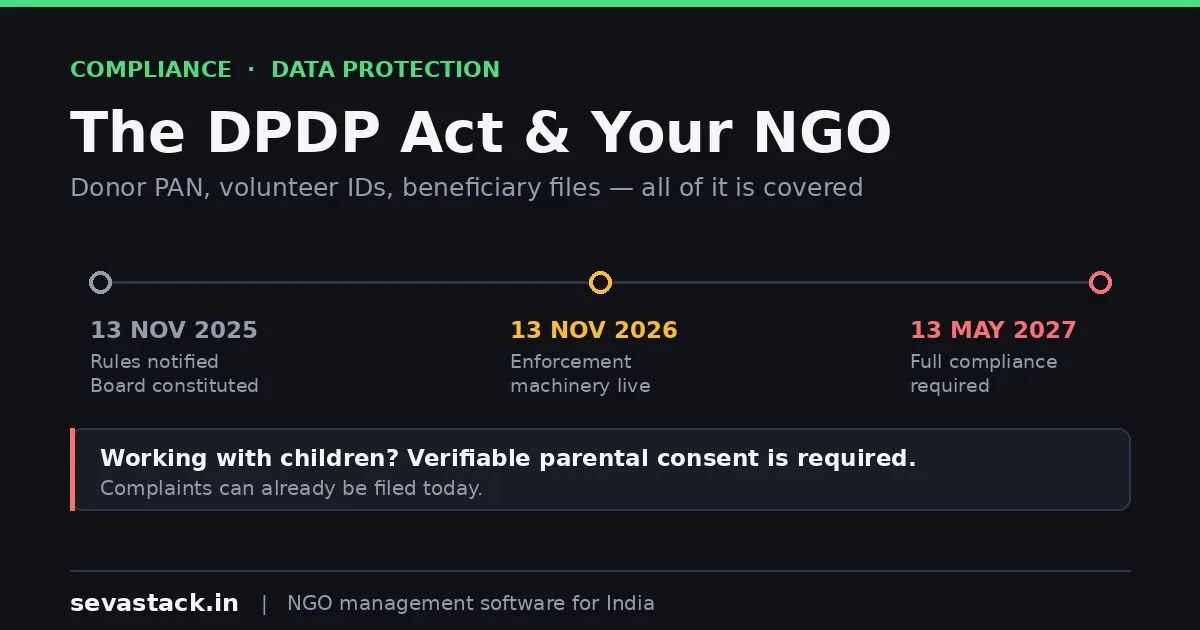
DPDP Act for NGOs in India: A Simple Compliance Guide
Your NGO holds donor PAN, phone numbers and beneficiary records. India's data protection law now covers all of it. Here is what to do, and by when.
Never miss a filing date
Sevastack keeps your NGO's compliance calendar and reminds you by email and WhatsApp before each return is due. Donors, 80G receipts and accounts sit in the same place.